
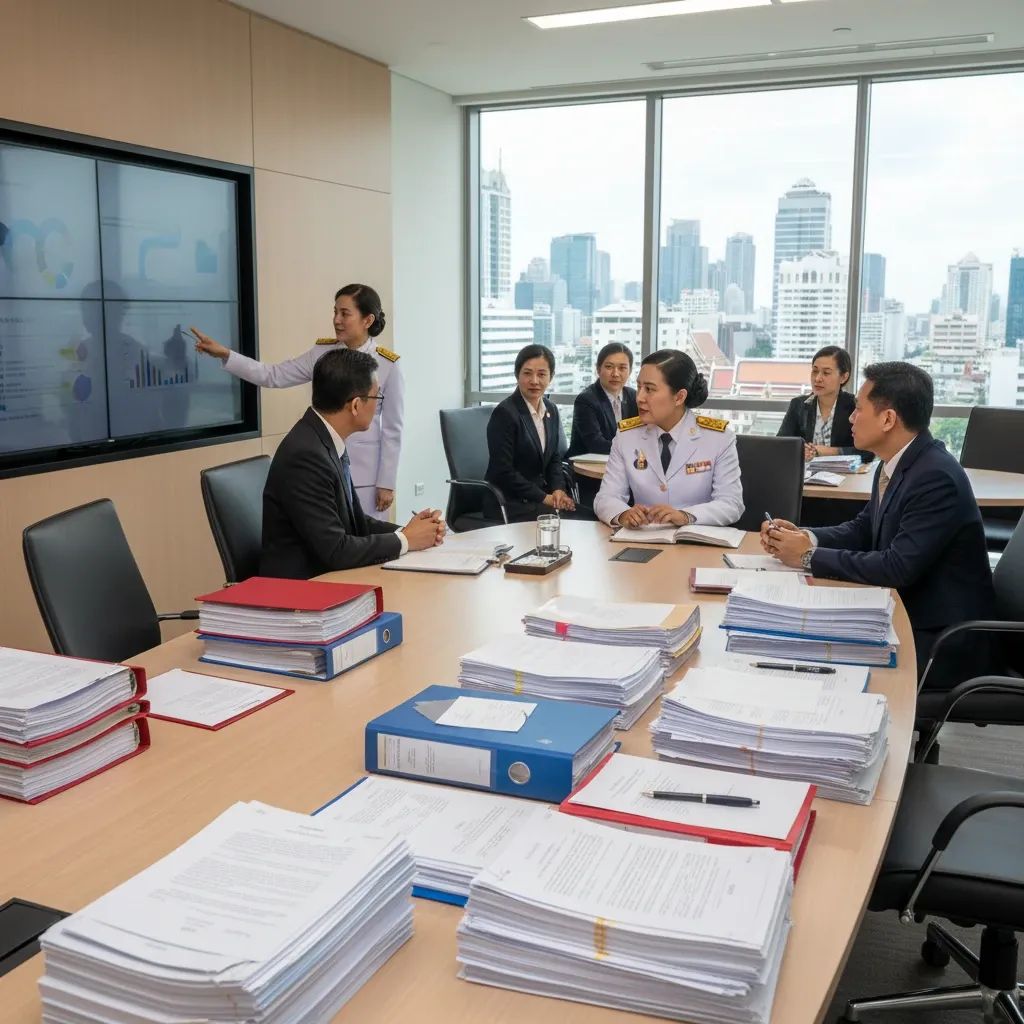
Thailand's cabinet formation is now in motion, and the clock is ticking hard. Prime Minister Anutin Charnvirakul has given his coalition partners exactly one week to steer all ministerial nominees through a gauntlet of 18 government agencies—a compressed schedule that leaves little room for complications. The target: cabinet sworn in by mid-April, ideally before the Songkran holiday shuts down most government operations.
Why This Matters
• Seven-day credential crunch: Nominees from Bhumjaithai and Pheu Thai must simultaneously clear vetting at the Thailand Cabinet Secretariat and across 18 separate agencies by late March—faster than typical precedent.
• Legal ticking time bombs already present: At least one Pheu Thai nominee faces Department of Special Investigation questioning over land encroachment allegations, signaling that the formal vetting process may surface issues party officials missed during internal screening.
• Vetting disqualifications force renegotiations: Any disqualifications require the nominating party to propose replacements, who must cycle through the entire vetting apparatus again, potentially consuming critical days in the tight timeline.
The Vetting Process: What Actually Gets Checked
The Thailand Cabinet Secretariat received the initial nominee list on March 20, 2026, immediately triggering what officials describe as a "parallel review" across roughly 18 agencies. This machinery is not ceremonial—it's constitutionally mandated and has blocked ministerial appointees in previous administrations.
Under Article 160 of the 2017 Constitution, prospective ministers face a strict checklist. They must be Thai-born nationals, at least 35 years old, hold at minimum a bachelor's degree, and possess documented integrity. More critically, none can have pending prison sentences—even if appeals are underway. The statute bars anyone who faces a potential jail term of any duration, which creates obvious friction when ongoing investigations occur.
The 18-agency network includes the Thailand Revenue Department, the Anti-Money Laundering Office, the Election Commission, the Civil Service Commission, and various other bodies that cross-reference nominees against employment records, asset declarations, and court databases. A disqualifying flag automatically routes the name back to the nominating party; the Thailand Cabinet Secretariat cannot override a finding from any of the 18 agencies based on political preference or coalition pressure.
Anutin deflected directly when asked whether coalition parties had conducted private vetting beforehand. He laughed—a deliberate gesture—and refused to confirm whether backup nominees had been quietly assembled in reserve. That evasion hints strongly at coalition contingency planning, though public acknowledgment would invite media speculation about candidate vulnerabilities.
The Sudawan Situation: When Investigations Collide with Timing
Sudawan Wangsuphakijkosol, a Pheu Thai nominee for a cabinet portfolio, was summoned by the Thailand Department of Special Investigation (DSI) regarding alleged land encroachment at Hat Suan Ya. The timing is awkward. Anutin stated he was unaware of the case specifics but emphasized that no ministerial appointments become public until His Majesty the King grants formal approval to the complete cabinet list.
The legal trap here is concrete. If the DSI formally opens charges against Sudawan before the cabinet reaches royal endorsement—say, by April 5—the Thailand Constitutional Court's interpretation of Article 160 would likely bar her appointment. Investigative status alone does not disqualify; formal charges creating potential imprisonment do. The calendar becomes brutal: if charges materialize five days before submission to the palace, Pheu Thai must either substitute a replacement (who re-enters the vetting cycle, consuming critical days) or gamble that royal approval will slip through before prosecutors move.
Time Pressure and the Songkran Deadline Reality
"About one week" sounds reassuring in a press conference. In administrative reality, it offers virtually zero buffer. The Thailand Cabinet Secretariat must synthesize responses from 18 separate agencies, each verifying distinct aspects. When irregularities surface, the nominating party receives confidential notification and a narrow window—typically 48 to 72 hours—to propose a replacement. That substitute then cycles through the entire vetting apparatus again, potentially adding 5 to 7 days to the overall timeline.
Songkran begins April 13, 2026. The practical deadline for submitting the final cabinet list to the palace is late March or the very first week of April, allowing enough time for the royal decree to be drafted, signed, published in the Royal Gazette, and officially announced before government-wide holiday closure. Any delays beyond early April push the cabinet oath ceremony into the second or third week of April, by which point parliamentary committees, budget process work, and legislative scheduling all suffer disruption. Major bills miss the pre-recess calendar entirely.
Coalition Government Formation and Ministerial Roles
Anutin serves as Interior Minister and leads the coalition government formed after parliamentary elections on February 8, 2026. Coalition partners Bhumjaithai and Pheu Thai negotiated ministerial positions as part of their governing arrangement, though the full final distribution of portfolios will be determined only after the vetting process clears all nominees and the cabinet receives royal approval.
This cabinet composition will directly shape legislative priorities over the coming months. Anutin committed to delivering a policy statement to parliament—a constitutional requirement preceding substantive legislative work—that aligns with his coalition's election platform, covering areas including agriculture, education, infrastructure, and labor initiatives.
Cabinet delays postpone the policy statement, which stalls parliamentary committee assignments, budget-committee work, and legislative scheduling. A cabinet sworn by early April permits parliament to begin substantive legislative work before Songkran recess—typically April 13 to 15—avoiding a month-long shutdown that would defer major bills into the rainy season and derail budget cycles entirely.
For private investors and employers evaluating near-term regulatory environments, this timeline carries material weight. Delayed cabinet formation means delayed clarity on governance frameworks and enforcement priorities that operational decisions depend on.
The Political Undercurrents Nobody's Talking About
Democrat Party leader Abhisit Vejjajiva recently challenged Anutin's fitness for the premiership, citing alleged links to a Senate collusion case. During the March 20 media briefing, when a reporter raised the issue, Anutin visibly prepared to exit the interview before journalists shifted to safer topics. The moment was revealing.
The vetting process itself carries political weight. Disqualifications involving senior nominees would reflect poorly on whichever party nominated them, creating pressure on coalition discipline at a moment when the government attempts to signal market confidence and governmental coherence.
Reading the Signals Over the Next Two Weeks
Cabinet formation progress will become visible through media reports by late March. Nominee withdrawals or last-minute substitutions signal vetting complications. By April 5, the final list should reach the palace; any silence beyond that date suggests either smooth progress or behind-the-scenes problem-solving that coalition press offices are keeping quiet.
Absences matter as much as announcements. No news of disqualifications by April 1 suggests the agencies found no major red flags. Media reports of a nominee withdrawing "for personal reasons" typically translate to vetting failure that officials prefer to conceal. Anutin's repeated assurance that he expects "no problems" sounds confident, but confidence in Thai politics often masks uncertainty about facts not yet known.
Thailand's economic stability over the next quarter hinges partly on this seven-day window. A cabinet formed smoothly by early April signals enough governmental coherence to present a policy agenda to markets and foreign investors. Delays into mid-April or later suggest coalition friction or governance dysfunction that investors read as regulatory unpredictability.
The Thailand Cabinet Secretariat's institutional competence—its ability to coordinate 18 agencies and deliver a vetted list in record time—is being tested now. So is the coalition's real discipline beneath the public optimism.


