
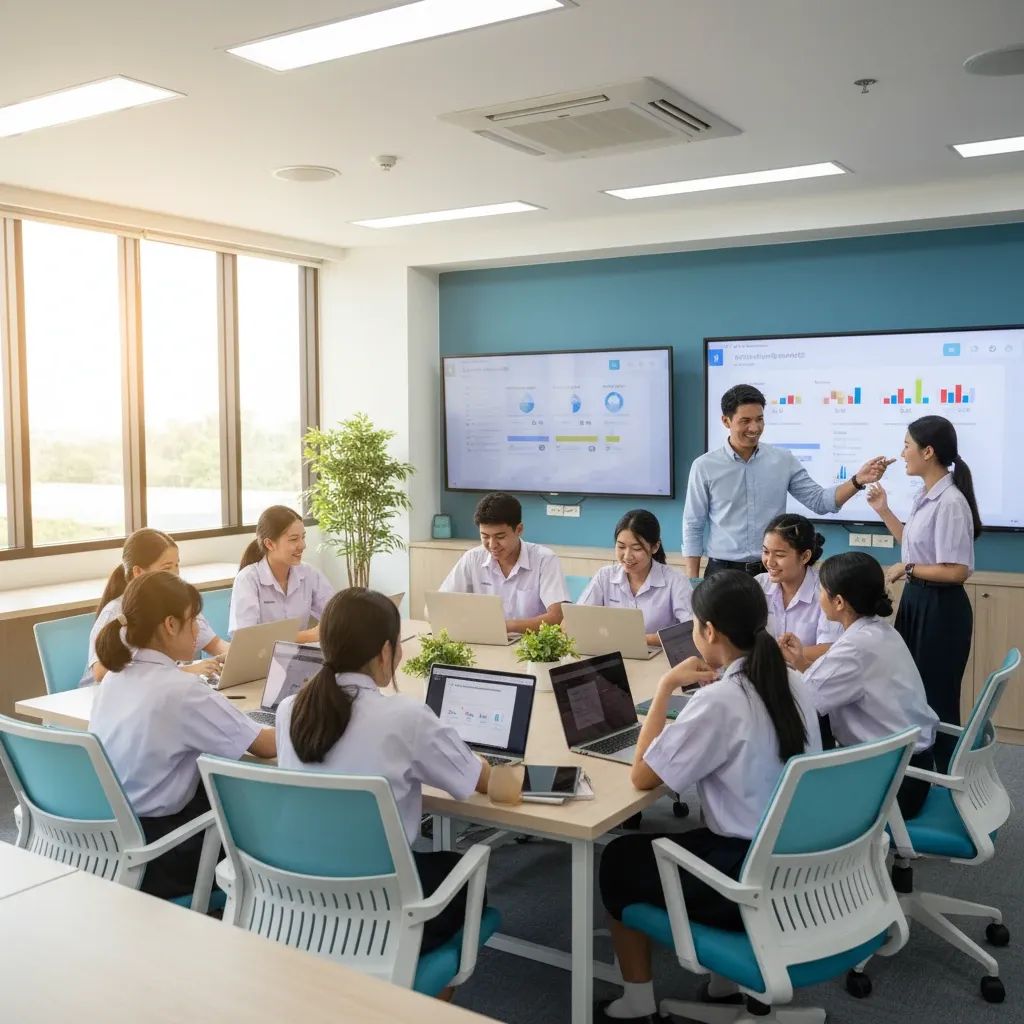
The Thailand Ministry of Education (MoE) has launched a sweeping restructure of its education system, targeting the inequities that have left Thai students scoring below OECD averages while confronting a demographic crisis that threatens to hollow out classrooms within a decade. With the country on the brink of becoming a super-aged society in 2026—where more than 28% of the population is 60 or older—the reforms aim to rescue a generation of students falling behind and prepare a shrinking workforce for the economy ahead.
Why This Matters
• Budget allocation: The Equitable Education Fund (EEF) received 7.99B baht for fiscal 2026, a jump from prior years, targeting 1.35M disadvantaged students to prevent dropouts.
• Teacher relief: Policies now eliminate mandatory non-teaching duties and security shifts, letting educators focus on instruction instead of administrative busywork.
• Digital access: A national online learning platform promises free courses covering all grade levels, with pilot rollouts underway across provinces.
• Enrollment collapse: Super-aged demographics mean student populations are plummeting, forcing universities and schools to rethink survival strategies.
The Performance Gap That Sparked Reform
International benchmarks paint a stark picture. Thai 15-year-olds scored 394 in mathematics, 379 in reading, and 409 in science on the 2022 PISA tests—the lowest results since Thailand first participated in 2000. All three scores dropped compared to 2018, with mathematics alone falling 25 points. Only 1% of Thai students reached the highest proficiency levels in math, compared to 9% across OECD nations. Within ASEAN, Thailand ranked 5th, trailing Singapore, Vietnam, Brunei, and Malaysia.
The pandemic exacerbated pre-existing fractures. Rural schools lacked reliable internet, urban private institutions widened their lead, and thousands of children vanished from official rolls. The Thailand Zero Dropout initiative, championed by the Prime Minister's office, now tracks every missing child with digital tools and AI-driven early-warning systems. The mission: prevent, intervene, and re-enroll before students disappear entirely.
Teacher-Centered Overhaul
Educators have long complained of crushing workloads unrelated to teaching—security patrols, paperwork marathons, endless performance reviews. The 2026 policies directly address burnout:
• Streamlined credentialing: Simplified evaluation procedures for teacher advancement, cutting bureaucratic steps.
• Homecoming transfers: A transparent system allowing teachers to relocate closer to their hometowns without favoritism or corruption.
• Debt relief programs: Systematic financial counseling and subsidies targeting educators drowning in personal loans.
• Equipment provisioning: Schools receive teaching materials and welfare support to reduce out-of-pocket expenses.
• Janitor hiring: A push to staff schools with custodians and security personnel, freeing teachers from non-instructional duties.
Political parties in the ruling coalition have staked reputations on these measures. The Pheu Thai Party champions "Learn to Earn," slashing theoretical coursework in favor of vocational training that guarantees immediate income post-graduation. The Bhumjaithai Party promotes "Equal Education Plus," bundling free online platforms, skill-bridging credentials, and a Learning Passport system that converts work experience and non-formal training into transferable academic credits across any life stage.
What This Means for Residents
For parents: Reduced household education costs through expanded free digital content and equipment subsidies targeting low-income families in primary through upper-secondary grades. Long-term plans include government-issued laptops for disadvantaged students.
For teachers: Immediate relief from non-teaching obligations, plus career mobility reforms. Debt counseling and equipment allowances ease financial strain, while the credentialing overhaul speeds promotions.
For students: Competency-based curricula replace rote memorization. Bilingual programs—English and Mandarin—now incorporate AI tutoring. Vocational pathways ensure graduates exit with marketable skills and potential employment, not just diplomas.
For the elderly: Lifelong learning programs expand dramatically as the retiree population swells. Community-run senior schools offer courses in health, technology, arts, and micro-entrepreneurship, leveraging the wisdom of older generations while keeping them economically and socially active.
Demographic Time Bomb
Thailand's fertility rate has plunged, and the number of seniors will overtake children in 2025 for the first time. Universities face existential threats as enrollment craters. Some institutions may close, mirroring Japan's university collapse a decade ago. The labor pool shrinks, and knowledge transfer from retiring professionals risks vanishing.
The MoE response pivots toward "anywhere, anytime" learning platforms—cloud-based repositories accessible via smartphone, tablet, or desktop. The goal: extend education beyond traditional school age, offering reskilling for mid-career workers and enrichment for retirees. Higher education institutions are urged to pivot toward continuing education, international students, and health sciences programs to survive the demographic shift.
Equity Push: From City to Countryside
Inequality remains the system's Achilles' heel. Bangkok's elite private schools operate in a different universe from rural public classrooms lacking basic supplies. The 2026 reforms target this chasm:
• One District, One Scholarship (ODOS): Revived funding guarantees at least one merit-based scholarship per district for talented but impoverished students.
• Quality school mandate: Every district must have at least one accredited quality school by fiscal year-end, with infrastructure upgrades and teacher rotations to spread expertise.
• Innovation zones: Pilot districts receive autonomy to design curricula fitting local economies—fishing communities teach marine science, tech hubs integrate coding boot camps.
• Decentralization: Provincial and municipal governments gain budgetary control, empowering local officials to address district-specific dropout triggers and resource gaps.
The Equitable Education Fund's 7.99B baht breaks into five priorities: direct student aid, teacher development, dropout prevention partnerships, research dissemination, and organizational capacity-building. The fund projects reaching 1.35M children, many in remote northeastern and southern provinces where poverty and insurgency intersect.
The Skill-Bridge Economy
"Learn to Earn" isn't a slogan—it's policy infrastructure. Vocational tracks now emphasize job-ready competencies over abstract theory. Students can accumulate credits through internships, apprenticeships, and online micro-credentials, then bank them in a Learning Passport valid for life. A 30-year-old factory worker can earn a degree by combining prior work experience, weekend courses, and formal exams—no need to return full-time to campus.
The Bhumjaithai Party's Virtual School concept takes this further: a fully accredited digital institution offering asynchronous coursework, AI tutoring, and peer forums. Early pilots target rural students who cannot commute to brick-and-mortar campuses and working adults juggling family obligations.
Political Consensus and Friction
Cross-party agreement on education reform is rare, but the 2026 package enjoys unusual support. The Prachachat Party focuses narrowly on returning teachers to classrooms, eliminating every administrative distraction. The Kla Dharma Party prioritizes high-quality digital platforms and teacher welfare. Pheu Thai and Bhumjaithai compete to own the equity narrative, each branding its version of free learning and vocational pathways.
Friction surfaces over execution. Local governments demand decentralized budgets but lack the administrative muscle to manage them. Universities resist pivoting toward lifelong learning, clinging to traditional degree pipelines. Teacher unions welcome debt relief but distrust credentialing overhauls that might mask downsizing. And rural communities question whether digital platforms can substitute for in-person instruction when internet penetration remains patchy.
Big Data and Bureaucracy
The MoE has committed to Big Data systems tracking student performance, attendance, and socioeconomic indicators in real time. AI algorithms flag at-risk students before they vanish. School administrators can access dashboards showing resource allocation, teacher workloads, and learning outcomes at granular levels.
Privacy advocates raise concerns about surveillance creep. Critics note that data-driven interventions only work if schools have resources to act—an algorithm identifying a dropout risk means nothing if the district lacks counselors or transport subsidies.
Implementation Timeline
The reforms roll out in fiscal 2026 (October 2025–September 2026), with phased milestones:
• Q1 2026: Teacher workload reductions take effect; janitor hiring begins in pilot districts.
• Q2 2026: Learning Passport beta launches in five provinces; EEF disburses first scholarship tranches.
• Q3 2026: One-district-one-school quality mandate deadline; digital platform national rollout.
• Q4 2026: Competency-based curriculum adoption in primary schools; AI-assisted bilingual programs expand.
Success hinges on coordination among the MoE, provincial governments, the EEF, and private-sector partners. Early stumbles—delayed laptop shipments, platform glitches, teacher resistance—could erode political will.
Long-Term Vision
By 2030, the MoE envisions a system where geography and income no longer dictate opportunity, teachers focus on pedagogy instead of paperwork, and students graduate with skills employers actually need. The super-aged society becomes an asset, not a burden, as retirees mentor youth and pursue lifelong learning that keeps them productive.
Whether Thailand can close the PISA gap, reverse dropout trends, and stabilize enrollment depends on whether political momentum survives budget cycles and bureaucratic inertia. The 2026 reforms represent the most ambitious education overhaul in a generation—but ambition alone doesn't guarantee results. For the 1.35M students the EEF hopes to reach, and the thousands of teachers awaiting relief, the proof will arrive not in policy documents but in classrooms across 77 provinces.


