
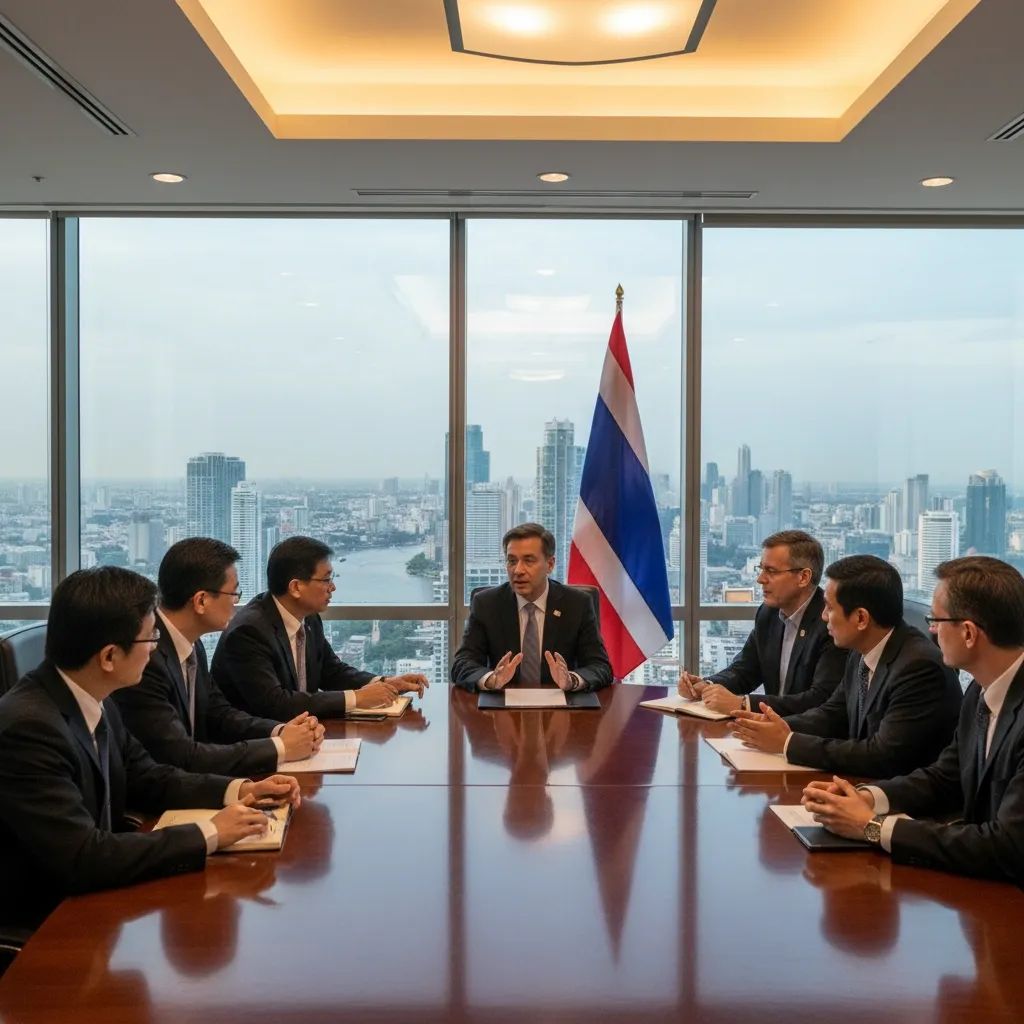
A Strategic Bid for Global Health Leadership
Thailand is officially entering the competition for global health leadership, and success would require far more than medical credentials. The Thai Cabinet green-lighted the bid on April 28, 2026, tasking the Thailand Ministry of Public Health with identifying a candidate for the World Health Organization's director-general post—a position wielding authority over pandemic protocols, vaccine policies, and disease surveillance frameworks that directly shape how Bangkok and provinces handle health emergencies.
Why This Matters for Thailand
• The submission deadline is September 24, 2026—leaving roughly four months for Thailand's vetting committee to identify, interview, and nominate a candidate with sufficient international standing.
• This is Thailand's first-ever formal challenge for a WHO leadership role, marking a significant shift in how the country positions itself within global health governance.
• The competition is substantial: Germany, Qatar, Spain, the UK, France, Indonesia, and Pakistan have fielded strong contenders with ministerial experience, research credentials, and established networks at the United Nations.
• For residents and healthcare professionals, a Thai WHO leader could reshape global health priorities to address tropical diseases, pandemic preparedness systems, and pharmaceutical equity—areas where Thailand has proven technical expertise that currently receive insufficient international attention.
How the Selection Process Works
On May 3, Public Health Minister Pattana Promphat announced that his ministry, working alongside the Thailand Foreign Ministry, has assembled a joint selection committee to screen potential nominees. The committee comprises three officials from each agency—six people tasked with evaluating candidates against WHO resolution WHA65.15, the organization's published selection framework.
The April 30 coordination meeting between Minister Pattana and Vice Minister Vijavat Isarabhakdi, alongside Foreign Ministry representatives, established the operational roadmap. The discussion focused on diplomatic strategy—how to position Thailand's eventual nominee within regional blocs, cultivate support from African member states (which carry substantial voting weight), and navigate the geopolitical complexities of WHO governance without appearing as a proxy for any particular power bloc or regional agenda.
The criteria for eligibility are rigorous and nonnegotiable. Candidates must demonstrate mastery of public health systems, proven track record managing international health initiatives, visible leadership across large organizations, and fluency in at least one of WHO's official working languages—English, French, Spanish, Russian, Chinese, or Arabic. Additionally, nominees must articulate a coherent vision statement addressing WHO's strategic priorities and organizational reform needs.
Thailand is not revealing potential candidates publicly. The selection committee is conducting confidential discussions with prospects and international allies before any public announcement, allowing time to assess international receptivity to a Thai candidate and develop diplomatic strategy without premature exposure to competing nations.
Thailand's Competitive Advantages
Thailand enters the arena with tangible accomplishments in health administration and regional leadership. The Thailand Universal Coverage scheme, launched in 2002, revolutionized access to primary care for 70 million people and has been studied and adapted by health ministries across South Asia, parts of Latin America, and sub-Saharan Africa. Thai pharmaceutical researchers pioneered generic HIV antiretroviral production during the 1990s, when brand-name medications cost $10,000 annually—work that positioned Thailand as a champion of treatment access and pharmaceutical equity in developing nations.
The Thailand Ministry of Public Health maintains standing deployments to regional disease surveillance networks and has contributed technical teams to international epidemic investigations, including the 2014–2016 West African Ebola response and multiple COVID-19 containment operations. This operational record has earned Thailand credibility within ASEAN health circles and among Indo-Pacific health officials.
But operational competence does not automatically translate into votes among the WHO's 194 member states. Winning the director-general role requires not only technical depth but also the political machinery to cultivate support across regions—particularly among African nations, which have historically favored candidates demonstrating commitment to tuberculosis control, maternal-child health, and vaccine access in resource-scarce environments.
The Strength of the Competition
Thailand will face a crowded field of accomplished rivals. According to previous WHO election announcements and public reports, candidates include individuals with substantial international health portfolios, ministerial-level experience, and established diplomatic networks. The competitive field reflects the position's significance—only major health systems and well-connected governments field serious candidates for WHO director-general roles.
The position demands candidates with decades of experience navigating international health governance, research leadership, or ministerial administration. Historically, successful WHO director-general candidates have demonstrated proven ability to manage complex international institutions, secure funding from diverse member states, and navigate geopolitical tensions while maintaining credibility across ideological boundaries.
What Success Would Mean for Thailand
If Thailand's representative reaches the three-person finalist threshold—determined by the WHO Executive Board after reviewing all nominations—the country gains immediate diplomatic leverage and global visibility on multilateral health initiatives. A victory would fundamentally alter how Thailand's healthcare sector is perceived internationally, likely attracting foreign direct investment in hospital networks, pharmaceutical research, medical device manufacturing, and clinical trials—sectors the government has explicitly identified for economic expansion.
For residents and healthcare professionals, concrete benefits include:
• Enhanced influence over regulatory standards that directly affect Thai healthcare—pharmaceutical approval timelines, occupational health protocols, food safety frameworks—and occupational safety standards that affect workers' health protections.
• Elevated positioning for Thai health professionals seeking WHO advisory appointments, funding for research programs, or international professional recognition.
• Reorientation of global health priorities toward diseases and health challenges prevalent in Thailand and Southeast Asia—dengue prevention systems, tuberculosis control in agricultural communities, antimicrobial resistance in livestock farming, and pandemic preparedness infrastructure tailored to tropical and developing-nation contexts.
• Strengthened voice in WHO decisions affecting pandemic response policies, vaccine distribution equity, and health emergency protocols that Thailand experienced firsthand during recent global health crises.
Beyond residents' healthcare interests, a Thai Director-General would reshape how global health initiatives address tropical and emerging infectious diseases, where Thailand possesses substantial technical expertise. Current WHO priority-setting reflects the institutional preferences of wealthy nations and tends to underweight disease burdens that middle-income countries in tropical regions face daily. A Thai leader could reorient international focus toward measurable health improvements for Thailand and Southeast Asia.
The Timeline Ahead
The selection process will accelerate significantly. The joint committee is expected to produce a shortlist by late June 2026, conduct detailed vetting and interviews through July and August, and submit Thailand's official nominee by late September. The WHO Executive Board, comprising 34 member-state representatives, will narrow the global field to three finalists by March 2027. The full World Health Assembly—all 194 member states—will then conduct the final election in May 2027.
Remaining uncertainties loom large. Thailand's nominee will need diplomatic finesse, demonstrated coalition-building ability, and the capacity to appeal across ideological and regional boundaries that often dictate WHO voting patterns. The organization's chronic leadership challenges around funding, reform, and geopolitical tensions between major powers mean that the next director-general assumes office amid exceptional institutional complexity.
Thailand remains publicly circumspect about its eventual nominee. Strategic timing likely continues until the vetting committee has completed preliminary discussions and assessed international appetite for a Thai candidate. Once a name surfaces, the campaign enters open competition—a phase where rival nations deploy diplomatic networks, media messaging, and member-state lobbying to influence outcomes.
Thailand's Role in Global Health Governance
This bid represents Thailand's first comprehensive attempt to compete for a senior position within the WHO hierarchy. The timing reflects a calculated assessment that geopolitical attention to Asian health leadership and Indo-Pacific regional security has created a favorable moment. If Thailand's candidate reaches the finalist round but ultimately does not prevail, the initiative still establishes Thailand as a serious participant in global health governance, positioning the country for future leadership opportunities or influential advisory roles within WHO structures.
A Thai victory would signal meaningful recalibration of WHO decision-making authority toward Asian and developing-nation perspectives—a shift with implications for how global health priorities are determined. For the residents, businesses, and health professionals across Thailand, the outcome carries concrete significance for how the country navigates international health standards, secures regulatory influence, and projects influence in forums where decisions about pandemic response, disease priorities, and health equity are determined.
The next five months will clarify whether Thailand's diplomatic initiative translates into meaningful global health influence or represents a strategic bid to increase Thailand's voice in an organization where decision-making authority has traditionally concentrated among wealthy member states with deep institutional memory and established diplomatic networks.


