
Why This Matters
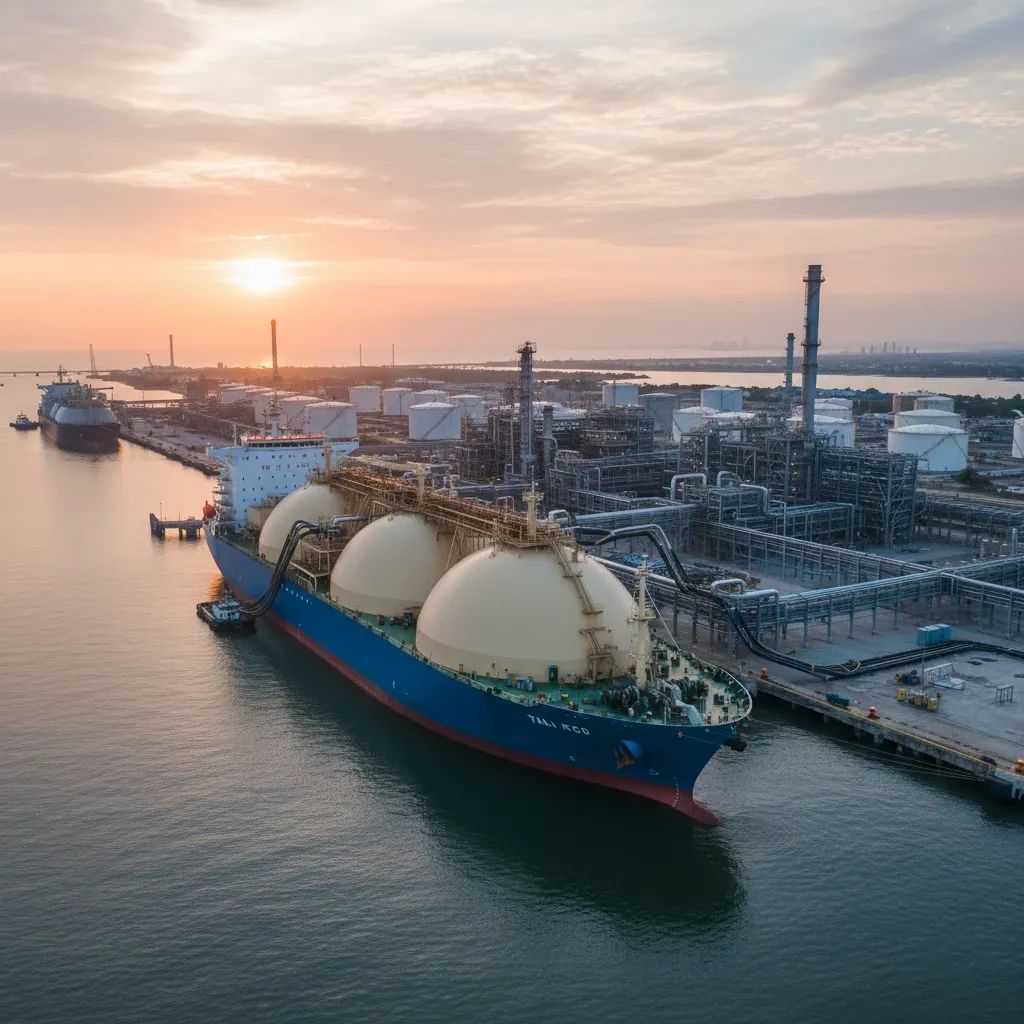
• Supply boost secured: Thailand's Energy Ministry finalized an agreement to increase U.S. LNG imports to 1.3M tonnes annually through 2041, up from the original 1M tonne baseline.
• Faster deliveries locked in: Select shipments scheduled for later in 2026 are now arriving earlier, providing enhanced supply reliability going forward.
• Diversification strategy: The expanded deal strengthens Thailand's energy portfolio by reducing reliance on Middle Eastern sources, particularly Qatar, which has historically supplied over 42% of Thailand's LNG.
• Price considerations: American LNG comes at higher cost compared to some traditional sources, and this agreement locks Thailand into that pricing structure for 15 years as part of the diversification strategy.
How Thailand Got Here: Energy Independence Through Strategic Diversification
Thailand's energy planners have long recognized a structural vulnerability: heavy dependence on a single region for liquefied natural gas. Qatar has historically supplied over 42% of Thailand's LNG, a concentration risk that prompted officials to explore alternative sources. This reality, combined with the knowledge that the Strait of Hormuz—which handles roughly 50% of crude shipments and 30% of liquefied natural gas—could face disruptions, motivated Thailand to pursue supply diversification.
The underlying challenge is straightforward. Thailand's domestic natural gas fields in the Gulf of Thailand are declining, and pipeline supplies from Myanmar have proven less reliable. Yet gas still powers 50–60% of Thailand's electricity grid. That dependency gap has driven Thailand's energy ministry to seek long-term, diversified sources of imported LNG.
Enter PTT Plc, the state-owned energy company that negotiates energy contracts on behalf of Thailand. In January 2026, PTT received its first cargo under a 20-year agreement with Cheniere Energy, a Texas-based LNG exporter. The initial contract specified 1 million tonnes annually. As geopolitical considerations underscored the value of supply diversification, Energy Minister Auttapol Rerkpiboon opened discussions with Cheniere's Chief Commercial Officer Anatol Feygin to expand the arrangement.
The result: 1.3 million tonnes per year through 2041—a 30% increase. Importantly, some cargoes originally scheduled for mid-2026 are now being moved forward to earlier in the year, enhancing supply flexibility.
Why American Gas, Why Now
The decision to expand U.S. LNG imports reflects Thailand's strategic priority to reduce concentration risk in its energy portfolio. Qatar's dominance as a supplier creates vulnerability; geographic or political disruptions affecting Middle Eastern producers would leave Thailand exposed. The Cheniere contract addresses this by creating an additional reliable source outside the Persian Gulf region.
The expanded agreement is part of a broader October 2025 energy trade package with Washington valued at roughly $5.4 billion annually. It includes crude oil, ethane, and additional LNG volumes throughout 2026 and beyond. For the first time, PTT Global LNG is buying directly from a U.S. producer rather than through intermediaries.
There is a trade-off to this diversification. U.S. LNG typically trades at a Henry Hub-linked formula, meaning Thai utilities absorb volatility in American natural gas markets. Qatari LNG, by contrast, has traditionally been pegged to oil prices. The Henry Hub index tends to fluctuate based on North American market conditions, which can influence Thai electricity costs.
The Infrastructure Race Against Time
Thailand has invested substantially in liquefied natural gas infrastructure, reflecting confidence in LNG's role in the nation's energy mix. The second regasification terminal came online in 2022, bringing total annual handling capacity to approximately 19.1 million tonnes. That infrastructure can accommodate the additional 300,000 tonnes per year from the expanded Cheniere agreement without strain in the near term.
A third terminal is planned for 2029, signaling Thailand's expectation that LNG imports will continue growing. The rationale is clear: renewable energy adoption, while accelerating, cannot provide all baseload power immediately. Grid operators need dispatchable power that responds instantly to demand fluctuations. Gas-fired plants serve this function effectively alongside wind and solar.
The infrastructure expansion also reflects market dynamics. Private players like Gulf Energy and B. Grimm have entered the LNG market, competing with PTT for supply. This competition can drive down prices, but also complicates coordination and may increase expenses during tight supply periods.
What Residents Should Know
Electricity bills may see upward pressure. The expansion of U.S. LNG contracts at Henry Hub-linked pricing means that energy costs will reflect American market conditions. However, the diversification achieved through this agreement is designed to provide long-term supply stability, which ultimately benefits consumers by reducing the risk of supply disruptions that could cause more severe price spikes.
The government is implementing parallel measures to support energy stability. Thailand has suspended certain fuel exports as one of several conservation measures to ensure adequate domestic supply. The Oil Fund, a government mechanism, is being used to help manage retail price pressures.
Energy efficiency initiatives are underway across government and industry. Coal-fired power plants are operating at capacity as part of the overall energy management strategy. PTT Exploration and Production is maximizing extraction from domestic gas fields in the Gulf of Thailand. These steps reflect the government's commitment to energy security while managing costs.
The Renewable Energy Pathway
Thailand's draft Power Development Plan for 2026–2050 establishes ambitious renewable energy targets: at least 51% of electricity from wind, solar, hydropower, and other clean sources by 2037, climbing to approximately 70% by 2050. The nation has committed to carbon neutrality by 2050 and net-zero emissions by 2065.
The expanded LNG agreement represents a pragmatic near-term energy solution while Thailand transitions toward renewable energy. Solar power has become the cheapest new electricity source deployed since 2022, with monthly growth in rooftop installations among residences and factories. The Electricity Generating Authority is experimenting with floating solar farms on reservoir surfaces. Energy storage systems capable of smoothing solar and wind output are critical to increasing the renewable share, though deployment continues to expand.
Small modular nuclear reactors remain under study as a potential long-term baseload option, though no decisions have been made. For the intermediate period, natural gas serves as a bridge fuel—carbon-intensive but dispatchable and compatible with existing infrastructure.
The Regional LNG Hub Vision
Thailand sees potential as a LNG trading hub for ASEAN. The country's geographic position and port infrastructure position it to receive LNG, regasify it, and redistribute portions to neighboring markets—Laos, Cambodia, Vietnam, Myanmar. This strategy depends on access to reliable, cost-competitive supply. The Cheniere agreement advances this objective by ensuring stable volumes.
Private utilities are exploring these opportunities, though business planning remains contingent on stable margins and predictable supply. The government is monitoring developments, recognizing that a thriving regional market requires confidence in consistent access to LNG inventory.
Energy Security and Strategic Positioning
Thailand's strategic energy reserves now exceed 90 days of consumption, including oil in transit. This buffer provides capacity to absorb temporary supply interruptions. Thailand's approach to reserve levels reflects a recognition of energy security as a strategic priority.
The Strait of Hormuz remains a potential chokepoint for energy supplies. Redirecting supply around alternative routes—via longer sea routes or pipeline infrastructure—remains expensive and logistically complex. The Cheniere agreement, by increasing volume from a supplier outside the Persian Gulf region, reduces exposure to a single geographic chokepoint without eliminating it entirely.
A complete decoupling from Middle Eastern energy would require years of global infrastructure investment. Europe experienced this reality during energy crises in 2022–2023, and Thailand is implementing long-term solutions reflecting similar lessons.
Looking Forward
The expanded Cheniere contract reflects Thailand's commitment to strengthening energy security through supply diversification and long-term strategic partnerships. Whether 1.3 million tonnes annually proves sufficient depends on demand trajectories, renewable energy deployment, and economic development patterns over the coming 15 years.
Energy Regulatory Commission staff are modeling various scenarios. If economic growth accelerates, demand could exceed the expanded volume by 2030. If growth moderates, capacity may provide greater flexibility.
Residents can expect energy costs to reflect the higher-cost nature of U.S. LNG relative to some historical alternatives. However, this investment in supply diversification is designed to provide long-term stability and reduce the risk of disruptions that could trigger more severe price volatility. Relief from cost pressures will depend on global energy market normalization, continued renewable energy expansion, and macroeconomic conditions over the next several years.
The Thai government is signaling a commitment to energy stability through infrastructure investment, strategic partnerships, and supply diversification. The success of this approach depends on managing the transition to renewables effectively while maintaining reliable power supply for Thailand's residents and economy.


