
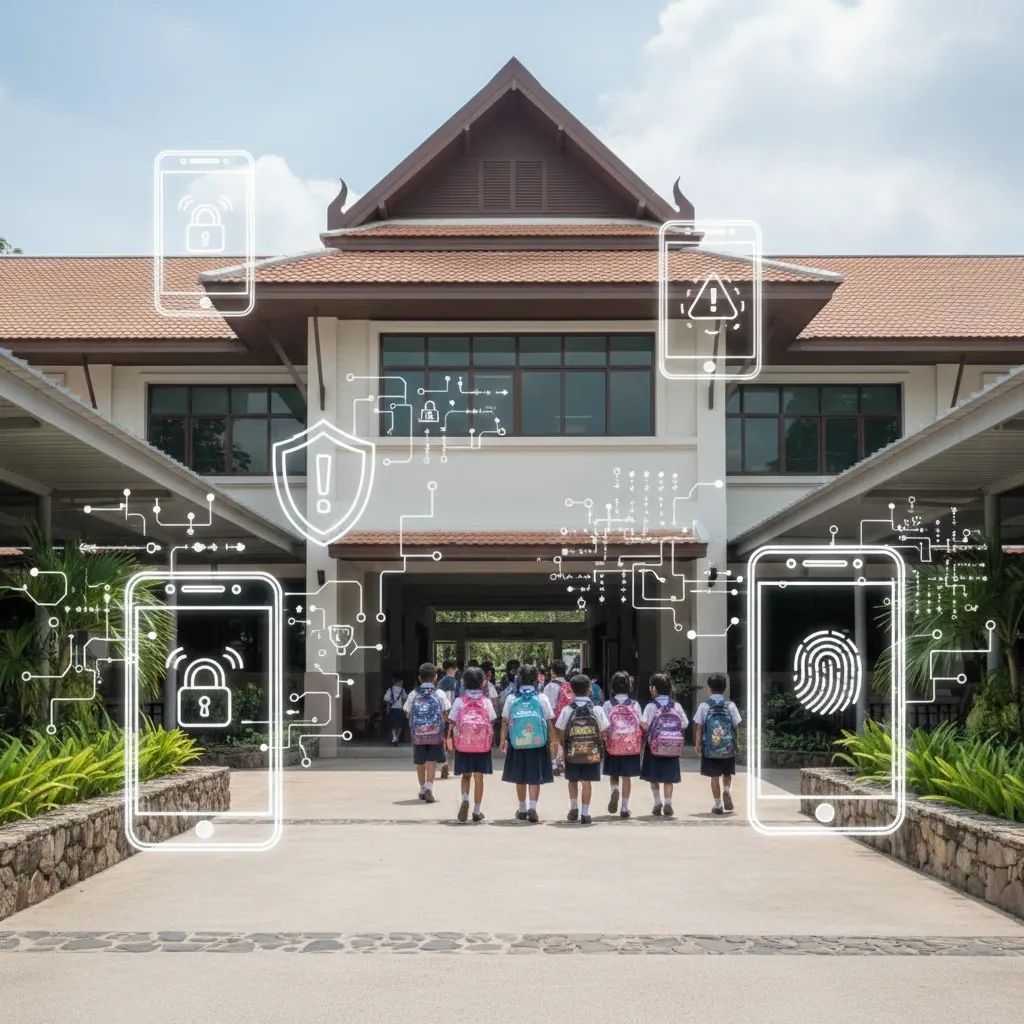
Thai police have arrested three members of a gang who posed as anti-fraud educators at two schools in Mae Ai district, Chiang Mai province, after stealing biometric data from hundreds of children to register fraudulent SIM cards for Myanmar-based scam networks. The data theft occurred in November 2025, with arrests made during raids across Chiang Mai and Chiang Rai provinces in February 2026.
Mae Ai district, located in the mountainous frontier region of northern Thailand approximately 90 kilometers from Chiang Mai city, became the target of a sophisticated identity theft operation in which perpetrators collected facial biometric data under the pretense of offering free anti-fraud security training. That stolen biometric information—eye movements, head rotations, natural facial expressions—was then weaponized to register active SIM cards later sold to Myanmar-based call-center networks. The discovery forces uncomfortable questions about whether the region's most advanced identity verification systems can withstand determined social engineering that costs nothing to execute.
Why This Matters
• Children face unwitting legal entanglement: Minors now have phone numbers registered in their names potentially tied to fraud operations, exposing them to police investigation and questioning despite their complete innocence.
• Biometric safeguards aren't failsafe: Thailand's multi-billion baht investment in liveness detection and facial recognition becomes irrelevant when fraudsters convince people to willingly perform the exact scans designed to prevent fraud.
• Border-zone vulnerability: Operations deliberately target mountainous frontier provinces where enforcement resources are thinner and institutional coordination weaker than in metropolitan centers.
Practical Steps for Protection
The most immediate protective step for anyone concerned about biometric compromise is direct verification with their mobile service provider. Thai nationals can register a maximum of 5 SIM cards per national ID card, while foreign residents are limited to 3 numbers per passport per carrier. If this threshold has already been reached through fraudulent registrations, the provider should immediately suspend the fraudulent numbers and initiate account investigation protocols.
Parents and school administrators should scrutinize any external organizations requesting permission to conduct workshops involving data collection. Legitimate government anti-scam programs do not require facial scanning, biometric data harvesting, or SIM card distribution. If an educational institution receives an unusually generous offer to provide free services or hardware to students, request references from the organization's parent agency, verify credentials through official government websites, and restrict participation in any program requiring biometric data collection.
For individual residents, the principle is straightforward: no authentic financial institution, government ministry, or telecommunications company will request that you send facial movement videos via messaging applications or email. These requests are indicators of fraud, regardless of the ostensible legitimacy of the request's framing.
Beyond SIM registration limits, residents should enable Multi-Factor Authentication (MFA) on all financial and government service accounts. This security posture ensures that even if fraudsters obtain biometric data, they cannot access secured accounts without possession of a secondary authentication device or code. Thai banks have committed to zero-liability policies for customers who report unauthorized transactions within 24 hours, but notification delays can complicate reimbursement processes.
Regular account audits of mobile banking applications represent another essential defensive layer. Fraudsters who gain access to phone numbers registered in your name may attempt to use those numbers to reset passwords on financial accounts or social media profiles. Reviewing transaction history and account activity weekly—rather than monthly—reduces the window within which fraudsters can exploit compromised accounts before detection.
The psychological dimension of defensive posture matters equally. Children and elderly family members face disproportionate vulnerability to social engineering techniques because they are less likely to question authority figures or to recognize manipulation patterns. Educating these demographic groups about common scam tactics and creating household protocols for verifying requests before sharing information can prevent catastrophic identity theft before it occurs.
If a resident suspects their identity has been compromised—discovering unauthorized SIM cards registered in their name, receiving police inquiries about phone numbers they don't recognize, or identifying fraudulent transactions—immediate action is necessary. File a police report with the Royal Thai Police and notify the relevant mobile service provider to suspend any fraudulently registered numbers. Request a formal investigation through the Anti-Online Scam Center's hotline at 1441, which coordinates with telecommunications companies to freeze accounts and analyze usage patterns that may link compromised identities to specific fraud operations.
The Social Engineering Blueprint
Two schools in Mae Ai district became unwitting participants in an identity harvesting operation that unfolded over several weeks in late 2025. The perpetrators arrived with calculated credibility markers—positioning themselves as certified educators offering valuable anti-scam safety training at no cost, a framing that aligned with government priorities and curriculum enrichment initiatives. School administrators had no obvious reason to suspect deception.
The psychological layering mattered strategically. Free programs invoking government initiatives receive less scrutiny than purely commercial offerings. Once positioned within the classroom, the individuals shifted approach. They collected extensive personal information—national ID details, personal photographs, family contact information—from each student. The critical deception came during the biometric capture phase.
Students received instructions to perform repeated facial scans through a mobile application. The stated purpose was protective security, not registration. Children were told their biometric movements would safeguard their new SIM cards from misuse. Authority figures delivering this message in an educational setting possessed inherent persuasiveness. The framing was technically true in reverse: the facial data being captured was precisely what passes Thailand's liveness detection systems, engineered to distinguish authentic human subjects from static photographs or AI-generated deepfakes.
When the Thailand Anti-Online Scam Center executed raids across Chiang Mai and Chiang Rai provinces in February 2026, one arrested individual possessed hundreds of active SIM cards, all registered under the names of children who understood nothing about what had occurred.
The Legal Quandary for Innocent Parties
Thailand's Telecommunications Act places accountability on the individual whose name appears on SIM card registration. This legal framework, designed to combat fraud by establishing personal liability, created an unexpected vulnerability when applied to minors. A school director expressed alarm about the implications: children who had committed no offense could theoretically face police questioning or legal proceedings if their registered numbers subsequently appeared in scam investigations.
Thai telecommunications law does not distinguish between intentional fraud and unwitting participation in identity theft when determining liability. A minor could receive notification that a number registered in their name was used to impersonate a bank or government agency, triggering official investigation into the child's household despite complete innocence.
This legal architecture added psychological harm beyond the initial identity theft. Not only had the children's identities been stolen, but their families now faced potential bureaucratic entanglement with law enforcement through no fault of their own. The school director's concern reflected a legitimate vulnerability in the legal system's design—it protects telecommunications integrity but creates collateral damage for victims of social engineering.
Destination: Myanmar's Industrial Fraud Ecosystem
The SIM cards discovered during the raids were destined for call-center operations operating from Tachilek township in Myanmar, which has become the operational nexus for industrial-scale fraud targeting Southeast Asia and beyond. The preference for Thailand-registered numbers within these operations stems from basic human psychology regarding caller ID skepticism.
When a victim in Thailand receives a phone call appearing to originate from a Thai number, psychological defenses lower. The caller claims to represent the Bank of Ayudhya, a government ministry, or a logistics company—entities with which the victim has genuine interactions. A Myanmar-registered number would trigger immediate suspicion. But a Thai number? The victim's brain processes it as domestic, familiar, lower-risk.
This psychological vulnerability translates directly into conversion rates for scam operations. Regional law enforcement documentation indicates that fraudsters using locally-registered numbers achieve success rates 3 to 4 times higher than those using international numbers. Thai SIM cards therefore command premium prices on underground markets serving Myanmar-based call centers.
The scale of this ecosystem became apparent through successive enforcement actions. In February 2026, Thai police arrested a single individual accused of supplying 200,000 SIM cards to Cambodian call-center operations, establishing parallel networks of mule bank accounts designed to launder fraud proceeds through the traditional banking system. On February 21, 2026, a raid on a suspected scam site in Surin province near the Cambodian border yielded staged office equipment and props designed to create realistic backgrounds during video calls with victims. These discoveries indicated that criminal organizations maintain multi-layered infrastructure designed to build victim trust through visual authenticity.
When Myanmar military forces raided the KK Park scam center on the Thai border in October 2025, they arrested more than 2,000 individuals and triggered the deportation of nearly 10,000 foreign workers through Thailand. Yet despite this massive enforcement action, the economic incentives driving SIM trafficking remained intact. A single fraudulently registered Thai SIM card sells for several hundred baht on black markets—a trivial cost that generates exponential returns when that number participates in defrauding victims of millions of baht through impersonation schemes.
How Advanced Technology Met Elementary Deception
The National Broadcasting and Telecommunications Commission (NBTC) implemented Thailand's biometric authentication framework specifically to prevent identity fraud of the type exposed in Mae Ai. The system requires facial recognition and fingerprint scanning during SIM registration, utilizing liveness detection technology that analyzes real-time facial movement patterns to confirm the presence of an actual human subject rather than a photograph or digital reconstruction.
The technology itself operates with accuracy rates exceeding 99%. It detects blinking patterns, head rotation dynamics, and micro-expressions that are virtually impossible to replicate through static images, video recordings, or even contemporary AI-generated deepfakes. Major telecommunications providers including True Corporation have invested substantially in AI-enhanced registration platforms that flag anomalies in real time, alerting fraud prevention teams when registration patterns deviate from normal parameters.
But the Mae Ai case reveals a human-layer vulnerability that no technological advancement can fully eliminate. When fraudsters convince victims to perform facial scans themselves—under false pretenses, in educational settings, with authority figures directing the process—the entire technological defense architecture becomes irrelevant. The biometric data being captured is genuine, performed willingly by the actual identity holder, and therefore passes every algorithmic verification that exists.
Telecommunications providers cannot distinguish between a parent legitimately registering a family member's phone and a criminal impersonating an educator while harvesting a child's biometric data. Both scenarios involve real human faces, real liveness characteristics, and genuine facial movement patterns. The difference exists only in intent and consent—elements that technology cannot evaluate.
This represents a fundamental security challenge that cybersecurity professionals have long acknowledged: the most sophisticated identity verification systems can be circumvented through social engineering and deception that costs nothing and requires no specialized technical knowledge.
Ghost SIM Infrastructure at Scale
The NBTC's official data reveals the magnitude of Thailand's ghost SIM crisis: in January 2026 alone, authorities suspended 28,112 phone numbers nationwide, representing a 22% increase from December 2025's suspension of 23,057 numbers. This upward trajectory reflects both increased investigative capacity and genuinely accelerating criminal activity.
Border provinces dominate the ghost SIM landscape. Sa Kaeo, Chiang Rai, Nong Khai, and Narathiwat provinces show the highest concentrations of irregular usage patterns, a concentration that directly correlates with their geographic proximity to Cambodia, Myanmar, and Laos. Law enforcement identifies these provinces as primary smuggling corridors where SIM cards and related telecommunications infrastructure move across international boundaries to supply fraud operations.
The geographic pattern reflects a deliberate criminal strategy. Mae Ai district, where the school-based identity theft occurred, sits in a mountainous frontier zone with limited government administrative presence and limited access to centralized verification infrastructure. Scam operations deliberately target such regions precisely because enforcement resources, institutional coordination, and technological verification systems remain thinner than in metropolitan areas.
Beyond individual cases, Thai police in November 2025 reported over 7,000 arrests related to illegal SIM cards, mule accounts, and illicit internet service provision in border areas, emphasizing regional cooperation to combat transnational online crime. The Cyber Crime Suppression Police conducted a separate major operation in November 2025, arresting over 300 suspects involved in scams, money laundering, and human trafficking, seizing laptops, mobile phones, SIM cards, and cash.
Emerging Threat Vectors for 2026
The Thailand Ministry of Digital Economy and Society has issued formal warnings about escalating scam vectors expected to intensify throughout 2026. Beyond SIM trafficking, residents face threats from AI-powered deepfake voice calls capable of replicating the speech patterns and vocal characteristics of trusted contacts, fraudulent SMS and LINE messages designed to appear from legitimate financial institutions, investment scams targeting social media followers, and social profile impersonation campaigns.
The convergence of these threat vectors creates compounding vulnerability. Biometric data harvested through social engineering at Mae Ai can be weaponized using deepfake technology to create synthetic video calls where fraudsters impersonate relatives or authority figures with alarming authenticity. A victim receives a call appearing to originate from their child, but the caller is an AI-generated voice trained on voice samples extracted from social media. The victim believes they are speaking with their child and complies with financial requests.
This escalation trajectory explains why law enforcement disruption efforts, while impressive in scale, struggle to reduce fraud rates. Enforcement actions disrupt specific operations without addressing underlying demand or preventing new criminal groups from entering the market.
Why Regulation Cannot Fully Solve This
The NBTC and telecommunications providers have implemented regulatory frameworks representing genuine advancement in identity verification security. Yet the Mae Ai case demonstrates that regulatory sophistication creates only limited protection against determined adversaries willing to exploit human psychology.
Border provinces represent a secondary regulatory challenge. Mae Ai district sits in a mountainous frontier zone with limited government administrative presence and limited access to centralized verification infrastructure. Scam operations deliberately target such regions precisely because enforcement resources, institutional coordination, and technological verification systems remain thinner than in metropolitan areas.
The Anti-Online Scam Center, established under the Thailand Ministry of Digital Economy and Society, has improved cross-border coordination with law enforcement agencies in Myanmar, Cambodia, and Laos substantially since 2025. Yet cooperation remains uneven and constrained by the reality that Myanmar's military leadership has historically benefited economically from scam operations operating within their territory, creating perverse incentives for incomplete enforcement.
Regional cooperation improved after Myanmar's military conducted the KK Park raid in October 2025, suggesting that direct operational pressure from inside Myanmar can produce enforcement results. But sustained cooperation depends on Myanmar leadership prioritizing scam suppression over the revenue streams these operations generate—a political calculus that remains uncertain.
The economic incentives driving SIM trafficking persist because fraud profits remain staggeringly high relative to operational costs and apprehension risks. A single successful scam targeting a middle-income Thai family might defraud victims of 50,000 to 500,000 baht—wealth equivalent to 1 to 10 months of household income. Call-center operations running dozens of simultaneous scams generate millions of baht in monthly proceeds. Against these profit margins, regulatory penalties and enforcement actions represent manageable business costs rather than genuine deterrents.
Breaking this economic model would require either a dramatic improvement in international law enforcement coordination or a fundamental technological innovation that makes locally-registered SIM cards worthless for fraud purposes. Neither development appears imminent.
What February 2026 Changed
The Mae Ai case crystallizes how technological advancement becomes limited by human behavior. Each new safeguard generates corresponding innovations in social engineering to circumvent it.
Thailand's biometric authentication system represents genuine technological advancement, incorporating 99%-accurate liveness detection and AI-enhanced fraud detection. But fraudsters responded not by attacking the technology directly—a path requiring specialized expertise and significant resources—but by exploiting the human trust systems that surround the technology. They positioned themselves as educators, located themselves in trusted institutions, and used authority figures' natural persuasiveness to convince children to perform the exact actions required to defeat the system's underlying purpose.
For residents engaged in the daily calculus of digital security, the Mae Ai case offers a specific warning: biometric data willingly provided under false pretenses is now a high-value asset on criminal markets. Protect it with the intensity you would protect access to your bank account. Verify external requests independently. Question generous offers arriving without clear institutional backing. Teach children and elderly family members to recognize manipulation patterns before they provide personal information.
Children and families across northern Thailand now navigate a changed threat landscape. The schools where they study are no longer exclusively educational spaces—they are also potential exploitation vectors. Teachers and administrators must carefully vet external visitors and programs with thorough scrutiny. Parents must accept that "free" educational programs arrive with hidden costs embedded in potential identity theft and bureaucratic vulnerability.
The confrontation between Thailand's advanced telecommunications infrastructure and elementary human deception will likely define cybersecurity challenges throughout 2026 and beyond.


