
Grab is reengineering its platform as an AI-driven operating system for daily living, not merely as a transaction processor. This shift—unveiled at the company's GrabX 2026 showcase—introduces 13 AI-powered features that reshape how Thai residents coordinate travel, manage spending, order meals, and handle financial needs through a single integrated interface.
Why This Matters
• Split rides now reach down to 40% savings: The Group Ride feature orchestrates up to four passengers with different waypoints into one shared journey with automatic fare division.
• Multi-store orders collapse delivery friction: Grab More bundles purchases across nearby merchants into synchronized deliveries, eliminating redundant fees that plague Thai consumers managing household tasks.
• Voice-to-cart technology handles the mental labor: Users can photograph shopping lists or dictate them aloud, and the AI assembles a checkout-ready basket with intelligent product substitutions.
• Travel logistics consolidate by mid-year: Airport gate alerts, passport reminders, and baggage claim navigation arrive in a single unified dashboard launching by Q3 2026.
The Infrastructure Beneath the Innovation
Grab built what it calls the Intelligence Layer, a computational system drawing pattern recognition from over 20 billion individual transactions across Southeast Asia. This system processes driver behavior, merchant operations, traffic flows, and user preferences at a massive scale. The Grab AI Assistant—the platform's conversational centerpiece—leverages this data to operate as a personal assistant, one that learns dietary restrictions, group size preferences, and travel patterns to suggest restaurants, arrange reservations, and coordinate logistics before users consciously request them.
This structural advantage matters for Thai users because it means recommendations aren't generic or algorithm-obvious. The assistant understands local context: it won't suggest seafood restaurants on Christian fasting days, recognize which Bangkok malls offer indoor navigation, or recommend ride-shares during hours when traffic makes carpooling viable. That contextual sophistication requires the kind of transaction density—and historical pattern recognition—that only a mature super-app like Grab can afford to develop.
Privacy and Data Concerns
The AI Assistant's personalization requires extensive data collection—travel patterns, shopping preferences, dietary restrictions, and location history. Grab has not yet detailed whether Thai users can opt out of such data collection while maintaining basic service access. This is a significant consideration, as Thailand's Personal Data Protection Act establishes regulatory requirements for user consent and data handling. Prospective users should verify what data collection is mandatory versus optional before activating these AI features.
Reshaping the Commute, One Feature at a Time
Group Ride addresses a friction point every urban Thai commuter recognizes: the inefficiency of solo transport during peak hours. The feature coordinates passengers traveling overlapping routes, optimizes pickup sequences, and splits costs automatically. Grab's internal data suggests this produces 40% per-capita savings for participating riders during shared routes—though the company did not specify whether this savings accounts for extended travel time from multiple pickups or applies only during peak hours when demand is highest.
For a Bangkok resident spending 500 baht weekly on solo taxis, that mechanism alone saves 200 baht—roughly equivalent to one premium coffee daily or three bowls of khao soi monthly. Thai residents can access Group Ride through a dedicated option in the app's ride selection menu, though availability depends on route compatibility and rider demand in specific zones.
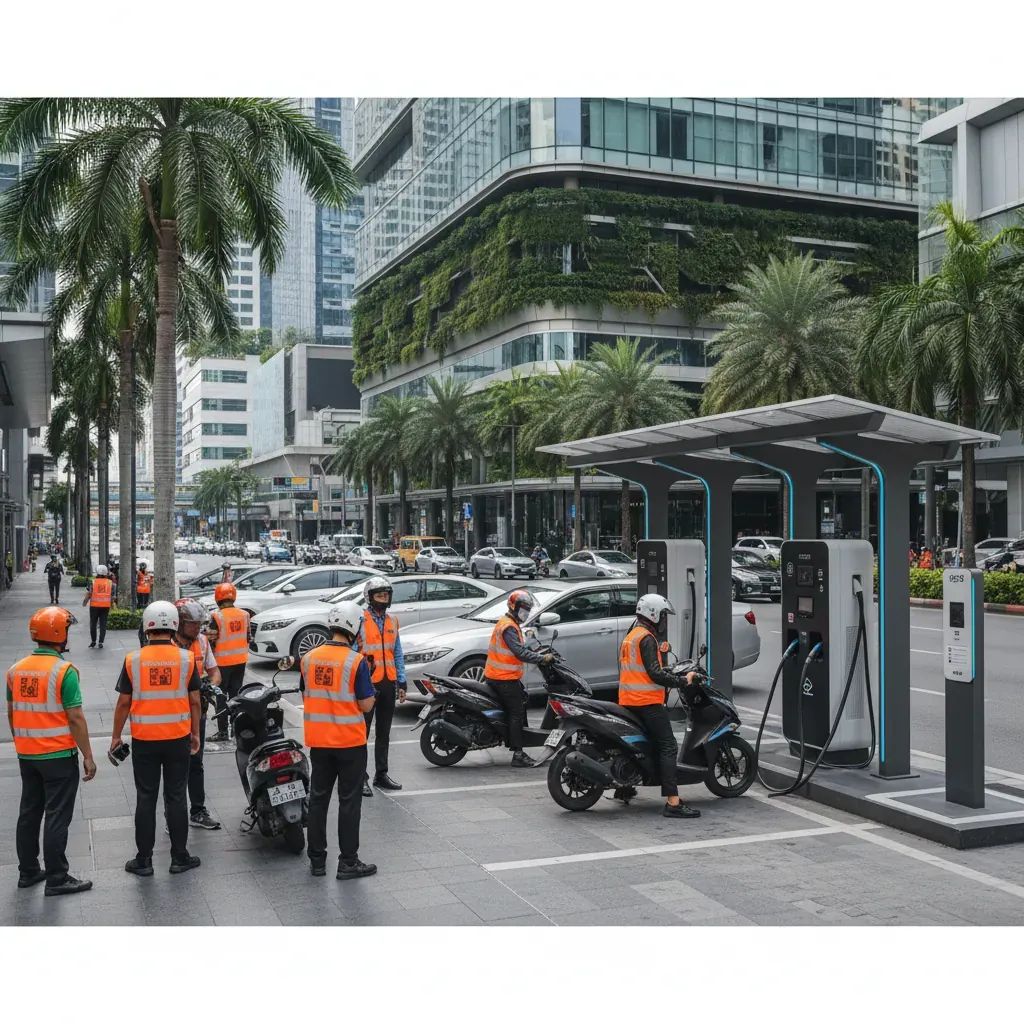
GrabMaps for Consumers extends beyond directional guidance. It layers parking spot availability, electric vehicle charging stations, real-time public transit schedules, and indoor navigation through malls and office complexes into its routing algorithm. The system integrates with personal calendars and past route history, meaning it learns whether a user prefers arriving early to appointment venues or cutting departure time close. For Bangkok residents navigating Siam Paragon or Central World, this internal mapping capability addresses a genuine navigation bottleneck—finding a parking space, locating the correct elevator bank, and reaching a restaurant reservation on time across three buildings demands the kind of granular data collection that independent map applications struggle to provide.
When Ordering Becomes Frictionless
Grab More directly tackles the merchant fee multiplication problem. Historically, ordering groceries from one vendor and prepared food from a second vendor meant absorbing delivery charges twice, or spending extra time coordinating separate arrivals. Grab More collapses these transactions into a single AI-managed delivery, with the platform absorbing the operational complexity—routing optimization, temporal coordination, and merchant notification—rather than imposing it on the user through split fees or delivery minimums.
This matters in Thailand's hyperlocal food and retail ecosystem, where single-district deliveries can involve dozens of small vendors. A resident managing dinner prep across a fresh market, a prepared food vendor, and a convenience store for forgotten items previously faced 60 baht in accumulated delivery fees. Grab More eliminates that friction by automating synchronization. The feature requires participating merchants within a limited delivery radius; not all vendors currently participate, and minimum order thresholds vary by location.
The Travel Companion Layer
The Personalised Travel Experience aims to consolidate airport complexity—a genuine pain point in Southeast Asia's hub-and-spoke aviation geography. When it launches in Q3 2026, users will receive passport expiration reminders, check-in prompts tailored to flight departure times, gate change alerts delivered in real-time, and luggage belt information upon landing. For Thai travelers managing visa requirements, multi-leg itineraries, and the geographic sprawl of Southeast Asian airports, this consolidation offers material value beyond mere convenience. The companion service directs users to ride pickup points, suggesting the cheapest GrabShare option or fastest private car alternative based on airport congestion patterns at departure time.
GrabStays and Discover by Grab address related pain points: last-minute accommodation hunts and travel dining fatigue. The former surfaces same-day hotel availability with GrabCoin incentive structures; the latter curates restaurant recommendations from community data, local reviews, and user preferences, reducing the paralyzing choice problem that often accompanies travel.
Of the 13 features announced, Group Ride, GrabMaps, Grab More, and the AI Assistant are currently available in Thailand. Travel tools and Cash Loan features roll out by Q3 2026.
Driver Tools: AI Assistance and Crowdsourced Traffic
The Driver AI Assistant—built collaboratively with OpenAI—processes driver questions about route efficiency, policy interpretation, and passenger communication in real-time. Within two months of its launch, drivers exchanged 1.24 million messages with the system, treating it as a constant companion during shifts. This represents genuine adoption patterns, not speculative usage projections.
Separately, the AI-assisted voice reporting tool has captured over 16,000 traffic reports daily from 900,000 drivers, whose crowdsourced congestion data feeds back into GrabMaps routing algorithms, creating a flywheel of driver input improving all users' navigation. Grab absorbs the computational costs of these driver tools—a deliberate subsidy ensuring adoption among lower-income workers less likely to pay for supplementary software.
Grab committed to training 10,000 drivers in AI functionality by mid-2026, reflecting institutional awareness that technology rollout requires workforce preparation.
Merchant Support: Automation and Payment Systems
For merchants, the Virtual Store Manager deploys computer vision to monitor hygiene compliance and foot traffic patterns, flagging operational anomalies without requiring manual spot-checks. The Cloud Printer automates order flow between front counters and kitchens, pausing store operations electronically if activity drops below thresholds—preventing dinner rush chaos or accidental order acceptance when establishments close.
Tap to Pay converts any smartphone into a card terminal, bypassing the hardware acquisition barrier that keeps Thailand's small merchants tethered to cash economies. The company has not yet disclosed whether merchants face additional fees for AI-powered tools, or whether tool adoption is mandatory for platform participation.
Grab committed to training 10,000 merchants in AI functionality by mid-2026, recognizing that merchants viewing AI as a support system rather than a threat represent stronger adoption rates.
The Financing Angle
Cash Loan, launching mid-2026, marks Grab's explicit entry into credit underwriting. Rather than depend on traditional bank decisioning—which often rejects applicants lacking formal credit history—Grab uses transaction velocity, delivery patterns, and ride history as creditworthiness signals. A driver who consistently completes high-rated trips or a merchant with strong order history and repeat customers represents lower default risk than their bank credit score suggests.
Grab's financial services division generated $347 million in revenue during 2025, expanding 37% year-over-year, with lending contributing a meaningful portion. However, the company has not disclosed whether lending operations are profitable or subsidized by other business units. Grab projects tripled EBITDA ($1.5 billion) by 2028, though this projection depends on AI features driving user engagement without proportional increases in infrastructure costs—a realistic but unverified assumption. The company has not clarified what happens to loan applicants rejected by the AI system, or whether users have any recourse for disputed creditworthiness determinations.
What This Means for Residents
The practical impact splits across three constituencies. Commuters and delivery consumers experience cost reductions and operational simplification—cheaper shared rides, consolidated shopping orders, consolidated travel planning. The mental load of managing separate apps for each task category diminishes; everything funnels through Grab's unified interface.
Workers—drivers, merchants, delivery partners—gain decision-support systems and operational automation that boost earnings or reduce administrative burden. The driver assistant eliminates guessing about optimal routes or policy edge cases; the merchant tools reduce manual order processing and hygiene monitoring overhead.
Grab itself consolidates user stickiness across its ecosystem, deepens the transaction data powering its Intelligence Layer, and expands revenue through financial services and cross-selling. Each feature encourages deeper platform immersion, which generates additional transaction velocity, which strengthens the underlying AI models, which enables more sophisticated recommendations—a classic network effect.
The company's 200,000-user Early Access Programme—which includes a "shake and share" feedback mechanism allowing instant user input via phone vibration—signals methodical rollout. Four thousand feature refinements generated through this feedback loop before public launch suggest Grab has tested core functionality before release.
How Grab's Approach Differs
Compared to regional rivals, Grab's breadth stands out. Lazada's AI Lazzie concentrates on e-commerce personalization and virtual try-ons; GoJek's Dira operates as a voice-activated fintech assistant in Indonesian; Shopee's AI primarily handles seller-facing customer service chatbots; foodpanda's AI focuses on delivery routing and merchant order automation. None consolidates transport, delivery, travel logistics, financial services, and consumer shopping into a single conversational interface the way Grab does.
That comprehensive approach carries both advantage and risk. The advantage: network effects compound across services, making Grab harder to displace once established. The risk: feature overload can paradoxically increase friction if users cannot locate functionality amid the accumulating feature set.
The Viability Question
These AI features represent operational shifts rather than marketing announcements. The 1.24 million driver-assistant messages and 16,000 daily voice reports demonstrate authentic adoption patterns. The financial data—$347 million in lending revenue growing 37% annually—shows revenue concentration materializing. When Grab claims 40% fare reduction through group rides, that figure derives from internal pool analysis.
The durability question concerns whether these AI systems improve meaningfully once the initial novelty fades. Early adopters enthusiastically embrace the Group Ride feature or voice-to-cart shopping when introduced; sustained usage patterns—whether parents continue using Grab More for weekday dinner prep six months post-launch, or whether drivers continue leveraging AI coaching after the first week—determines whether this represents genuine strategic evolution or sophisticated feature deployment.
For Thai residents, the practical signal is straightforward: Grab is building infrastructure to make daily logistics simpler and cheaper. Whether that manifests as 30-minute order consolidation time savings or 200-baht weekly transport cost reductions, the direction moves toward friction reduction. The evidence so far—adoption numbers, revenue growth, driver engagement—suggests the platform is executing on that vision. However, residents should remain aware of the data collection requirements, carefully evaluate whether features actually deliver advertised savings across their specific use cases, and understand the implementation timelines before adjusting their commuting or shopping routines around these tools.


