
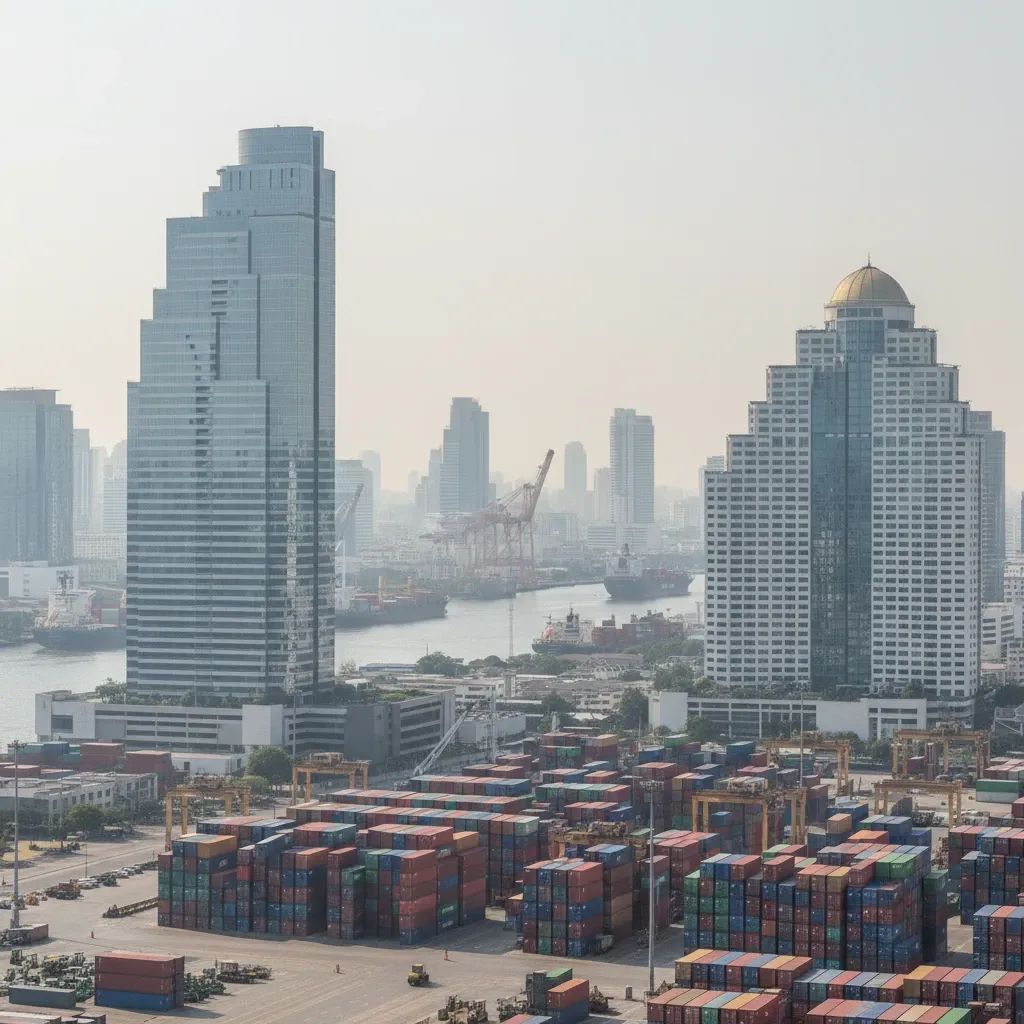
The Thailand Ministry of Commerce and US Trade Representative office are racing to finalize a reciprocal trade agreement that could shield Thai exporters from punitive tariffs—but only if Bangkok agrees to overhaul customs enforcement, labor laws, and supply chain sourcing in ways that could reshape how businesses operate in the kingdom.
Why This Matters:
• Thailand faces a 19% baseline tariff on exports to the US unless negotiators secure exemptions for products not made domestically in America
• Section 301 probe underway: Thai officials are scheduled to head to Washington in mid-May to answer questions about forced labor and factory overcapacity—potential penalties loom
• Customs law changes required: The Thai government must eliminate its customs reward system and tighten country-of-origin enforcement
• New investment pledges: Thai companies are expected to funnel capital into US agro-processing and energy projects as part of the deal
The Strategic Calculus Behind the Agreement
Deputy Prime Minister and Commerce Minister Suphajee Suthumpun held accelerated talks with US Trade Representative Jamieson Greer and Deputy USTR Rick Switzer in early May, marking a sharp uptick in the urgency of negotiations. The framework builds on recent bilateral discussions in which Thailand committed to substantial tariff elimination on US goods, while Washington maintains its 19% reciprocal tariff rate on Thai imports—with exceptions to be negotiated product-by-product.
For context, the United States is among Thailand's largest trading partners. Yet the US goods trade deficit with Thailand has been a concern for American negotiators, who are now pressing for what they call "rebalancing"—a focus on Thailand increasing purchases of American products and integrating more US-sourced components into its manufacturing base.
The strategic dimension extends beyond economics. The Agreement on Reciprocal Trade (ART) framework resembles recent deals struck with Cambodia, Malaysia, and Vietnam—arrangements designed as economic security coordination tools to strengthen regional partnerships. Unlike conventional FTAs that focus solely on mutual tariff elimination, these agreements emphasize non-tariff barriers, digital trade rules, and supply chain realignment.
Non-Tariff Barriers: Where the Real Friction Lies
While headline tariff rates grab attention, the most consequential negotiations revolve around regulatory acceptance and administrative hurdles. The United States is demanding that Thailand accept a range of American standards and certifications without requiring separate domestic approval processes—a shift that could upend established bureaucratic procedures and create openings for US exporters.
Automotive sector: Washington wants Thailand to accept vehicles certified under US federal motor vehicle safety and emissions standards, bypassing Thai inspection requirements. This would allow American automakers to ship directly into a market currently dominated by Japanese and European manufacturers who have invested heavily in meeting local regulations.
Pharmaceuticals and medical devices: The US is pushing for recognition of FDA certificates and prior marketing authorizations, reducing duplicative Thai approval processes. For American pharmaceutical companies, this would dramatically reduce time-to-market; for Thailand's Ministry of Public Health, it represents a significant regulatory shift.
Agriculture and food products: American negotiators seek expedited access for certified agricultural products and resolution of long-standing trade disputes. Thailand's agricultural sector, while largely focused on different product categories, views these demands as setting precedents that could expand over time.
Customs practices: Perhaps most controversially, Thailand has committed to amending its Customs Act to eliminate the reward system tied to breach discoveries and penalty collections—a mechanism that has historically incentivized customs officials to identify violations but which US trade lawyers argue creates inconsistencies in enforcement.
What This Means for Thai Exporters and Investors
Thai businesses stand to gain tariff exemptions on products not manufactured domestically in the United States—a category that includes significant portions of Thailand's electronics components, automotive parts, and specialty food exports. However, exporters should prepare for heightened scrutiny on country-of-origin determinations, as Washington moves to address concerns about trade circumvention practices.
The Section 301 investigation poses a more immediate concern. The Thai delegation's mid-May visit to Washington will address US concerns about structural conditions in Thai manufacturing sectors and potential labor standards in supply chains—issues that could affect market access regardless of the broader trade agreement.
On the investment side, Thai companies are being asked to increase capital deployment in the United States, particularly in processed agriculture and energy. This represents a significant shift for Thailand's traditionally export-focused business model, effectively requiring companies to become US employers to secure market access.
Sectoral cooperation proposals offer potential upside in clean energy, carbon-reduction technologies, food innovation, public health, and specialty food production—areas where Thailand has technical capabilities and the US market offers scale. Thai private companies have expressed interest, though concrete commitments remain under negotiation.
Labor Rights and the Shadow of Compliance
American negotiators have made labor rights protection a recurring focus, demanding that Thailand strengthen protections for freedom of association and collective bargaining. These demands focus particularly on sectors prone to labor concerns—categories in which Thailand has faced international scrutiny.
For Thai manufacturers in garment, seafood processing, and agricultural sectors, enhanced labor standards could mean higher compliance costs and operational adjustments. The political dimension is equally significant, as labor organizing rights intersect with Thailand's domestic legal framework.
The Geopolitical Dimension
Negotiations reflect broader strategic considerations, with both countries viewing trade agreements as mechanisms to enhance economic coordination and strengthen regional partnerships. Thailand's balancing act between its largest trading partners and security allies grows more complex as these agreements embed economic relationships with strategic dimensions.
Timeline and Tactical Considerations
Both governments have committed to accelerating negotiations, driven by mutual interest in providing economic certainty and avoiding escalation. For Thailand, the calculus is straightforward: secure exemptions or face potential tariff impacts. For the United States, the goal is reshaping trade flows and regulatory alignments.
The mid-May Section 301 consultation serves as an immediate test. How Thai officials address labor standards and manufacturing concerns will signal whether negotiations proceed smoothly or face additional obstacles.
Businesses operating in Thailand should monitor three critical elements: first, whether specific product categories receive tariff exemptions under the final agreement; second, how Thailand enforces new rules-of-origin requirements; and third, what amendments to the Customs Act ultimately pass through Thailand's legislative process.
Implications for Thailand's Export Economy
Thailand's export economy is entering a period of adjustment, where market access depends not just on competitive manufacturing but on alignment with American regulatory standards and labor practices—a shift that will require both government policy changes and private sector adaptation. Companies in affected sectors should begin reviewing their supply chains, compliance procedures, and export documentation now to prepare for potential changes ahead.


