
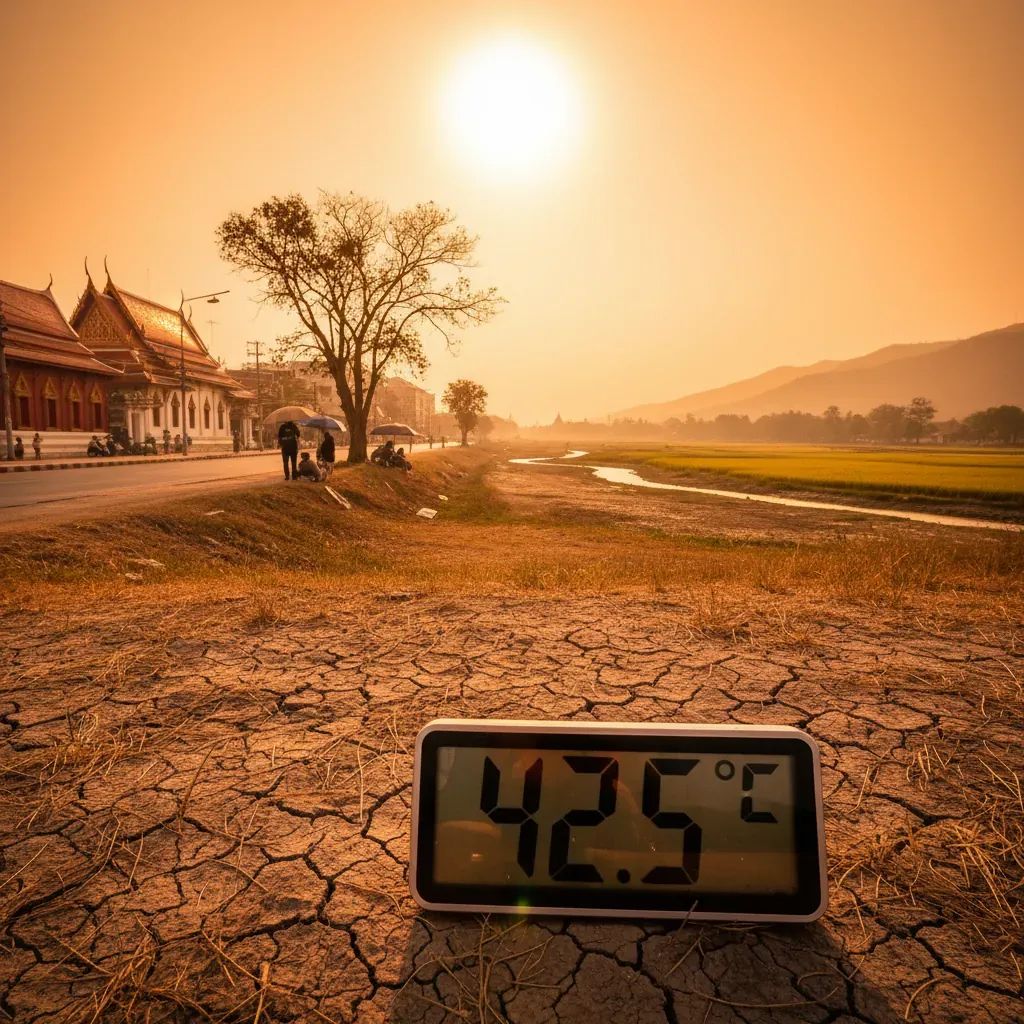
The Thailand National Water Resources Office has mobilized what officials are calling an unprecedented multi-year water security response after climate forecasts confirmed a Super El Niño event will intensify through late 2026, likely making 2027 the hottest year on record and triggering a drought cycle that could stretch 18 months.
Why This Matters
• Temperature extremes: Parts of Thailand may hit 44°C or higher from February to April 2027, with heat index values reaching a dangerous 58.7°C — well into heatstroke territory.
• Water supply crunch: Rainfall is forecast to drop 18.6% year-on-year in 2026, affecting household taps, industrial operations, and crop irrigation across 41 provinces.
• Food price pressure: Yields of rice, sugarcane, durian, cassava, and oil palm are expected to decline sharply, potentially triggering "Food Shock" price surges both domestically and regionally.
• Dual hazards: While drought dominates, 43 provinces face both water scarcity and flash flood risk due to volatile weather swings under El Niño conditions.
The Forecast: What Climate Models Are Showing
International meteorological agencies now estimate an 80% probability that El Niño conditions will form by mid-2026 — specifically May through July — and persist through year-end. Some experts warn this system could escalate into a "Super El Niño" comparable to the devastating 1997–1998 and 2015–2016 episodes, with ocean surface temperatures in the Pacific rising enough to disrupt monsoon patterns across Southeast Asia.
For Thailand, the implications are stark. The 2026 winter season will be unusually mild or effectively absent, and annual average temperatures will climb well above the long-term mean. The rainy season will deliver below-normal precipitation, especially in the second half of the year, draining reservoirs that supply urban centers and irrigation networks. The dry season could extend by several months, compounding stress on water infrastructure already stretched thin.
Fire and air quality concerns loom large as well. Prolonged heat and low soil moisture create ideal conditions for wildfire ignition and transboundary haze, particularly PM2.5 pollution drifting from agricultural burns and forest fires in neighboring countries.
Geographic Risk Mapping: Who Gets Hit Hardest
Government risk assessments identify 12 provinces at critical risk of agricultural water shortages during the 2025/2026 dry season, with 41 provinces facing household and municipal supply deficits. Areas outside formal irrigation districts — primarily in the North, Northeast, East, and South — will bear the brunt of the crisis.
Water quality is another flashpoint. The Thailand Department of Water Resources has flagged 22 major river basins where low flow rates could degrade quality, and saltwater intrusion threatens tap water production in Bangkok, Nonthaburi, and Samut Prakan if tidal barriers and upstream releases are not carefully managed.
Paradoxically, some of the same regions face flash flood danger. The western and lower northern provinces — including Tak, Kamphaeng Phet, Nakhon Sawan, Uthai Thani, Suphan Buri, Kanchanaburi — may experience sudden, intense downpours between May and August as localized convection cells dump rain faster than dry soil can absorb. Later in the year, September through November, tropical storms and monsoon troughs will elevate flood risk in lowland areas of the North, the Chao Phraya basin, and the southern peninsula.
The Eastern Economic Corridor (EEC) — home to Thailand's industrial heartland — sits squarely in the cross-hairs, prompting officials to prioritize water security planning for petrochemical plants, electronics manufacturers, and port facilities that depend on stable freshwater supply.
What This Means for Residents
Household Water Security
If you live in one of the 41 at-risk provinces, expect voluntary or mandatory rationing during peak dry-season months. Local utilities are pre-positioning pumps and tanker trucks to supplement piped supply, but rural communities and informal settlements may face multi-day outages. Consider installing household rainwater storage or purchasing emergency water stocks now.
In Bangkok and surrounding metros, watch for saltwater intrusion alerts that could affect tap water taste and safety. The Metropolitan Waterworks Authority typically issues advisories when salinity thresholds are breached; have bottled water on hand during vulnerable tidal windows.
Health and Safety
The Thailand Ministry of Public Health is preparing hospital surge capacity for heatstroke cases and respiratory illness linked to smoke and dust. Officials plan to designate Cooling Centers in high-density urban zones where residents can escape extreme heat, similar to models used in Singapore.
If you work outdoors or commute on foot or motorbike, adjust schedules to avoid midday exposure. The forecast heat index of 58.7°C falls into the "extreme danger" category, where prolonged activity can cause organ failure within minutes.
Haze and PM2.5 spikes are almost certain if forest fires ignite regionally. Stock up on N95 or equivalent masks and monitor air quality apps daily, especially if you have respiratory or cardiovascular conditions.
Food Costs and Availability
Expect price volatility for staples. Rice paddies that depend on monsoon rains will see reduced planting in the second crop cycle, and durian and oil palm orchards in the South are particularly vulnerable to heat stress. Imported food may partially buffer domestic shortages, but Thailand is a net rice exporter, so any significant yield drop will reverberate across Asian markets.
Farmers are being advised to skip the second off-season rice crop entirely and shift to short-cycle, drought-tolerant crops such as mung beans or vegetables that require less irrigation.
Government Response: A Three-Year Roadmap
Dynamic Reservoir Management
The Royal Irrigation Department and Electricity Generating Authority of Thailand (EGAT) have adopted a Dynamic Operation Curve framework, which uses six-month rainfall forecasts to adjust dam releases in near real-time. The goal is to balance flood prevention with water banking, ensuring reservoirs retain enough volume to supply households and farms through extended dry spells.
Officials are modeling scenarios out to 2028 to avoid the mistakes of past droughts, when overly optimistic assumptions led to premature drawdowns.
Cloud-Seeding and Artificial Recharge
The Department of Royal Rainmaking and Agricultural Aviation has deployed mobile units to drought-prone zones. Aircraft will seed clouds when conditions allow, aiming to top up reservoirs and dampen wildfire risk in upland forests. While cloud-seeding cannot replace monsoon rains, it can add crucial incremental volume during narrow weather windows.
Agricultural Adaptation
Farmers are being urged to:
• Defer or cancel second-crop planting where irrigation is unreliable.
• Adopt deficit irrigation techniques that apply less water at critical growth stages.
• Diversify into high-value, low-water crops such as herbs, leafy greens, or livestock that can be fed with drought-resistant fodder.
• Invest in on-farm water storage — small ponds, tanks, or lined reservoirs — to capture whatever rain does fall and recharge shallow aquifers.
Subsidies and soft loans are being made available for water infrastructure upgrades, and extension officers are conducting village-level training on soil moisture management and organic matter addition to improve water retention.
The government is also preparing a Disaster Relief Center for Agriculture to coordinate assistance, distribute emergency supplies, and provide financial relief packages if crop failures become widespread.
Industrial and Urban Measures
In the EEC, factories are being encouraged to install wastewater treatment and recycling systems, reducing dependence on municipal and river sources. Some heavy users may face mandatory cutbacks if reservoir levels fall below critical thresholds.
Bangkok and provincial capitals are accelerating leak detection and pipeline repair programs to reduce non-revenue water — a long-standing problem that wastes an estimated 30% of treated supply in some districts.
Regional Context: Lessons from Neighbors
Thailand is not alone. The broader Southeast Asian mainland and archipelago are bracing for similar conditions. Indonesia faces heightened wildfire risk in Sumatra and Kalimantan, with transboundary haze likely to reach Malaysia, Singapore, and southern Thailand by mid-year. Vietnam has announced plans to reduce rice exports to safeguard domestic food security, a move that could tighten regional supply and push prices higher.
Singapore has activated its national heat response plan, including island-wide cooling centers and public health campaigns. The Philippines is overhauling disaster-response protocols to address slow-onset crises like drought, which fall outside traditional rapid-response frameworks designed for typhoons and earthquakes.
China has launched more than 16,000 water conservation projects in recent years, recognizing that climate volatility is the new normal. India is promoting crop diversification and drought-resistant varieties such as millet, potatoes, and sweet potatoes to reduce reliance on water-intensive rice and wheat.
These regional efforts underscore a shared recognition: El Niño is no longer a cyclical anomaly but a recurring stress test that demands structural adaptation.
What You Can Do Now
At Home
• Audit your water use. Fix leaks, install low-flow fixtures, and consider greywater recycling for gardens.
• Stock emergency supplies: bottled water, electrolyte solutions, and N95 masks.
• Plan for power outages: Heatwaves spike electricity demand; grid stress is likely during peak afternoons.
For Farmers and Rural Landowners
• Harvest and store runoff from early-season rains before the dry spell deepens.
• Join cooperative water-sharing schemes to pool resources and reduce individual risk.
• Monitor extension service bulletins for updated planting calendars and subsidy announcements.
For Businesses
• Stress-test your supply chain for water and heat disruptions, especially if you source from agriculture or depend on river transport.
• Review contingency plans with suppliers in drought-prone provinces.
• Communicate with employees about flexible schedules or remote work during extreme heat days.
The Bigger Picture
This Super El Niño event is unfolding against a backdrop of rising baseline temperatures and more erratic monsoons — symptoms of longer-term climate change. Even after El Niño dissipates, likely in 2027, Thailand's water and agricultural systems will remain under pressure. The infrastructure investments, policy reforms, and behavioral shifts being rolled out now are not temporary fixes but down payments on resilience for decades to come.
Residents, farmers, and businesses that adapt early will fare better than those who wait. Government support is substantial, but the scale of the challenge means individual preparedness is not optional — it is essential.


