
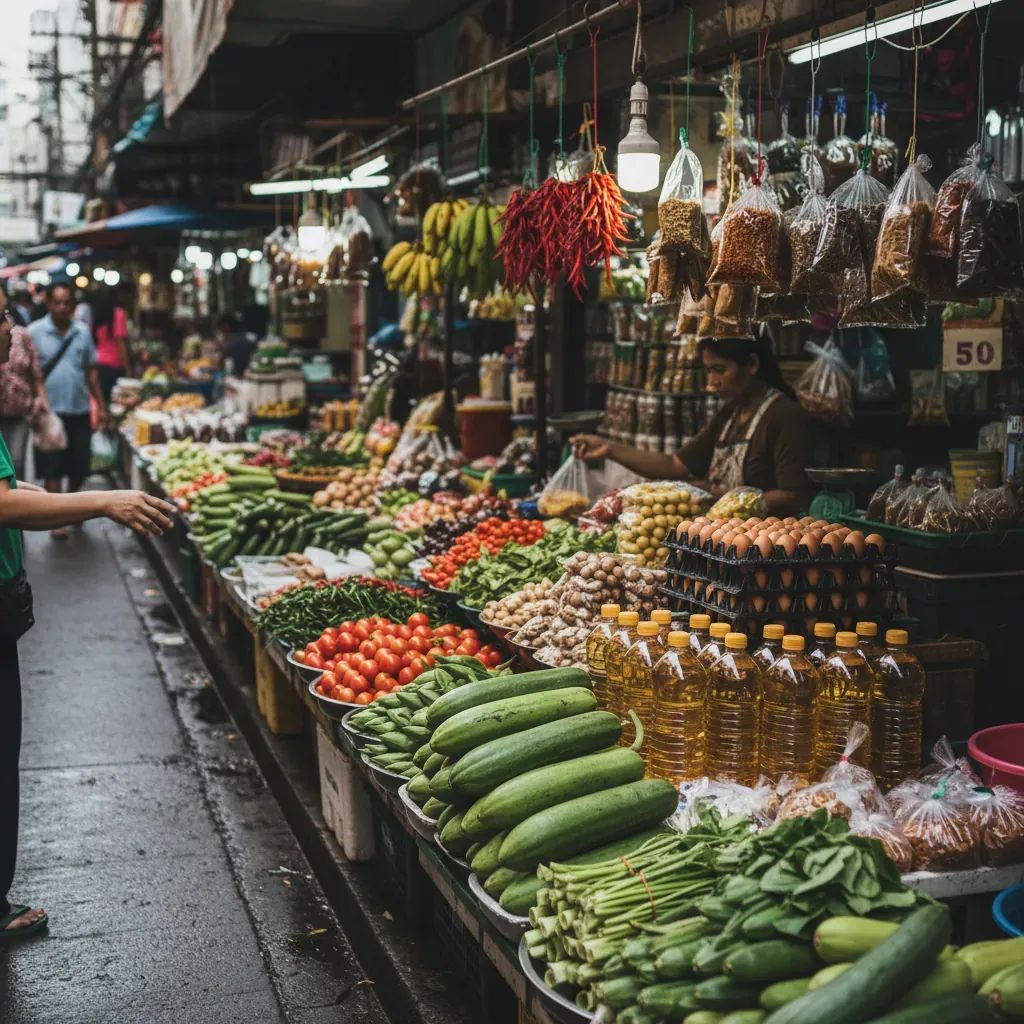
The Thailand Ministry of Commerce is preparing to expand its list of price-regulated goods amid mounting concerns over energy volatility and cost-of-living pressures, a move that could extend government price caps to dozens more everyday products but risks deepening market distortions that economists warn are already straining business operations.
Why This Matters
• Stricter grocery bills ahead: The Ministry oversees 59 controlled product categories and is now reviewing which essential items to add — meaning more products may require government approval before any price increase.
• Diesel price management: Price controls on diesel remain in effect, with the government managing incremental adjustments to cushion transport and food costs.
• Report price gouging: Residents can flag suspected overcharging or hoarding via the 1569 hotline (available nationwide, dial to report suspected violations at markets and retail outlets). Provide the product name, location, and alleged overpriced amount. After reporting, inspection teams will investigate and take action against violators.
• Public hearings coming: The Central Committee on Prices of Goods and Services will solicit input before finalizing any additions to the controlled list. Check the Ministry of Commerce website or local provincial commerce offices for hearing dates and how to submit comments.
What's Already Under Government Price Control
Thailand currently enforces strict oversight on eight core categories: instant noodles, canned fish, powdered milk, fertilizers, pesticides, animal feed, rice, and seasonings including fish sauce. Any business seeking to raise prices on these items must first notify and obtain approval from the Department of Internal Trade (DIT).
Commerce Minister Suphajee Suthumpun emphasized that existing inventories must be sold at current controlled levels. Provincial commerce offices, working alongside the Interior Ministry and energy regulators, conduct on-site inspections at markets and retail outlets to enforce compliance and prevent hoarding.
The ministry's reach extends well beyond supermarket shelves. Agricultural inputs — fertilizers and pesticides — remain heavily regulated to shield farmers from import-cost shocks, while a "Green Flag" program promotes organic alternatives to reduce reliance on imported chemical products. These programs are distributed through provincial agriculture offices and participating retailers; check with your local provincial commerce office for participating locations in your area. Officials are also expediting fertilizer imports and managing buffer stocks to ensure availability during planting seasons.
Which Products Might Be Added Next
While no final list has been released, the ministry is closely monitoring several categories vulnerable to energy and production cost fluctuations. Items under consideration include detergents, eggs, cooking oil (both palm and vegetable varieties), tissue paper, fresh pork and chicken, beverages in plastic packaging (including bottled water and milk), and construction materials such as cement, steel bars, house paint, PVC pipes, and tiles.
Plastic pellets — a key input for packaging — are also under review, reflecting supply-chain anxieties that ripple through multiple sectors. Prepared food, hot-rolled steel sheet, and fresh produce like oil palm and fruit have appeared on internal watch lists, underscoring the breadth of the government's intervention.
Public hearings will allow consumer groups, manufacturers, and trade associations to weigh in before the Central Committee makes formal recommendations. The Ministry has signaled that any expansion will aim to "better reflect current market conditions" and mitigate risks stemming from global energy volatility and geopolitical conflicts.
The Economic Trade-Off: Stability Versus Market Efficiency
Economists and business leaders caution that while price caps offer short-term relief, their expansion carries significant long-term risks. A study on Thailand's cassava price intervention found that such policies redistribute welfare rather than improve allocative efficiency, and when fiscal costs are included, they often produce a net welfare loss.
Nonarit Bisonyabutr, a researcher at the Thailand Development Research Institute (TDRI), has urged the government to conserve fiscal resources and deploy stimulus measures only when narrowly targeted, warning that broad interventions can prove unsustainable. An OECD report echoed this view, stating that price controls "distort relative prices, making for less efficient resource allocation," and recommending that the "long-term objective should be to pare back the use of this policy instrument."
Commerce Minister Suphajee himself acknowledged the tension, cautioning that "excessive pressure on businesses could have unintended consequences for employment and supply chains." Many manufacturers already face rising import, energy, and transport costs; strict price ceilings that ignore these input pressures can force companies to absorb losses, potentially triggering reduced investment, slower growth, or closures.
Amonthep Chawla, Chief Economist at CIMB Thai Bank, has highlighted declining purchasing power among lower- and middle-income groups and warned that if current pressures persist, even large corporations may face distress. The risk is that rigid controls stifle competition, discourage innovation, and add another layer of red tape to a regulatory environment already criticized for excessive complexity and lack of transparency.
Universal subsidies, often deployed alongside price caps, compound the fiscal burden. Analysis suggests Thailand's universal subsidy programs cost approximately 17 times more than targeted support for households below the national poverty line, raising questions about the sustainability of the current approach.
What This Means for Residents
For expatriates, retirees, and Thai families navigating day-to-day expenses, the review process introduces both promise and uncertainty. If executed with precision, adding high-impact items like cooking oil, eggs, and fresh meat could deliver tangible savings, particularly for households spending a significant share of income on food and utilities.
To track which items are controlled, residents can check the Department of Internal Trade (DIT) website or visit their local provincial commerce office for the current official list of price-controlled products. This list is regularly updated and should be your reference point when comparing prices.
However, history suggests that prolonged controls can lead to supply shortages if producers find it unprofitable to maintain output at capped prices. The 1569 hotline offers a direct channel to report irregularities, but enforcement depends on the capacity of inspection teams to cover thousands of retail outlets across provinces.
Administered prices already account for roughly 35% of Thailand's Consumer Price Index (CPI) basket, with energy and public transportation as prominent categories. Research indicates that institutional measures — including price controls and inherent price stickiness — do absorb some external shocks.
Yet the National Economic and Social Development Council (NESDC) has underscored the direct link between energy costs and GDP, warning that protracted global conflicts or sustained cost pressures could trigger stagflation. Price management of essential items is designed to cushion logistics expenses and protect household budgets as global conditions remain uncertain.
Relief Programs and Supply Chain Management
Beyond price caps, the Ministry is collaborating with manufacturers and retailers on "Blue Flag" discount campaigns in selected regions. These programs distribute subsidized goods through participating wholesale and retail channels; to find Blue Flag locations near you, check announcements from your local provincial commerce office or ask retailers directly about participating stores. The goal is to provide targeted relief without distorting prices across the entire market.
Supply-chain management remains a priority: the Ministry is exploring alternative sourcing for critical inputs and working to ensure sufficient stocks of essential goods. These efforts aim to prevent panic buying or artificial scarcity, which have historically accompanied sudden policy shifts.
For farmers, the expanded Green Flag program and expedited fertilizer imports represent a dual strategy — stabilizing input costs while promoting long-term sustainability through organic alternatives. Officials have stressed that these measures are not merely reactive but part of a broader plan to reduce import dependency and enhance domestic resilience.
The Path Forward
The upcoming public hearings will test the government's ability to balance populist pressure for lower prices with the economic realities facing producers and retailers. Residents interested in participating should watch for announcements from the Central Committee on Prices of Goods and Services through the Ministry of Commerce website or local media. You can submit comments during public hearings by contacting your provincial commerce office directly.
If the Ministry adds too many categories without corresponding support for businesses absorbing higher input costs, supply disruptions and reduced product quality could follow. If it adds too few, households may feel the pinch as unregulated items absorb cost pressures.
For now, residents should monitor announcements from the Central Committee on Prices of Goods and Services and track which products appear on finalized lists. The 1569 hotline remains the primary tool for reporting suspected violations, and provincial commerce offices continue to publish updated price guidance. Bookmark your local provincial commerce office contact information for quick access to price lists and program details.
As global energy markets remain turbulent, Thailand's price-control regime is unlikely to shrink in the near term. The question is whether the expansion can achieve genuine cost-of-living relief without compounding the market inefficiencies and fiscal burdens that critics warn are already embedded in the system.


