
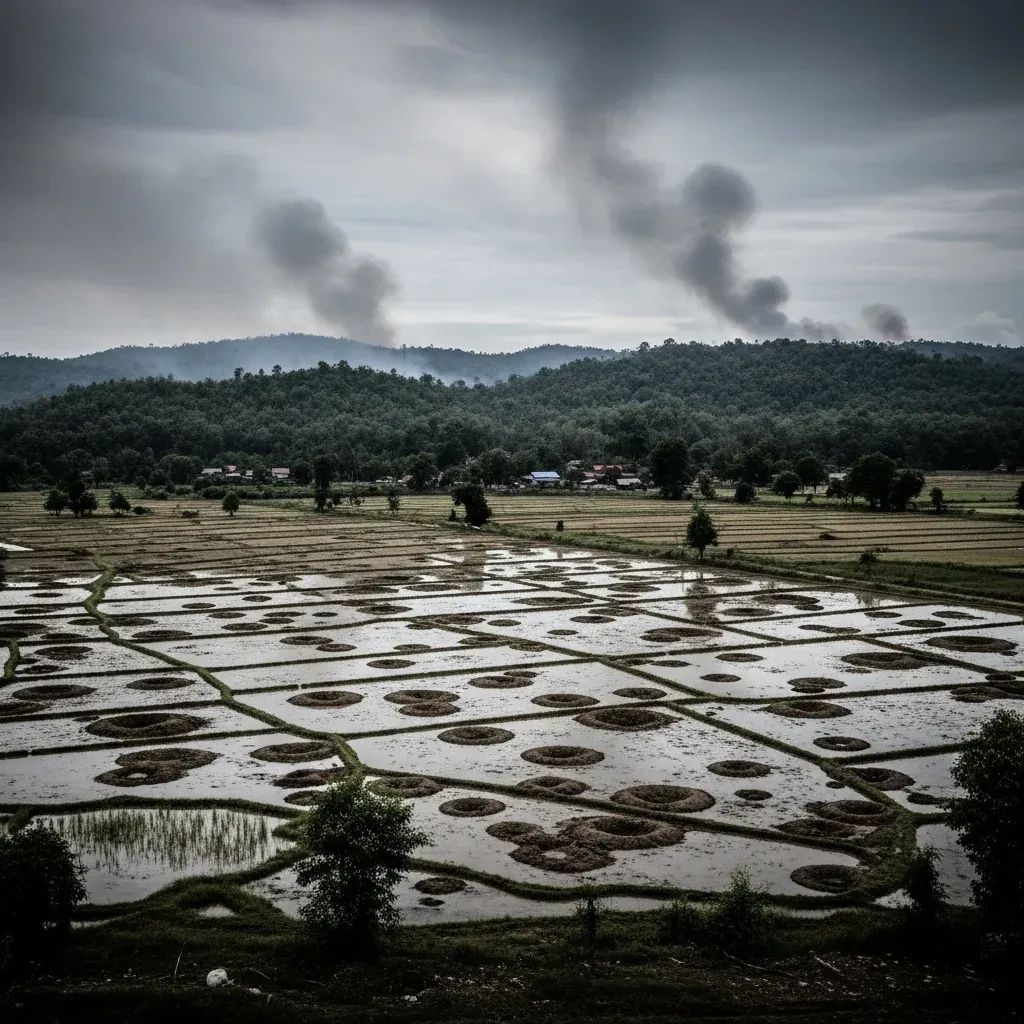
Border residents heard yet another round of accusations this week, but the version of events depends entirely on which capital you listen to. Phnom Penh insists the Thai military rained cluster munitions and even toxic agents on Cambodian soil during two intense exchanges of fire last year, while Bangkok counters that such claims are "flat-out fiction" and points instead to shells that landed in Thai villages. In the absence of an international investigation, uncertainty keeps communities in Isan and across the frontier on edge.
Snapshot: What the Dispute Boils Down To
• Cambodia’s CMAC accuses Thailand of using banned weapons, including chemical agents, in July and December 2025.
• Thai Army says it followed international law, used only conventional artillery, and that unexploded shells found in temples and farms on the Thai side are Cambodian.
• No outside body—neither the UN nor OPCW—has verified either side’s claims so far.
• Border provinces from Sisaket to Surin report civilian casualties and disrupted trade worth billions of baht.
Tensions Flare Again Along the Dangrek Range
The most recent flare-up began on 7 December when artillery rumbled near the ancient Preah Vihear complex. By month’s end, Cambodian officials reported 31 civilian deaths; Thai authorities listed 1 direct fatality but blamed "secondary effects" for 44 additional Thai deaths—mostly heart attacks during evacuations and road accidents amid blackouts. Residents who endured similar barrages in 2011 say last year’s clashes felt "closer and louder," forcing more than 40,000 Thais to spend nights in temporary shelters.
Competing Narratives: What Phnom Penh Says, What Bangkok Denies
Cambodia’s Mine Action Centre published photographs of pock-marked rice paddies and claimed the patterns match aerial cluster bombs. It also cited soldiers with "chemical-burn" lesions after what they described as a cloud of “noxious mist” drifted across the line of control. The Thai Army spokesman, Maj-Gen Winthai Suvaree, shot back on 31 December that the photos show "standard cratering from 155 mm high-explosive shells" and that white phosphorus rounds Cambodia calls chemical weapons are actually legal smoke munitions used for illumination.
Bangkok further argues that roughly 200 pieces of unexploded ordnance recovered inside Thai monasteries and schools prove Cambodian gunners fired deep into civilian zones. The rebuttal calls CMAC’s report "selectively edited" and "dangerous to public confidence." Yet without independent verification, both narratives remain rhetorical artillery in a propaganda war.
The Legal Backdrop: Treaties Signed—And Not Signed
Thailand ratified the Chemical Weapons Convention in 2003 but never joined the Convention on Cluster Munitions (CCM), citing national-security needs. Cambodia signed the same chemical pact in 2005 and also stayed outside the CCM. That legal grey zone allows both militaries to retain cluster stocks even while condemning their use. Analysts note that ASEAN has no enforcement mechanism to adjudicate such disputes, leaving verification to bodies like the OPCW—which so far has no mandate on the ground.
Human Cost on Both Sides of the Border
Estimates gathered from provincial hospitals, UN briefings and NGO field notes paint a grim picture:
• Thai civilian casualties 2025: at least 60 dead, 120+ injured.• Cambodian civilian casualties 2025: somewhere between 50 and 90 fatalities, with over 150 wounded.• Displacement: more than 1 M people—mostly farmers—temporarily abandoned homes during shelling alerts.
Beyond the obvious tragedy, the stop-and-go border closure stalled cross-border trade valued at ฿12 B in December alone, according to Thailand’s Commerce Ministry. Rubber prices in Buriram fell 6 % after exporters couldn’t truck latex to Cambodian processors, while Cambodian cassava growers lost Thai buyers.
Why It Matters For People in Thailand
Safety of border communities: Families in Kantharalak district now sleep with packed "go-bags," fearing another late-night evacuation.
Economic ripple: The closure of Chong Chom and three smaller checkpoints throttles small-scale traders who live on daily border runs.
Diplomatic credibility: If allegations of chemical use stick, Thailand’s global standing—and its hope to chair the next ASEAN Defence Ministers’ Meeting—could take a hit.
Legal exposure for veterans: Past lawsuits over Agent Orange in Vietnam show that accusations, once proven, can spawn decades-long compensation battles.
What Happens Next
Bangkok has invited "any qualified international observer" to inspect recovered shells on Thai territory, yet Phnom Penh insists the investigation must begin where "the alleged crimes occurred." Analysts at Chulalongkorn University expect ASEAN to push for a joint fact-finding mission after the bloc’s foreign-ministers retreat in February. Meanwhile, villagers wait. As one saffron-robed monk sweeping debris outside a damaged ordination hall put it: "We pray the big men swap papers, not rockets." Until that happens, every rumble of thunder risks being mistaken for the next volley of artillery—and every rumour, for the truth.


