
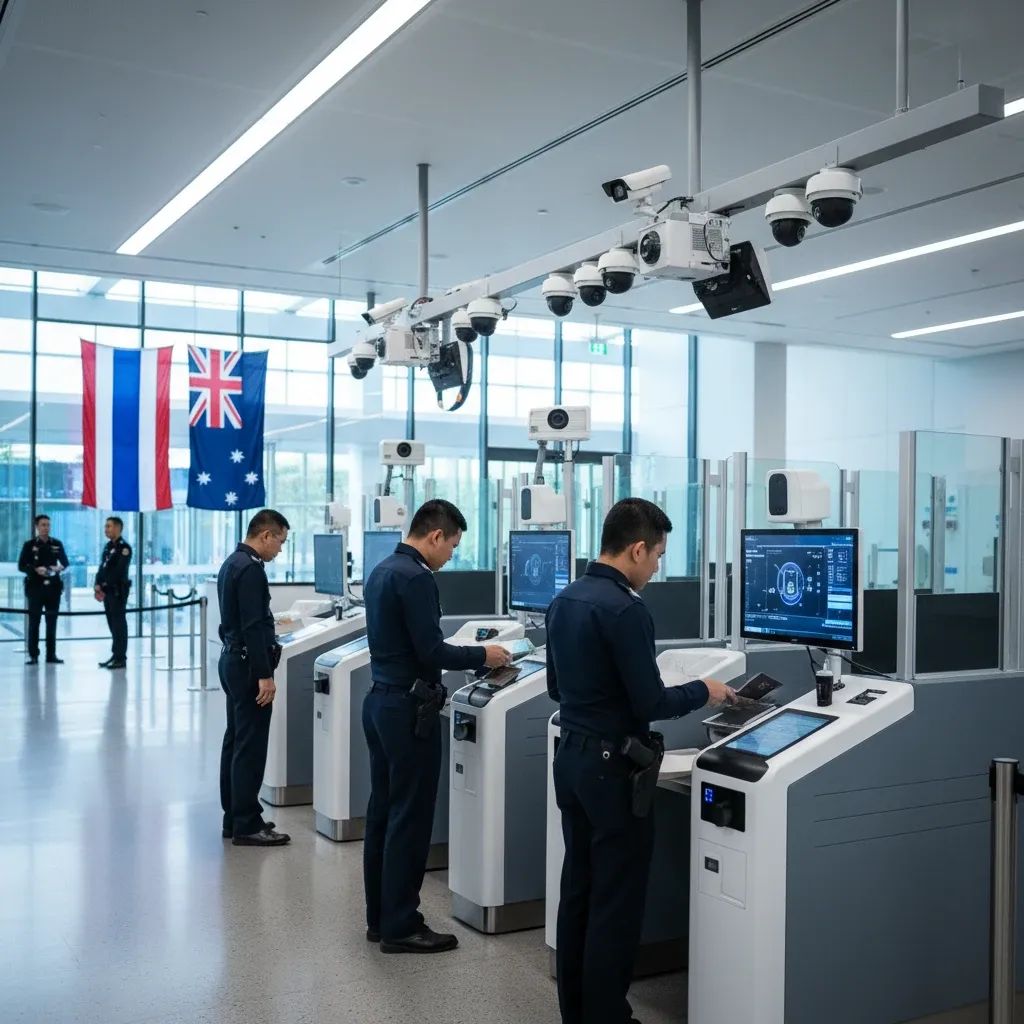
Thailand Immigration Police have detained a 57-year-old Australian national in Khon Kaen province, a case that underscores the country's increasingly robust enforcement posture against foreign fugitives exploiting Southeast Asia as a safe haven. The arrest, carried out on April 28 in a coordinated dawn operation, marks another high-profile capture in Thailand's zero-tolerance campaign against transnational criminals—particularly those wanted for crimes against children.
Why This Matters
• Foreign fugitive networks: The case highlights Thailand's role as both a transit hub and destination for international offenders, prompting heightened scrutiny of visa overstays and border controls.
• Extradition pathway: Thailand and Australia maintain a modernized extradition framework under the Extradition Act 1988, enabling swift legal processing for serious offenses.
• Child protection priority: Thai authorities treat child exploitation cases as top-tier enforcement targets, reflecting commitments under regional anti-trafficking agreements.
The Arrest: A Five-Month Manhunt Ends in Khon Kaen
Richard Carl Skrinjar was taken into custody without resistance at a residence in Ban Ped subdistrict, Mueang district, where he had been living with a Thai partner. According to Thai immigration officials, Skrinjar entered Thailand after a grueling solo maritime journey of approximately 5 months, eventually docking his vessel in Prachuap Khiri Khan province on the Gulf of Thailand coast before traveling inland to the northeastern region.
The operation was the result of intelligence-led collaboration between the Thailand Immigration Bureau, the Australian Federal Police (AFP) Bangkok office, and other Australian law enforcement agencies. Skrinjar had been listed on an INTERPOL Green Notice issued on April 9—a warning mechanism used to alert member countries about individuals who pose a cross-border criminal threat, particularly repeat offenders in sexual abuse cases.
At the time of arrest, Skrinjar was found in possession of a canceled Australian passport and was in violation of Thailand's immigration laws due to overstaying his permitted duration. During the raid, officers reported that Skrinjar attempted to destroy a laptop, an act investigators believe was intended to eliminate potential evidence of ongoing criminal activity.
A Convicted Offender on Australia's Sex Registry
Skrinjar's criminal record in Australia spans nearly 15 years, with convictions recorded between 2007 and 2021 for a range of serious offenses. He is registered on Australia's national sex offender registry and has been convicted of:
• Sexual abuse and indecent acts involving children
• Production and possession of child sexual abuse material
• Physical assault
• Drug-related offenses
Australian authorities had issued an arrest warrant for Skrinjar after he allegedly breached probation conditions that required him to remain in Australia and regularly report his whereabouts to law enforcement. Despite these legal obligations—binding for life following his release from custody—Skrinjar fled the country. His passport was subsequently canceled by Australian officials to restrict further international movement, though by that time he had already embarked on his maritime escape.
In post-arrest questioning, Skrinjar reportedly confessed that he fled to Thailand because he "missed his Thai girlfriend" and was fully aware of his legal obligations to remain under supervision in Australia.
What This Means for Residents and Expats: Practical Guidance
For foreign nationals living in Thailand, this case signals that Thai immigration enforcement is tightening its net around fugitives exploiting visa loopholes or overstay privileges. The Immigration Bureau has reiterated its zero-tolerance policy toward the use of Thailand as a refuge for international criminals, particularly those involved in child exploitation, drug trafficking, and human trafficking.
Actionable Steps for Expats:
If you're an expat living in Thailand with any unresolved legal matters in your home country, here's what you should know:
• Check for notices: Contact your home country's law enforcement or judicial authorities to verify whether any warrants, arrest notices, or probation conditions are active against you. Thailand participates in INTERPOL networks, meaning such notices will likely flag you during immigration processing.
• Understand overstay consequences: Overstaying your visa in Thailand carries penalties of up to 20,000 baht per day and can result in deportation, multi-year entry bans, and blacklisting from future visa applications. Conviction for overstay is also recorded on your immigration file.
• Visa renewal and extension: Any outstanding legal issues from your home country can complicate or deny visa renewals and extensions. Immigration officials now routinely cross-reference international databases before processing applications.
• Documentation: Maintain proper passport status, visa documentation, and travel permits. Using expired or canceled travel documents—as Skrinjar did—constitutes an additional immigration violation.
The arrest also reflects the operational reach of INTERPOL notices within Thailand. A Green Notice, while not an arrest warrant, serves as a global alert system that prompts local authorities to monitor and detain individuals flagged for repeated or serious criminal behavior. Expats with outstanding legal issues in their home countries should be aware that Thailand actively cooperates with foreign law enforcement agencies and participates in international intelligence-sharing networks.
For parents and child protection advocates, the case reinforces Thailand's commitment to regional anti-trafficking frameworks, including the ASEAN-Australia Counter-Trafficking Initiative and the Mekong Australia Partnership on Transnational Crime (MAP-TNC), both of which prioritize child sexual exploitation as a top enforcement area.
Legal Processing and Extradition Outlook
Skrinjar is currently being held in Thai custody for legal processing on immigration violations, including overstaying and possessing a canceled travel document. However, the more consequential legal proceedings will involve extradition to Australia, where he faces outstanding warrants for probation breaches and potentially additional charges.
Thailand and Australia operate under a bilateral extradition treaty governed by Australia's Extradition Act 1988 and Thailand's Extradition Act 2551 (2008). The framework allows for expedited transfer of individuals accused of serious crimes, provided the offense carries a penalty of at least 1 year imprisonment in both jurisdictions. Importantly, the treaty includes safeguards that prohibit extradition if the individual faces the death penalty—a clause that protects defendants in Thailand's capital punishment cases but is not relevant here, as Australia abolished the death penalty decades ago.
Beyond extradition, the two countries maintain a Treaty on Mutual Assistance in Criminal Matters, signed in 2006, which facilitates evidence sharing, document service, search and seizure coordination, and asset forfeiture measures. This means Australian prosecutors can request Thai authorities to provide forensic evidence, witness testimony, and digital records to support prosecution efforts once Skrinjar is returned.
Thailand's Role in Regional Child Protection Enforcement
The arrest is part of a broader pattern. Thai authorities have increasingly positioned the country as a frontline enforcer in Southeast Asia's fight against child exploitation and human trafficking. The Royal Thai Police collaborates with the AFP under initiatives like Operation Taskforce Storm, a joint effort targeting transnational crime networks operating across the Mekong region.
Australia has invested heavily in building Thailand's investigative capacity through training programs in digital forensics, cryptocurrency tracking, and victim assistance protocols. A Thai Centre of Excellence to counter trafficking in persons (TIP) was established with Australian support, and a new training center launched in November 2022 focuses specifically on human trafficking and child protection.
The Mekong Australia Partnership on Transnational Crime (MAP-TNC), scheduled to run from 2025 to 2029, will further deepen bilateral cooperation in areas including information sharing, border management, and cross-border investigations. Child sexual exploitation is one of three priority areas under this framework, alongside narcotics and financial crime.
Why Thailand Remains a Target for Fugitives—and Why That's Changing
Thailand's geographic position, relatively affordable cost of living, and ease of visa access have historically made it an attractive destination for foreign nationals seeking anonymity. However, the country's law enforcement apparatus has evolved significantly in recent years, with the Immigration Bureau adopting data-driven tracking systems, enhancing airport biometric screening, and participating in INTERPOL's global alert networks.
The Green Notice system, in particular, has proven effective in flagging high-risk individuals before they can establish long-term residency. In Skrinjar's case, the notice issued on April 9 provided critical early warning that allowed Thai and Australian agencies to coordinate surveillance and execute the arrest within less than three weeks.
For expats and tourists, the takeaway is straightforward: Thailand is no longer a low-scrutiny jurisdiction for fugitives. The country's integration into international law enforcement frameworks means that individuals with active warrants, canceled passports, or unresolved probation conditions are increasingly likely to be identified and detained.
Next Steps and Ongoing Coordination
Thai authorities are expected to finalize immigration-related charges against Skrinjar in the coming days, after which formal extradition proceedings will begin. The Office of the Attorney General, which serves as Thailand's Central Authority for mutual legal assistance, will coordinate with Australian counterparts to prepare the extradition request.
Given the seriousness of Skrinjar's offenses and the strength of the bilateral treaty, legal observers anticipate a smooth and expedited extradition process. Once returned to Australia, he will face prosecution for probation violations and may be subject to additional charges if new evidence is uncovered during the investigation.
The case serves as a potent reminder that Thailand's borders are not beyond the reach of international law—and that the country's cooperation with foreign agencies is both deepening and accelerating.


