
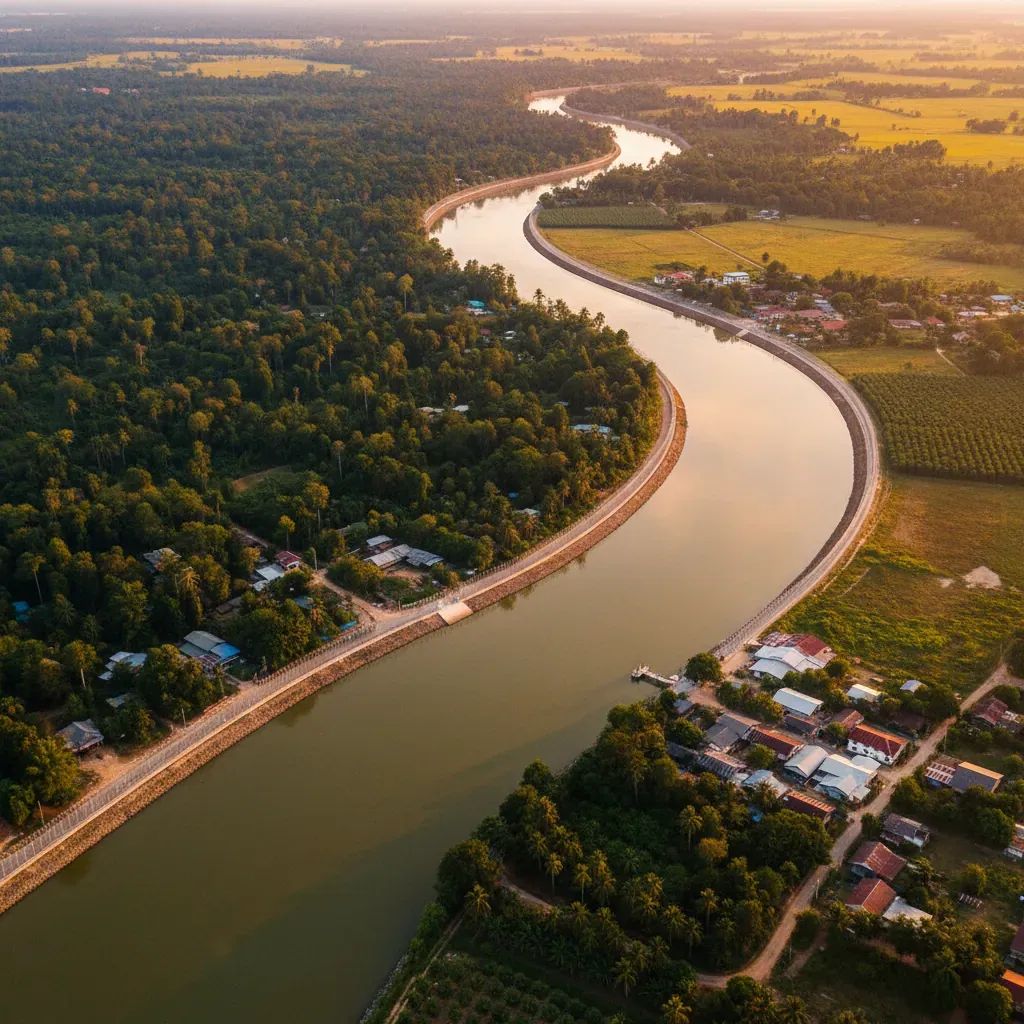
Malaysia's General Operations Force is requesting more funding to extend barbed-wire barriers across 69 remaining unauthorized crossing points along the Golok River, which divides Kelantan state from Thailand's Narathiwat province. This expansion follows the successful completion of a 1.5-kilometer pilot stretch that closed 27 illegal jetties, a move that has already forced smuggling syndicates to alter their tactics and shift operations to alternate routes.
Why This Matters
• Border enforcement tightening: Malaysia is systematically sealing informal river crossings used for contraband, drug trafficking, and human smuggling — reducing cross-border crime that affects southern Thailand.
• Phase one completed: The initial 1.5 km barrier was installed from Rantau Panjang to Pos Ibrahim Pencen before Ramadan, with phase one expected to be completed by February 2026.
• Long-term plan: A 1.5 billion ringgit (roughly 350M USD) security wall spanning 50 km is currently in procurement and bidding phase as of early 2026, designed to double as flood protection infrastructure.
• Thailand backing the project: Thai police and the 4th Army Region have publicly endorsed Malaysia's barrier plans, viewing them as a shared benefit in curbing illegal movements.
Smugglers Shifting to Sea Routes
Early results from the concertina-wire installations show that criminal networks are adapting. Intelligence gathered by the General Operations Force (GOF) indicates that syndicates previously operating along the Golok River have redirected their activities to the Kelantan River coastline, using sea landings instead of overland trails. While this displacement confirms the deterrent effect of the new barriers, it also underscores the fluid nature of cross-border crime and the need for comprehensive maritime and land surveillance.
Malaysian authorities note that continuous deployment of GOF personnel at fortified posts has so far prevented breaches at the newly fenced segments, but the existence of dozens of unprotected "rat routes" upstream and downstream remains a vulnerability. The pending 69-site expansion aims to close that gap entirely.
Thailand's Parallel Efforts and Joint Coordination
Thailand is not a passive observer. Bangkok has been rolling out its own electric fencing and CCTV camera networks along stretches of the Thai side of the border, targeting the smuggling of migrant workers, weapons, and narcotics. A 2018 Memorandum of Understanding between the two governments laid the groundwork for a jointly funded and maintained single barrier at key checkpoints, including the busy Dannok/Bukit Kayu Hitam crossing.
Lieutenant General Paisan Nusang, commander of Thailand's 4th Army Region, has publicly stated that Thailand respects Malaysia's sovereign decision to dismantle illegal crossings and views the initiative as a positive step for bilateral border management. Thai police in Narathiwat have similarly voiced strong support, particularly for the planned 50 km security wall, which they believe will reduce the flow of contraband into southern Thai provinces.
Both nations maintain regular consultations through the General Border Committee (GBC) and Regional Border Committees (RBCs), forums that address mutual security concerns, intelligence sharing, and infrastructure projects. Recent high-level meetings have prioritized expediting connectivity projects — such as bridges and road alignments — to facilitate legitimate trade and tourism while simultaneously hardening defenses against illicit activity.
What This Means for Residents
For those living in border provinces like Narathiwat, Songkhla, and Yala, these measures translate into tighter checkpoints and potentially slower movement at informal crossings that have historically served local communities for trade and family visits. Residents who relied on informal river ferries or small jetties for daily commerce may need to redirect trips to official immigration posts, adding time and cost.
For daily crossers, the main official checkpoints remain at Sungai Kolok-Rantau Panjang and other designated immigration posts where residents can continue legitimate cross-border movement.
On the upside, sustained reduction in smuggling and trafficking is expected to lower crime rates and improve safety in borderlands that have long grappled with violence linked to contraband networks and separatist activity. The planned 50 km wall, once operational, will also serve as flood mitigation infrastructure, a critical benefit for communities along the low-lying, flood-prone Golok River basin.
Travelers should anticipate increased scrutiny at legitimate crossings as both countries streamline enforcement and consolidate border control under unified command structures, implementing standardized procedures.
Broader Security Overhaul in Motion
The wire installations are one layer of a multi-tier border transformation. Beyond physical barriers, Malaysia is exploring advanced technological solutions, including sensor networks and drone surveillance, to monitor remote stretches of the frontier. The 1.5 billion ringgit wall project, currently in procurement and bidding phase as of early 2026, remains positioned as a strategic deterrent and a symbol of Kuala Lumpur's commitment to ending the region's reputation as a porous corridor for organized crime.
For Thailand, the cooperation signals a pragmatic alignment with a neighbor that shares vulnerability to the same transnational threats: methamphetamine flows from the Golden Triangle, people smuggling from Myanmar and Bangladesh, and arms trafficking linked to insurgent groups. By endorsing and mirroring Malaysia's hardline approach, Thai authorities are betting that synchronized enforcement will yield better outcomes than unilateral action.
The Golok River, historically a lifeline for commerce and cultural exchange, is being redefined as a controlled boundary. Whether that shift ultimately enhances security without strangling legitimate cross-border life will depend on how well both governments balance enforcement with the needs of communities that straddle the line.


