
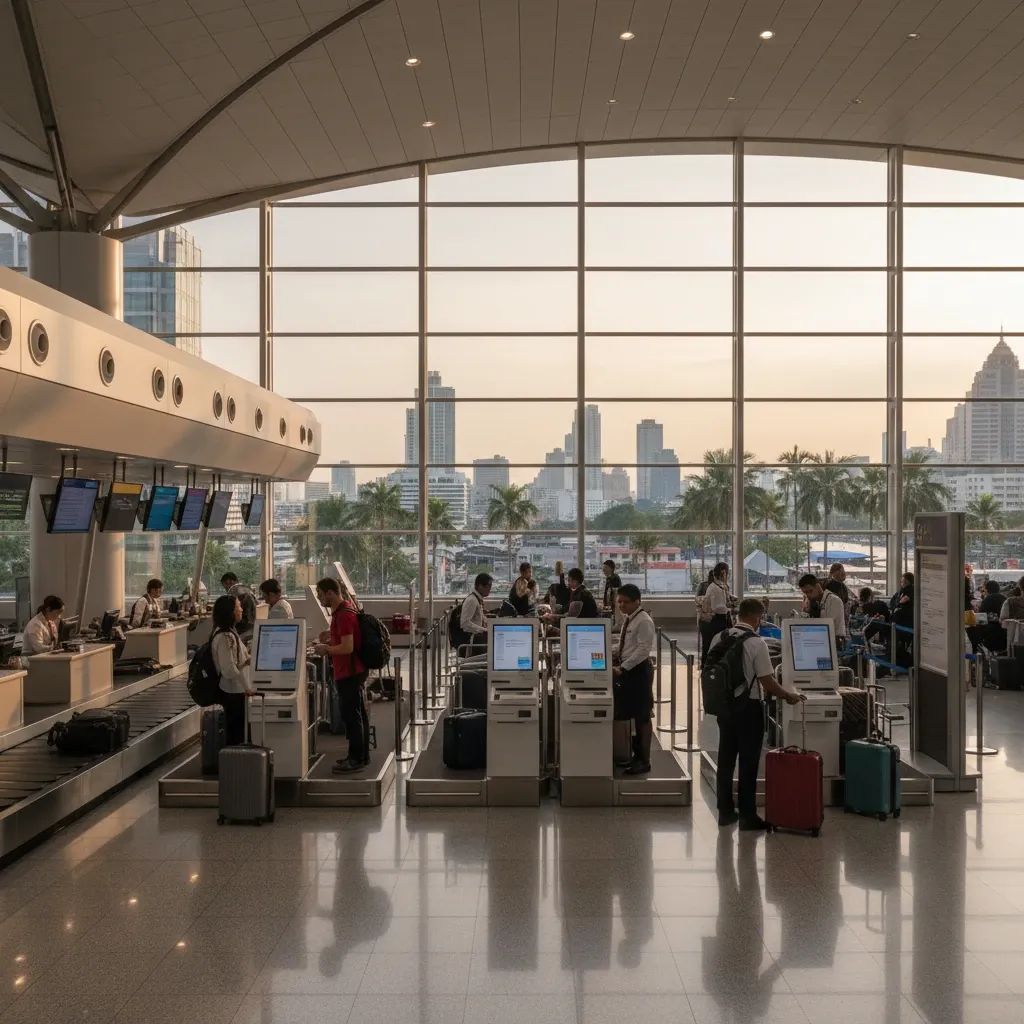
Airports of Thailand (AOT) will implement a 53% increase in international departure fees starting June 20, 2026, raising the Passenger Service Charge (PSC) from ฿730 to ฿1,120 across six major Thai airports. This adjustment—equivalent to roughly $31—marks a strategic pivot in aviation finance that raises fundamental questions about revenue diversification, regional competitiveness, and whether Thai airports are leaning too heavily on passengers themselves to fund expansion.
Why This Matters
• Your ticket just got pricier: International departures from Suvarnabhumi, Don Mueang, Phuket, Hat Yai, Chiang Mai, and Chiang Rai airports will cost an additional ฿390 per person starting mid-2026.
• Regional comparison: Thailand's new rate will exceed Manila (฿570), Kuala Lumpur (฿381-฿555), and Jakarta (฿41-฿61), but remain below Singapore Changi's current ฿1,230 fee.
• Revenue windfall: AOT projects the increase will generate an additional ฿10-13B annually, earmarked for terminal expansions, digital upgrades, and security modernization.
• Low-cost carrier squeeze: Budget airlines operating regional routes may face margin pressure, potentially triggering frequency cuts or route reallocations.
The Revenue Balance Question
Airport finance globally splits into two streams: aeronautical revenue (passenger fees, landing charges, airline service fees) and non-aeronautical revenue (retail, duty-free, property leasing, advertising, hospitality). Leading international hubs have aggressively expanded the latter category in recent years, recognizing that commercial ecosystems generate higher margins without directly inflating perceived travel costs. The more robust an airport's retail and real estate engine, the less pressure exists to raise passenger charges.
AOT's current revenue structure reveals a system still recovering from pandemic disruptions. During the first nine months of fiscal year 2025 (October 2024 to June 2025), the operator reported ฿52.32B in total revenue. For the three months ending March 2025, non-aeronautical income stood at ฿8.52B—a 13.69% year-over-year decline driven primarily by reduced duty-free concession returns. AOT has publicly stated a strategic target of achieving a 50:50 aeronautical-to-non-aeronautical revenue split, up from a pre-COVID ratio of 56:44. Analysts predict non-aeronautical income will trend toward 45-50% of total revenue in 2025-2026 as retail, food and beverage, and property yields normalize with higher spend per passenger.
Yet the PSC increase suggests that Thailand's airport revenue diversification remains incomplete. If commercial operations—retail, property development, digital platforms, parking concessions—were generating adequate margins, the urgency to impose a 53% passenger fee hike would be substantially lower. The policy decision essentially signals that aeronautical charges remain the primary lever for funding large-scale capital projects, including the Suvarnabhumi Satellite Terminal 1 (SAT-1) construction and Don Mueang terminal modernization.
Regional Competitiveness at Stake
Thailand has long marketed itself as a value-for-money destination, a positioning that begins not at the hotel reception desk but during the initial flight price comparison. In Southeast Asia's fiercely competitive short-haul market—where Bangkok, Kuala Lumpur, Singapore, Manila, and Ho Chi Minh City compete for the same regional travelers—even marginal cost differences can influence routing decisions.
The Thailand PSC increase places the country at the higher end of regional departure fees, trailing only Singapore Changi (which will rise to ฿1,548 by 2031). By contrast:
• Kuala Lumpur (KLIA): ฿381-฿555 depending on terminal
• Manila (NAIA): ฿570 (increased September 2025)
• Hanoi (Noi Bai): ฿900
• Ho Chi Minh City (Tan Son Nhat): ฿648
• Jakarta (Soekarno-Hatta): ฿41-฿61
• Phnom Penh: ฿1,080 for foreigners
For low-cost carriers (LCCs)—which dominate intra-ASEAN travel—this matters considerably. Budget airlines operate on razor-thin margins where a ฿390 fee increase can translate to a 7-10% rise in total one-way ticket costs for short regional hops. If neighboring countries maintain lower fee structures while Thailand raises barriers, airlines may gradually shift capacity allocation, reduce frequencies, or favor alternative hubs for connecting traffic.
Suvarnabhumi Airport handled 62.2M passengers in 2024, placing it second in Southeast Asia behind Singapore Changi's 67.7M. Thailand's six AOT airports collectively processed over 52M passengers in the first half of 2024 alone, with 32.05M international travelers. The volume underscores Thailand's role as a regional aviation anchor—but also highlights the vulnerability if cost competitiveness erodes.
The "User Pays" Principle vs. Tangible Improvements
Proponents of the PSC increase invoke the "user pays" principle: those who use infrastructure should contribute to its financing. This logic is economically sound in theory. However, public and traveler acceptance hinges less on economic theory and more on observable service improvements.
If the additional ฿10-13B annually translates into measurably shorter immigration queues, reduced terminal congestion, faster baggage handling, and seamless digital check-in experiences, the fee hike may be perceived as a justified investment. If those improvements fail to materialize—or if service quality stagnates—the charge risks being viewed as a revenue grab rather than a service upgrade.
The Thailand Civil Aviation Authority approved the increase on December 3, 2025, with a second confirmation on February 20, 2026. AOT has committed funds toward:
• Suvarnabhumi Satellite Terminal 1 (SAT-1) construction, targeting 80M annual capacity by 2031
• Don Mueang terminal modernization
• Enhanced security systems and digital passenger platforms
• Regional airport upgrades at Phuket, Chiang Mai, Chiang Rai, and Hat Yai
Regulatory authorities have indicated they will monitor passenger traffic and airline operational data post-implementation and may reassess the fee structure if evidence suggests significant demand suppression or connectivity degradation.
What This Means for Residents
For Thailand-based expats, frequent travelers, and business professionals, the PSC increase has several practical implications:
• Budget accordingly: International departures will cost an additional ฿390 per trip starting mid-2026. For families or frequent flyers, this adds up quickly across multiple trips.
• Ticket price opacity: Since PSC is embedded in ticket prices, the increase may not be immediately visible during booking. Compare total costs rather than base fares when shopping for flights.
• Low-cost carrier pricing: Budget airlines may absorb part of the increase initially but are likely to pass costs to consumers over time through fare adjustments or ancillary fee hikes.
• Regional alternatives: For flexible travelers, consider departure from Kuala Lumpur, Penang, or other regional hubs if total journey cost becomes a deciding factor, especially for short regional trips.
• Service expectations: Hold AOT accountable for the promised improvements. The justification for this fee rests on tangible infrastructure upgrades—residents should expect faster processing, reduced congestion, and better facilities.
Domestic travel remains unaffected: the domestic PSC stays at ฿130 per person. Transit passengers currently face no additional fees in Thailand, unlike Singapore, which charges escalating transit fees (rising to ฿477 by 2031) or Kuala Lumpur (฿220 for transfers).
Strategic Shift or Stopgap Measure?
A deeper question embedded in the PSC debate is whether Thailand is consciously transitioning from a volume-driven tourism model to a value-driven strategy. If the long-term policy objective is attracting higher-spending visitors—luxury tourists, digital nomads, medical travelers—then moderate cost increases may be sustainable. The country could tolerate slightly lower visitor volumes if per-capita spending rises.
However, much of Thailand's tourism infrastructure—from beach resorts to street food vendors—remains heavily dependent on high visitor volumes and price-sensitive markets. If structural travel costs rise while tourism messaging still emphasizes affordability, the mismatch could create friction throughout the value chain.
The PSC increase is not merely an aviation matter; it intersects directly with national tourism strategy, foreign investment policy, and economic positioning. AOT's ability to demonstrate revenue diversification progress will determine whether future infrastructure funding requires repeated passenger fee hikes—or whether commercial operations can shoulder a greater share.
The Bigger Picture
Ultimately, the debate transcends the ฿390 per-passenger surcharge. It centers on whether Thailand's airport revenue model is sufficiently diversified and sustainable for long-term growth—or whether escalating passenger fees represent the path of least resistance rather than strategic necessity.
Maybank Investment Bank, a leading Southeast Asian financial institution, projects AOT's overall earnings for fiscal year 2025 will grow 22% year-over-year, driven by recovering passenger traffic and retail normalization. Yet the fact that AOT still requires a 53% PSC increase to fund capital projects suggests the 50:50 revenue diversification target remains aspirational rather than operational reality.
Whether this policy strengthens Thailand's competitive position—or signals the need for deeper structural reform beyond fee adjustments—will become clear in the quarters following implementation. For now, travelers departing Thai airports after June 20, 2026, will pay noticeably more, and the question of value delivered for fees charged will define public and industry sentiment toward AOT's financial strategy.


