
Thai Navy Defends Plan for Additional AWAV Procurement to Strengthen Eastern Border Operations
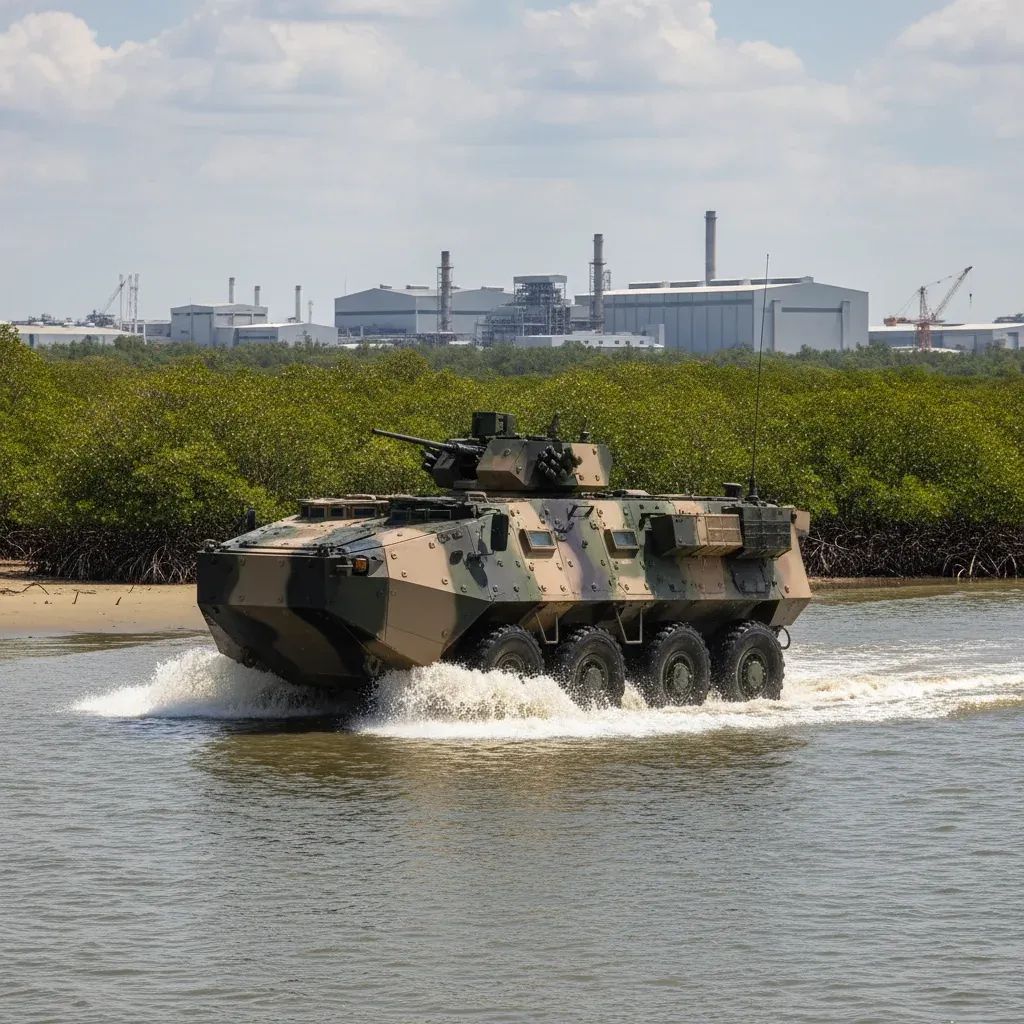
On April 27, 2026, the Royal Thai Navy publicly defended its decision to procure additional AWAV 8x8 amphibious vehicles manufactured by Chaiseri Metal and Rubber Co Ltd, citing operational validation and eastern border security requirements. Rear Admiral Paratch Rattanachaiphan, Navy spokesperson, confirmed that the initial batch of seven AWAV vehicles—delivered in September 2024 at a total cost of 448M baht (approximately 64M baht per unit)—has exceeded performance expectations during 18 months of operational service across Thailand's eastern maritime zones.
The procurement defense signals the Navy's confidence in continuing its commitment to building indigenous defense capacity rather than perpetually importing foreign military hardware. However, the decision to publicly justify the additional purchase indicates that questions or scrutiny surrounded the expansion, prompting formal Navy statements at headquarters.
Why the Navy Defended This Purchase
The eastern maritime zones present specific operational challenges that the AWAV platform addresses. Trat, Chachoengsao, and Ranong provinces feature complex coastal terrain—mangrove swamps, river deltas, and scattered outposts across 600-plus kilometers of coastline. The Navy emphasized that the seven existing AWAV vehicles have proven effective for:
• Border patrol operations: Seamless transitions from sea to land without logistical delays, enabling rapid response across estuary systems and muddy riverine terrain typical of the eastern border.
• Emergency response capability: Amphibious vehicles function as mobile lifelines during monsoon seasons, delivering supplies and evacuation capacity when roads submerge and conventional vehicles cannot operate.
• Integrated command operations: The vehicles' secure military communications systems link directly with patrol boats, helicopters, and shore command posts—critical when responding to incidents in remote coastal zones.
After 18 months of service, the fleet has logged no catastrophic failures, providing baseline operational validation that justifies expanded deployment.
Technical Specifications and Operational Capabilities
The AWAV 8x8 represents a hybrid engineering model: Thai-designed platform, locally manufactured chassis. The vehicle uses a 711-horsepower diesel engine driving an 8x8 all-wheel-drive system, achieving 105 km/h on land and 10 km/h in water via a water-jet propulsion system engineered by Thai technicians at Chaiseri. Its 600-kilometer operational range covers the sprawling geography of the eastern maritime zone.
The platform carries 11 troops plus a three-person crew across severe terrain: it climbs 60-degree slopes, negotiates jungle trails using crab-walk lateral steering, and fords rivers up to 1.5 meters deep without bridge infrastructure. Factory trials confirmed the AWAV completed 200-kilometer continuous road runs, two-hour open-sea maneuvers, and obstacle courses simulating eastern Thai forest terrain.
Defensively, the platform meets STANAG 4569 Level 2 ballistic protection (withstanding 7.62mm armor-piercing ammunition) and Level 3b blast resistance (surviving anti-tank mine detonations)—significant for eastern border zones where ordnance contamination persists from the Cambodia conflict era. The vehicle is outfitted with Spain's Guardian 1.5 remote weapon station, mounting a 12.7mm heavy machine gun and 76mm smoke-grenade launchers.
Industrial Policy Context: Domestic Content Requirements
The AWAV procurement aligns with Thailand's broader defense manufacturing strategy. The Navy emphasized that expanding the domestic fleet reduces dependency on foreign suppliers while sustaining local manufacturing networks in metal fabrication, hydraulics, and engine assembly concentrated in Samut Prakan and Chachoengsao provinces.
The procurement reflects a policy commitment to increase domestic defense production and reduce vulnerability to foreign export restrictions or political leverage that could freeze military acquisitions mid-project. However, specific targets for domestic-content percentages or timeline projections were not detailed in the Navy's April 27 statement.
Chaiseri's Production Track Record
Chaiseri Metal and Rubber Co Ltd has delivered or upgraded over 1,500 military vehicles, establishing production discipline. The company's First Win 4x4 MRAP (Mine-Resistant Ambush-Protected vehicle) has been procured by the Thai Army in multiple tranches, and the company has exported armored platforms under various brand names to over 40 countries across six continents.
Pakistan's Heavy Industries Taxila recently contracted for similar vehicle designs under a co-production agreement, demonstrating that Thai-origin platforms attract international interest.
What This Means for Eastern Border Residents
The Navy's expanded AWAV fleet directly affects residents in border provinces. Enhanced patrol coverage and emergency-response capacity during monsoon flooding provides more rapid assistance to coastal and island communities. These vehicles enable forces to transition seamlessly from naval operations to overland emergency response—critical when responding to incidents in Trat, Chachoengsao, and Phang Nga provinces, where terrain alternates between mangrove swamps, rocky shores, and river deltas.
Budget Considerations and Future Procurement Trajectory
The Navy did not publicly disclose the size of the new procurement contract, though Rear Admiral Paratch indicated the order is "proportionate to operational requirements." Extrapolating from the 64M baht per-unit baseline, even a modest expanded order would require significant fiscal commitment competing against submarine maintenance, frigate upgrades, and personnel costs.
The AWAV procurement serves as a pilot for broader defense industrialization. If the expanded fleet performs reliably over the next 24–36 months, similar domestic-content-focused contracts will likely follow for patrol boats, artillery systems, and eventually frigate modules.
The seven AWAV vehicles already deployed continue patrols along eastern maritime approaches—physical demonstration that defense procurement policy has transitioned from government planning into observable military capability operational in Thailand's border zones.


