
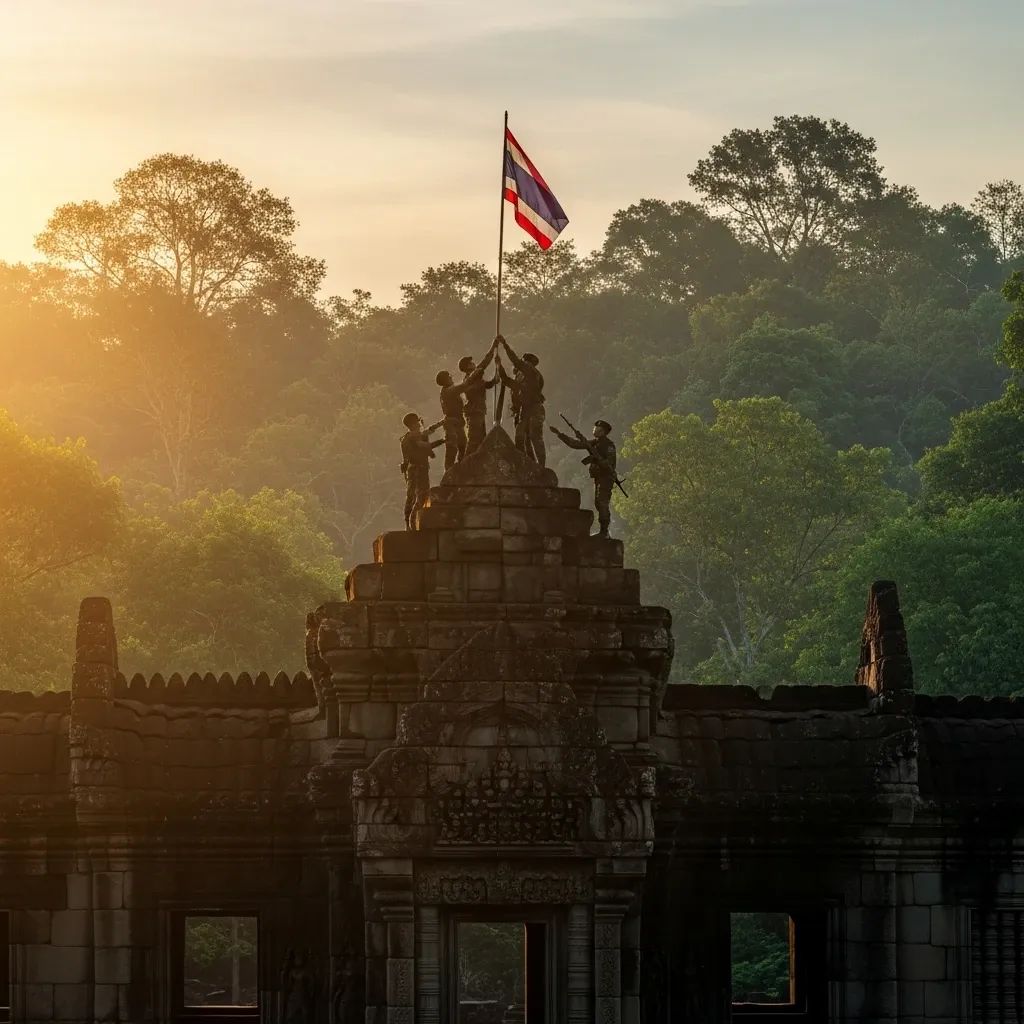
Securing the 10th-century Ta Khwai sanctuary that straddles the Thai-Cambodian frontier may have taken Thai soldiers only a weekend, yet transforming the battlefield back into a place of worship—and keeping it that way—now dominates Bangkok’s agenda.
At a Glance
• Thai troops retook Ta Khwai temple and nearby Hill 350 after two days of clashes.
• Cambodian units are massing artillery and BM-21 rockets within sight of the ruins, fuelling fears of a fresh assault.
• The Fine Arts Department will deploy an anastylosis team once the army declares the site safe.
• More than 4,000 villagers in Surin’s Phanom Dong Rak district remain under martial-law evacuation orders.
• Twenty-three foreign military attachés toured the border on Tuesday, underscoring the dispute’s international stakes.
Strategic Win Amid Unsettled Border
The Second Army’s lightning push delivered a symbolic victory for Bangkok, reclaiming a shrine that Cambodians had used as a forward operating base since early June. Yet drone footage captured Monday night shows fresh Cambodian trench lines, reminding commanders that territorial control here is fluid. Defence analysts in Khon Kaen warn that the skirmish sits on a larger chessboard: whoever dominates Hill 350 controls artillery angles on Provincial Route 24, the arterial road linking three Thai border districts with Buriram.
Inside the 48-Hour Operation
Military sources say the assault began before dawn on 14 December when 86th Infantry Battalion units crept through dry dipterocarp forest, bypassing mined trails flagged by blue-white UNESCO markers. By noon, precision mortar fire forced Cambodian troops to abandon the nave of the sanctuary. Engineers raised a yellow-red Thai flag over the lintel at 15:47 local time, triggering cheers on military radio. Army chief Gen Pana Klaewplodthuk later praised his troops for avoiding heavy calibres near ancient stonework, a decision he said “saved centuries-old bas-reliefs from irreversible blast damage.”
Cultural Heritage in the Crossfire
Conservationists call Ta Khwai a rare Khmer sandstone chapel whose carvings bridge pre-Angkorian and Baphuon styles. “When artillery shells detonate near porous laterite blocks, the shock waves cause micro-fractures that tourists will never see but future restorers must fix,” warns Suthida Worasap, a Silpakorn University archaeologist. Under the 1954 Hague Convention, combatants must protect cultural property; field lawyers argue that Phnom Penh forfeited that protection the moment it turned the temple into a logistics hub.
How Bangkok Plans to Bring Ta Khwai Back to Life
Fine Arts Department chief Phnombootra Chandrajoti confirmed a three-phase scheme: emergency stabilization, full anastylosis and long-term site management. Specialists will map every dislodged lintel, colonette and pediment with 3-D scanners before dismantling unstable sections. Replacement stones will be tagged so visitors can distinguish original material from new infill, mirroring successful work at Phanom Rung and Phimai. Budget talks are under way, but insiders expect a figure “north of ฿300 M” spread over five years, pending security guarantees.
Lives on the Move: Border Villagers in Limbo
For residents of Ban Khoke Charoen, artillery duels translate into sleepless nights and lost income. Local officials have trucked 2,800 head of cattle to makeshift corrals 30 km inland, while schools conduct classes via LINE video. “We pray the soldiers finish quickly so we can harvest cassava and jasmine rice before New Year,” says farmer Anurat Chanpok, speaking from a Red Cross shelter. The army has erected sand-filled Hesco barriers around the district hospital and imposed dusk-to-dawn curfews to curb looting in evacuated zones.
Phnom Penh’s Response and Global Optics
Cambodian Foreign Minister Sok Visal accuses Thailand of staging an “unprovoked raid” and has hired a Washington-based lobbying firm to press the case at UNESCO. Phnom Penh’s media outlets broadcast images of damaged stonework at distant Preah Vihear, hoping to rally global sympathy. During Tuesday’s border tour, however, diplomats from 23 countries photographed unexploded BM-21 rockets embedded in Thai cassava fields, a visual that Bangkok intends to submit to the International Court of Justice should the dispute escalate.
What to Watch Next
Thailand’s National Security Council meets Friday to calibrate both guns and glue—deterrence on the ridge, restoration in the sanctuary. Observers suggest keeping an eye on:
Artillery movements on the Cambodian side over the next 72 hours.
The army’s decision on a buffer zone that would let conservators work safely.
Funding allocations in the upcoming mid-year budget bill.
Potential ASEAN mediation, which Bangkok now views as a last resort.
Whether Ta Khwai can reopen for pilgrims and tourists by Songkran.
The next few weeks will reveal whether Ta Khwai becomes a beacon of cross-border cooperation—or slips back into the firing line.


