
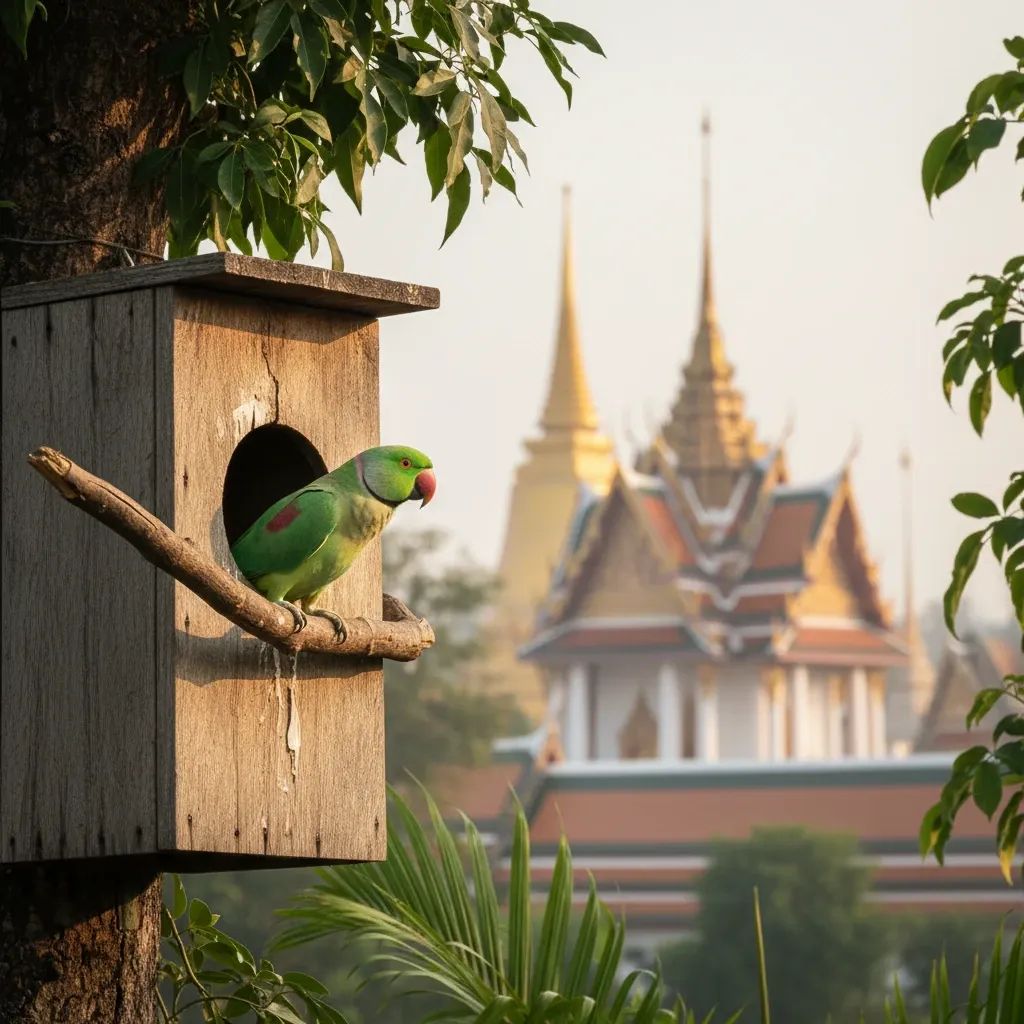
The Thailand Royal Forest Department's protected Alexandrine parakeet population has taken unexpected root in Nonthaburi and Pathum Thani provinces, sustained almost entirely by grassroots conservation centered around Buddhist temples—a conservation model that experts now regard as critical for urban biodiversity in Thailand's densely populated central corridor.
Why This Matters:
• Legal protection: The species is classified "Near Threatened" globally and Endangered nationally under the Wildlife Conservation and Protection Act of 2019—possessing or trading them is a prosecutable offense.
• Habitat pressure: Urban expansion has destroyed traditional nesting trees; artificial nests and temple sanctuaries are now the primary breeding sites for dozens of chicks annually.
• Invasive risk: Escaped pet parrots from illegal markets pose threats through resource competition, disease transmission, and genetic dilution of wild populations.
The Temple Sanctuary Model
Conservation efforts in Nonthaburi's Suan Yai Temple and Madua Temple represent a distinctly Thailand phenomenon: private citizens and monks collaborating to shelter wildlife within temple compounds, bypassing bureaucratic delays and funding shortages that typically stall government-led initiatives.
Jirawat Singhanin, vice president of the Alexandrine Parakeets Conservation Club, describes the approach as "custodianship by proximity." Residents near Suan Yai Temple in Bang Kruai District tolerate parakeets feeding on mango and guava crops, install wooden nest boxes on temple property, and educate schoolchildren about the birds' ecological role. In April 2024, the club reported approximately 30 chicks successfully hatched through artificial nest programs—a statistically significant reproductive rate for a species facing regional decline.
The model proved its resilience in September 2023 when Madua Temple agreed to delay felling dead Yang trees after conservationists documented 12 nesting pairs in the hollows. The intervention, supported by district forestry officers citing the 2019 Wildlife Act, set a precedent for balancing urban safety concerns with species protection—a compromise that had no legal framework just five years earlier.
What Escaped Pet Parrots Mean for Wild Populations
Thailand's central region faces an ecological curveball: pet parakeets, often sourced illegally from wild-caught stock, routinely escape or are released by owners. These birds now compete with native populations for tree cavities, fruiting trees, and feeding territories.
While no published research quantifies the specific impact in Nonthaburi, ecological principles borrowed from invasive species studies suggest three primary risks. First, resource competition: escaped exotics may occupy nesting sites faster during breeding season, particularly if they carry behavioral traits from captive environments. Second, disease vectors: domesticated birds can transmit Psittacosis (parrot fever) to wild flocks, a bacterial infection documented in Thailand bird markets but rarely monitored in field populations. Third, genetic dilution: if escaped birds interbreed with wild Alexandrine parakeets, hybrid offspring may carry reduced fitness traits, undermining long-term population resilience.
The Bird Conservation Society of Thailand (BCST) and the Office of Natural Resources and Environmental Policy and Planning (ONEP) both classify the species as Endangered domestically, a more severe designation than the IUCN's global "Near Threatened" status, reflecting the acute pressure in Thailand specifically.
Urban Expansion vs. Breeding Biology
Alexandrine parakeets require large, mature Yang trees (Dipterocarpus alatus) with natural hollows—structures that take decades to form and are increasingly rare in Thailand's rapidly urbanizing central provinces. Nonthaburi and Pathum Thani sit at the edge of Bangkok's metropolitan sprawl, where orchards are rezoned as housing estates and old-growth trees are removed for safety liability concerns.
The temples offer a biological loophole. Religious properties in Thailand are typically exempt from aggressive land development, and monks possess the authority to refuse tree removal requests from municipal agencies. This creates de facto wildlife corridors within otherwise hostile urban terrain.
Dr. Saranphat Suwannaratana, a wildlife ecologist who has advised Nonthaburi Province on the parakeet issue, notes that "the temple model is not scalable without legal reform." He points to the need for provincial zoning ordinances that mandate habitat impact assessments before tree removal permits are issued—a policy standard in some European capitals but absent in Thailand's municipal codes.
What Residents Should Know
The Thailand legal framework is clear: Alexandrine parakeets are protected wildlife, meaning possession, sale, or harm to the species is punishable by up to 5 years imprisonment and fines up to 500,000 baht under the 2019 Act. However, enforcement remains inconsistent. Bird markets in Bangkok and surrounding provinces continue to sell parakeets openly, often mislabeled as captive-bred imports to circumvent scrutiny.
For residents in Nonthaburi and Pathum Thani, the parakeets are both a conservation win and a practical nuisance. Flocks can strip a mango tree in an afternoon, and their loud calls at dawn irritate light sleepers. Yet community surveys conducted by the Alexandrine Parakeets Conservation Club in 2024 found that 68% of temple-adjacent households view the birds positively, associating them with "merit-making" and local environmental identity.
The provincial government has floated plans to market the parakeets as an eco-tourism draw, potentially generating revenue for temple maintenance and conservation programs. This model has precedent: Khao Yai National Park and Kaeng Krachan both leverage flagship bird species for visitor income, though neither faces the land-use conflicts inherent to urban settings.
The Role of Informal Conservation Networks
Unlike formal protected areas managed by the Department of National Parks, Wildlife and Plant Conservation, the Nonthaburi parakeet population owes its survival to individuals with no official conservation credentials. The gas-strut specialist mentioned in local reports—whose name has not been widely published—exemplifies this trend. Working weekends, he designed and installed wooden nest boxes modeled on natural tree cavities, adjusting entrance hole diameters and interior dimensions through trial and error.
This DIY conservation mirrors international urban parrot projects in cities like Barcelona, London, and Sydney, where escaped or naturalized parrot populations thrive due to citizen stewardship rather than government intervention. The World Parrot Trust's FlyFree Initiative, which focuses on rehabilitating trafficked birds, has suggested that Thailand could formalize these grassroots networks into a volunteer monitoring system, providing training and data collection tools to citizen conservationists.
Looking Ahead: Policy Gaps and Opportunities
As of February 2026, Nonthaburi Province has not enacted specific ordinances to protect parakeet habitat outside temple grounds. The Wildlife Conservation and Protection Act prohibits harm to protected species but does not compel habitat preservation on private or municipal land. This leaves the parakeets vulnerable to incremental habitat loss—one felled tree at a time.
Conservationists are lobbying for amendments to Thailand's Urban Planning Act that would require environmental impact assessments for developments in districts where endangered species have documented breeding populations. Such legislation exists in Australia and parts of the EU, where urban planners must demonstrate "no net loss" of critical habitat.
Meanwhile, the illegal pet trade continues unabated. Thailand law enforcement agencies seized 1,247 parrots in 2024, according to ONEP data, but prosecutions remain rare. Strengthening enforcement would require dedicated wildlife crime units and penalties severe enough to deter commercial traffickers—reforms that have gained traction in Southeast Asian policy circles but remain politically sensitive in Thailand.
Impact on Expats and Investors
For foreign residents and property developers in Nonthaburi and Pathum Thani, the parakeet issue has subtle but real implications. Land parcels near temple compounds may face development restrictions if breeding populations are documented, as occurred in Bang Bua Thong District when a housing project was delayed pending an ecological survey. Developers should budget for environmental due diligence and anticipate that temple authorities and conservation groups may challenge projects that threaten nesting trees.
On the positive side, properties marketed as "eco-adjacent" or near conservation zones command premium rents in Bangkok's expatriate market, where environmental amenities are increasingly valued. The parakeet sanctuary model could enhance neighborhood desirability if managed as a cultural and ecological asset.
For those interested in supporting conservation directly, the Alexandrine Parakeets Conservation Club accepts volunteer participation and donations, though it operates informally and lacks NGO registration. International conservation organizations like the World Parrot Trust also fund projects in Thailand, offering avenues for expats to contribute to urban biodiversity efforts.


