
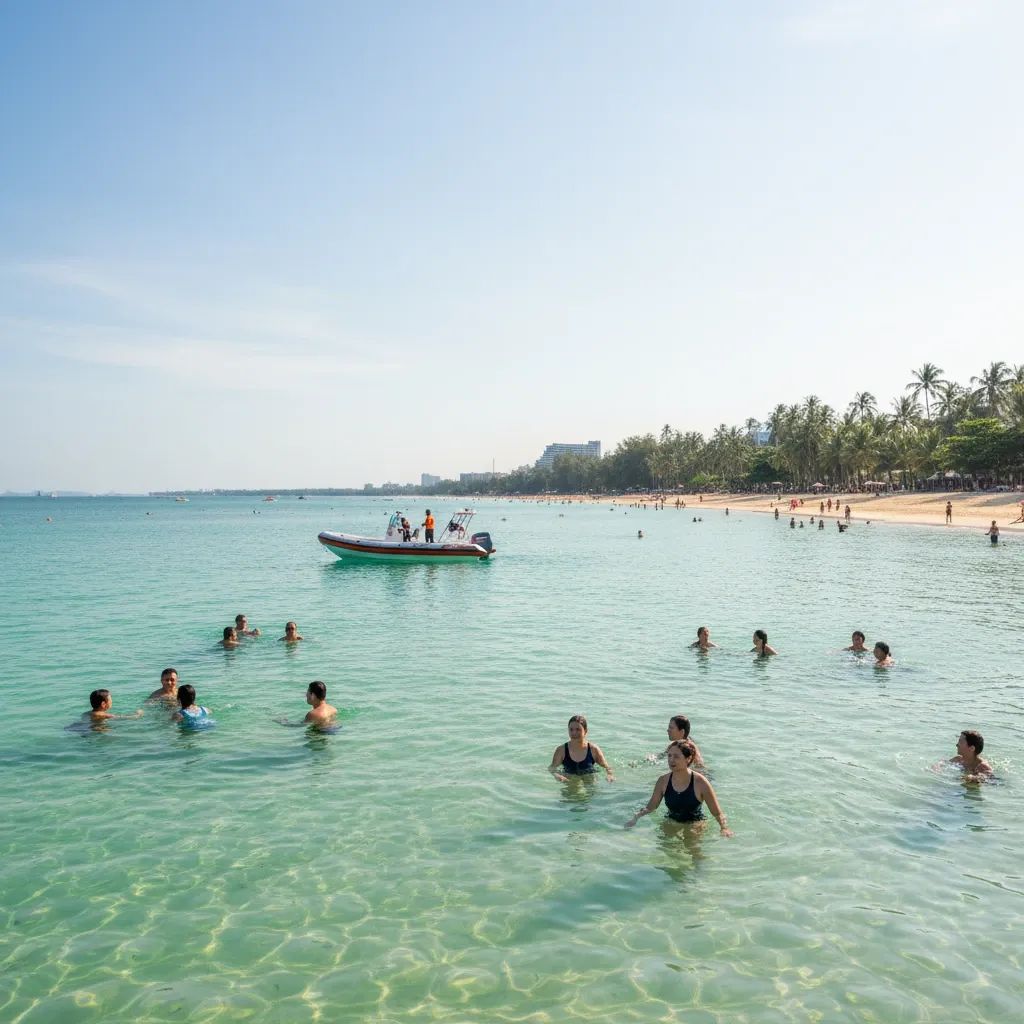
On April 21, a 62-year-old British tourist died in shallow water off Pattaya—not because he couldn't swim or because rescue teams failed, but because his body stopped obeying him exactly when he needed it most. The incident reflects a hard reality many residents and visitors often overlook: tropical beaches can turn lethal in minutes, even with bystanders watching and help arriving promptly.
Why This Matters
• Medical emergencies in water are invisible. Cardiac arrest, heat stroke, and sudden neurological events leave no warning signs. By the time someone realizes something is wrong, drowning has already begun.
• Informal rescue capacity has real limits. A nearby jet ski operator saved this man's life for the first few minutes—but that luck won't be available every time on every beach in Thailand.
• Pattaya's safety equipment inspections and ongoing upgrades don't guarantee protection. Equipment improvements and zoning regulations are meaningful steps forward, yet many beach sections still lack continuous professional surveillance.
The Moment Everything Changed
The victim, identified in reports as a 62-year-old British tourist, arrived at Pattaya Beach Road on an ordinary afternoon in late April. He had spent hours resting on the sand in temperatures exceeding 35°C, consuming alcohol to manage the oppressive heat—a combination that sets the stage for physiological collapse even if everything else goes right.
In the late afternoon, he waded into the sea perhaps five to six meters from shore, well within what anyone would call safe distance. Initial observations suggested nothing unusual. He appeared oriented, speaking coherently with other swimmers nearby. Then his body betrayed him. Witnesses described him appearing to lose consciousness abruptly before slipping face-down into the water.
A 25-year-old jet ski rental operator, positioned close enough to act, pulled the tourist from the sea and immediately began basic life support. When teams from Sawang Boriboon Thammasathan rescue foundation and Pattaya City Police arrived within minutes, paramedics initiated aggressive cardiopulmonary resuscitation on the beach. Medical personnel continued compressions inside the ambulance en route to hospital, and emergency staff maintained resuscitation efforts after arrival. The victim was pronounced dead shortly after hospital admission.
The Thailand Royal Police investigation is still examining what triggered his collapse. Toxicology results, autopsy findings, and detailed witness statements typically take weeks to compile. Investigators are considering cardiac arrest, heat-related illness, or a combination of factors—essentially, the categories that account for most sudden deaths in tropical water settings.
Why Strong Swimmers Die in Shallow Water
The victim's fate follows a predictable medical pattern that appears frequently in Thailand's coastal zones. The essential misunderstanding many visitors carry is that drowning happens when someone "can't swim." In reality, most fatal incidents occur when a competent swimmer encounters a sudden medical crisis that renders them physically incapable of staying vertical.
Cold-shock response initiates the cascade. When a warm body enters cool seawater, the nervous system reacts dramatically. Heart rate accelerates abruptly, breathing becomes involuntary and rapid, and blood vessels constrict unpredictably. For most people, this passes within seconds. For anyone with underlying cardiovascular vulnerability—undiagnosed hypertension, coronary artery disease, or arrhythmias—the shock can trigger fatal heart rhythms instantaneously.
Cardiac disease remains the leading medical cause of swimming-related death globally and carries particular weight in tropical regions. Middle-aged and older adults face heightened risk, yet many never receive a formal cardiac assessment. The exertion of swimming combined with heat exposure amplifies the strain on the heart. In this case, the victim's age bracket (62 years) places him in a higher-risk demographic for undiagnosed or pre-symptomatic cardiovascular disease.
Heat accumulation presents a slower but equally lethal pathway. Prolonged sun exposure, especially when combined with alcohol consumption (which impairs the body's temperature regulation), leads to progressive dehydration and core temperature elevation. Confusion, weakness, dizziness, and loss of consciousness can develop gradually or suddenly. Once incapacitation begins in the water, the outcome is nearly predetermined—a person cannot simultaneously manage altered consciousness and stay afloat.
Environmental triggers matter too. Strong currents, unexpected drop-offs, and even aggressive marine life (jellyfish stings, for instance) can incapacitate a swimmer instantly. In Pattaya's busy waters, collision with jet skis or banana boats remains a documented hazard, though less common than medical emergencies.
The mechanic is consistent across scenarios: the person does not drown because they lack swimming ability. They drown because a physiological catastrophe has stripped away their ability to remain conscious and vertical. Shallow water and daylight offer no protection against this mechanism. Nor do bystanders, unless they happen to be within arm's reach at the precise moment of collapse.
What This Means for Residents and Long-Term Visitors
This death carries practical implications for anyone who enters Thai waters:
Before entering: Conduct an honest assessment of your own cardiovascular fitness. Anyone with a history of high blood pressure, heart disease, or who takes cardiac medications should consult a physician before swimming in tropical heat. Ideally, this consultation happens before arriving in Thailand, not during your holiday.
Avoid alcohol near water. This is not moralism; it is physiology. Alcohol accelerates dehydration, impairs judgment about your physical state, and compromises the body's ability to regulate temperature. The combination of alcohol, heat, and seawater is statistically dangerous.
Acclimatization reduces risk. If you've spent hours in air-conditioned hotels or malls, allow your body gradual heat exposure before water immersion. The shock of rapid temperature change itself is a documented risk factor.
Understand the flag system. Red flags mean entry is prohibited. Yellow flags signal caution. Red-and-yellow flags designate lifeguard-patrolled zones where supervision is active. Green flags indicate safe conditions. If no flags are visible, assume no lifeguard coverage exists and plan accordingly.
Never enter the water alone. A sober companion observing from shore or from a proximate location can alert rescue personnel or initiate assistance. The victim had other swimmers and the jet ski operator nearby, yet remained vulnerable to sudden incapacitation. A dedicated observer—someone not distracted or intoxicated—significantly improves survival odds.
Recognize that commercial beaches differ from protected facilities. Pattaya's most popular beaches, despite genuine improvements in safety equipment and protocols throughout 2026, depend partly on informal rescue capacity from tourism operators. They are not equivalent to professionally staffed, continuously monitored beaches in Australia or Spain. Understand that you bear primary responsibility for your own safety.
Pattaya's 2026 Safety Improvements—Genuine Progress with Remaining Gaps
Deputy Mayor Kritsana Boonsawat toured marine rescue equipment in April 2026, publicly signaling the city's stated commitment to rapid emergency response. Equipment maintenance standards have been tightened. Rescue personnel receive regular training. The Pattaya Marine Department has reinforced beach zoning to separate swimming zones from jet ski and banana boat operations—a meaningful step toward reducing motorized craft collisions.
The Pattaya Smart Safety project, launched in March 2026, introduced QR codes at frequently reported problem locations. Patrol officers scan these codes to log complaints and identify patterns. The system is designed to support data-driven management, though it functions primarily as a reactive tool rather than a preventative intervention.
These measures represent genuine infrastructure advancement. Equipment that fails or delays response costs lives. Zoning that separates swimmers from motorized traffic prevents one category of incidents entirely. QR-based complaint tracking identifies systematic problems that pure anecdotal reporting would miss.
Yet lifeguard coverage remains inconsistent. Unlike Australia, where voluntary lifesavers and paid professionals patrol designated zones under rigorous protocols—or Spain, which mandates lifeguard presence from 11 a.m. to 7 p.m. during peak season—Thailand's approach remains geographically uneven. The Phuket Lifeguard Club, established in 2003, has successfully pushed toward international standards through collaboration with Surf Lifesaving Australia, but this model has not been systematically replicated across other popular destinations, including all sections of Pattaya.
The gap is significant. Dedicated lifeguards provide continuous water monitoring, rapid response positioning, and specialized rescue equipment that informal arrangements cannot match. Many Thai beach stretches—including portions of Pattaya—rely on proximity and chance. Rescue capacity depends on whether a hotel employee, jet ski operator, or volunteer foundation member happens to be nearby and alert.
These individuals are often remarkably competent. Sawang Boriboon Thammasathan personnel routinely demonstrate skilled emergency response. Yet no informal system consistently maintains the surveillance depth, response positioning, and specialized equipment that international standards consider essential.
How Other Countries Approach Beach Safety
Australia operates one of the world's most effective systems. Red-and-yellow flags designate zones patrolled by trained lifesavers (both volunteer and paid). Swimming outside these zones is discouraged. Lifeguards hold certifications like the Surf Life Saving Australia Bronze Medallion and advanced resuscitation training. The cultural rule is simple and enforced: swim between the flags, or expect no systematic rescue support. Lifeguard coverage is not universal across all Australian beaches, but on high-traffic zones, it is continuous and professional.
Spain requires lifeguards on major beaches from roughly 11 a.m. to 7 p.m. during June through September. A tiered flag system communicates conditions (green, yellow, red, purple for marine hazards). Lifeguards hold internationally recognized certifications, often through the American Lifeguard Association. Non-compliance with lifeguard instructions carries legal penalties.
United States coastal beaches rely on professionally trained ocean rescue personnel certified through programs like the U.S. Lifesaving Association. High-traffic zones receive continuous monitoring. Rescue equipment is staged, maintained, and immediately accessible. Lifeguards enforce flag protocols with legal authority.
Thailand combines trained lifeguards at select locations with formal flag warnings, but implementation is patchwork. The ISO 13009 standard for beach management—encompassing supervision, rescue readiness, signage, and water safety—is referenced but inconsistently applied. Many Thai beaches lack the full suite of preventative measures (continuous surveillance, rapid-response positioning, comprehensive emergency equipment staging) that international standards recommend.
The Aftermath and Investigation
The British Embassy in Bangkok has engaged with Thai authorities to assist the victim's family with repatriation and to navigate bureaucratic requirements surrounding death abroad. The Thailand Royal Police investigation will determine the precise sequence of events and likely cause—information that typically emerges over weeks or months.
For the broader expat and tourist communities across Thailand, this death reinforces an unwelcome reality: environmental beauty and commercial development do not eliminate biological risk. The sea in April remains the sea. Tropical heat remains thermally demanding. The human body, placed under enough physiological stress, can fail regardless of how close rescue personnel are stationed.
Infrastructure improvements in 2026 represent progress worth acknowledging. They do not, however, constitute a full international-standard safety net. Individual swimmers remain their own first and most important line of defense. Vigilance, honest self-assessment of personal health, and respect for the water's unpredictability are not optional precautions—they are essential practices for anyone who enters the sea in Thailand.


