
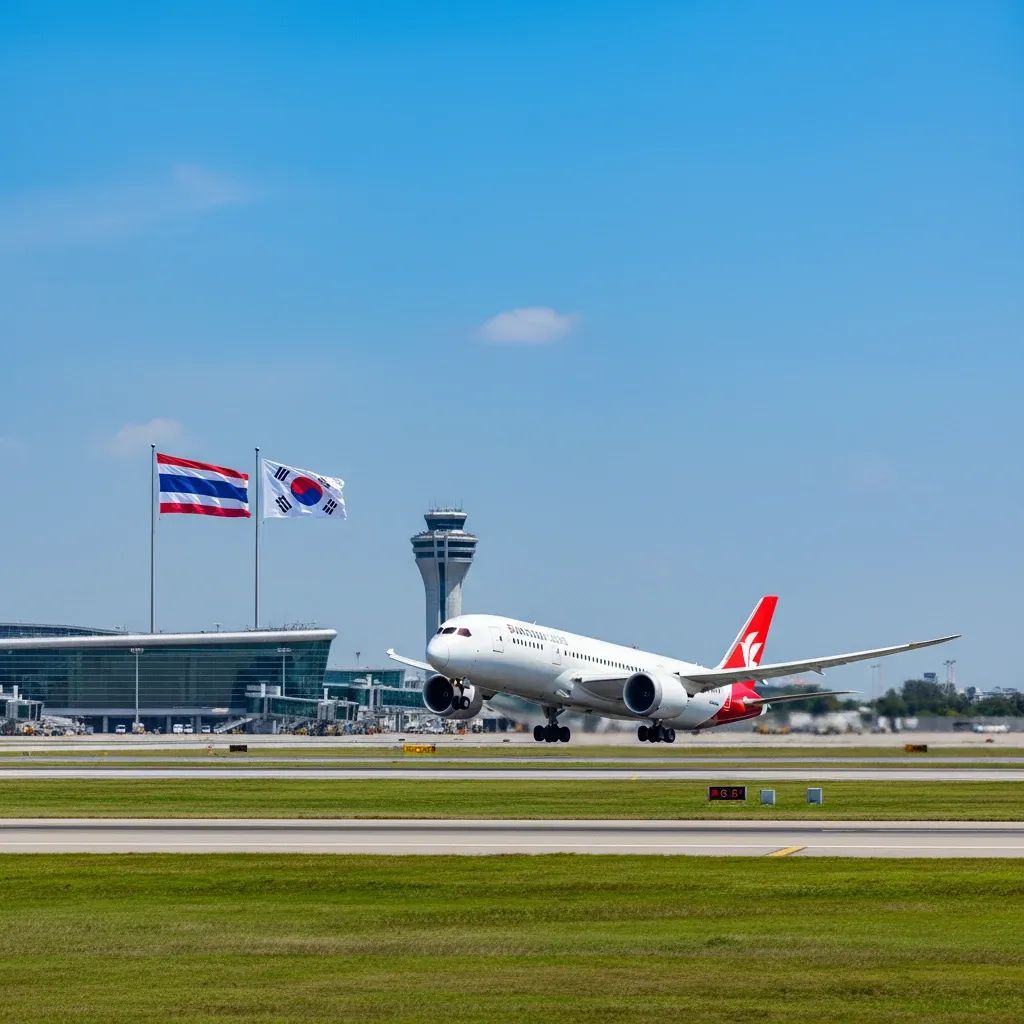
The Thailand-based budget carrier Thai AirAsia will assume control of the Bangkok Don Mueang to Seoul Incheon route starting May 1, 2026, replacing its long-haul sister airline Thai AirAsia X in a fleet realignment that trades wide-body comfort for narrow-body economics. The shift means passengers will fly aboard single-aisle Airbus A320neo jets instead of the twin-aisle A330-300 wide-bodies currently serving the route — a change that will reduce seat count, eliminate lie-flat business options, and tighten cabin space on one of Southeast Asia's busiest leisure and business corridors.
Why This Matters
• Aircraft downgrade: Capacity drops from ~280 seats on the A330 to ~180 seats on the A320neo, with a single aisle replacing the twin-aisle layout.
• Premium cabin impact: Business travelers lose lie-flat seats and gain only recliner-style seating in a 2-2 configuration.
• Daily service maintained: Thai AirAsia will operate one daily flight initially, with plans to scale up to twice-daily frequency later in 2026.
• Price advantage expected: The carrier aims to undercut rivals by leveraging the fuel-efficient A320neo for lower operating costs.
Strategic Repositioning Inside the AirAsia Group
This route handover is part of a broader fleet specialization strategy across the AirAsia network. Thai AirAsia X, the long-haul affiliate, is reallocating its A330 aircraft to longer sectors where wide-body range and capacity justify the economics — specifically routes to Japan, Central Asia, and the Middle East. The airline has already launched services to Almaty, Sendai, and Riyadh in late 2025 and is preparing two additional European routes for 2026.
Meanwhile, Thai AirAsia (FD) is consolidating its position as the group's short- to medium-haul workhorse. The carrier is adding four to five aircraft in 2026, with an additional five A320s arriving in the second half of the year. It aims to grow domestic market share from 40% to 45% and projects serving 23.5 million passengers at an 85% load factor — an ambitious target that depends on sustaining demand on international trunk routes like Seoul.
According to Thai AirAsia CEO Phairat Pornpathananangoon, the switch to narrow-body jets will not dent passenger numbers because multiple competitors already fly A320s and Boeing 737s on the Bangkok-Seoul corridor. The airline believes the A320neo's fuel efficiency and lower seat-mile costs will allow it to offer more competitive fares while maintaining profitability on a route known for price-sensitive leisure traffic.
What Passengers Will Notice
The most immediate impact for travelers is the cabin experience downgrade. The A330-300 typically seats 250–290 passengers in three classes, with configurations featuring 28 business seats, 21 premium economy seats, and 230 economy seats. By contrast, the A320neo accommodates 150–180 passengers in a two-class layout, with a maximum squeeze of 194 seats in single-class configurations.
Economy travelers can expect seat pitch ranging from 30 to 32 inches — comparable to the A330's 31–32 inches, but within a single-aisle cabin that feels noticeably tighter. The 3-3 seating layout replaces the A330's 2-4-2 configuration, which offers fewer middle seats and easier aisle access. On a flight lasting roughly five to six hours, the difference in perceived space is significant.
Business-class passengers face the steepest downgrade. The A330's lie-flat seats with up to 60 inches of pitch will give way to recliner-style seats in a 2-2 configuration. While Thai AirAsia's A320neo business cabin offers wider seats (around 18 inches) and improved recline, it lacks the full-flat sleeping surface that long-haul travelers value on overnight or early-morning flights.
In-flight entertainment will likely shift as well. A330s often feature individual seat-back screens with extensive content libraries, while A320neo cabins may rely on streaming to personal devices or smaller, less comprehensive screens — though this depends on Thai AirAsia's specific fit-out. The A320neo's Airspace cabin design does include modern touches like LED mood lighting, larger overhead bins, USB ports, and HEPA-filtered air, but the overall ambiance remains that of a narrow-body regional jet, not a wide-body international workhorse.
Intensifying Competition on the Bangkok-Seoul Corridor
The route handover arrives at a time of fierce competition between Thailand and South Korea, with Thai carriers, Korean low-cost airlines, and full-service operators all vying for market share. East Asian markets now represent 16% of Thai AirAsia's network, up from 15% in 2025, and the airline is betting that lower fares enabled by the A320neo will help it capture budget-conscious travelers.
The South Korea route will also integrate more tightly into Thai AirAsia's domestic and regional network from Don Mueang, offering enhanced connectivity for passengers flying onward to northern Thailand, Laos, and Vietnam. The carrier already operates fifth-freedom services like Vientiane to Hanoi, and the Seoul route could serve as a northern anchor for similar connectivity strategies.
Thai AirAsia's broader 2026 expansion includes discounted fares on routes to Da Nang, Singapore, Taipei, Kathmandu, Macau, and Johor Bahru as part of a "BIG SALE" campaign launched earlier this year. The airline projects 6–9% year-on-year revenue growth, supported by aggressive capacity additions and route rationalization.
Impact on Residents and Business Travelers
For expatriates, remote workers, and business travelers based in Thailand, the aircraft switch presents a clear trade-off: lower fares in exchange for reduced comfort and capacity. Those flying economy for leisure or short business trips may find the A320neo's fuel-efficient pricing attractive, especially if Thai AirAsia follows through on its promise to undercut competitors.
However, premium travelers accustomed to lie-flat seats on the overnight or early-morning Bangkok-Seoul run will need to adjust expectations or consider alternative carriers still operating wide-bodies on the route. The reduced seat count per flight could also lead to tighter inventory during peak travel periods, such as Thai New Year, Korean holidays, or summer vacation season.
For Thai AirAsia X, the fleet redeployment frees up A330 capacity for higher-margin long-haul routes. The carrier plans to add three more A330s in 2026, supporting expansion into Europe and deeper penetration into Japan and India. The airline is also targeting increased India-Japan transit traffic, leveraging its established presence in both markets.
Notably, Thai AirAsia X suspended its Don Mueang to Shanghai Pudong service effective March 4, 2026, signaling a strategic retreat from certain China-bound routes amid shifting demand patterns and regulatory complexities.
Operational Efficiency and the Narrowbody Future
The May 1 changeover reflects a long-term vision within the AirAsia group to become an all-narrowbody operator across short- and medium-haul routes, reserving wide-bodies exclusively for sectors where they generate superior economics. By standardizing on the A320 family, Thai AirAsia simplifies crew training, maintenance, and parts inventory — operational efficiencies that translate into lower ticket prices and faster turnaround times.
The A320neo's fuel burn is approximately 15–20% lower than older A320ceo models, and its quieter engines and extended range make it suitable for routes up to six hours — comfortably covering the Bangkok-Seoul sector. Thai AirAsia's bet is that operational savings will outweigh the revenue loss from reduced premium cabin offerings, especially on a route where the majority of passengers fly economy.
What to Watch
Frequency increases: Thai AirAsia has signaled plans to double daily flights on the Seoul route later in 2026. How quickly this ramp-up occurs will indicate demand resilience and the carrier's confidence in the narrow-body strategy.
Competitor response: Other airlines operating the Bangkok-Seoul corridor — including Korean Air, Jin Air, Jeju Air, and Thai Lion Air — may adjust pricing or capacity to defend market share against Thai AirAsia's lower-cost model.
Premium cabin evolution: Whether Thai AirAsia invests in upgraded business-class seating or ancillary services to partially offset the loss of lie-flat seats will shape the route's appeal to business travelers.
Broader network integration: The success of the Seoul route as a northern hub for onward connections within Thai AirAsia's regional network could influence future route planning and fifth-freedom strategies.
For now, passengers should book early during peak periods and adjust expectations around cabin space and premium amenities when the A320neo takes over on May 1. The route remains a vital artery for Thailand's Korean tourism and business traffic — it's just getting a bit narrower.


