
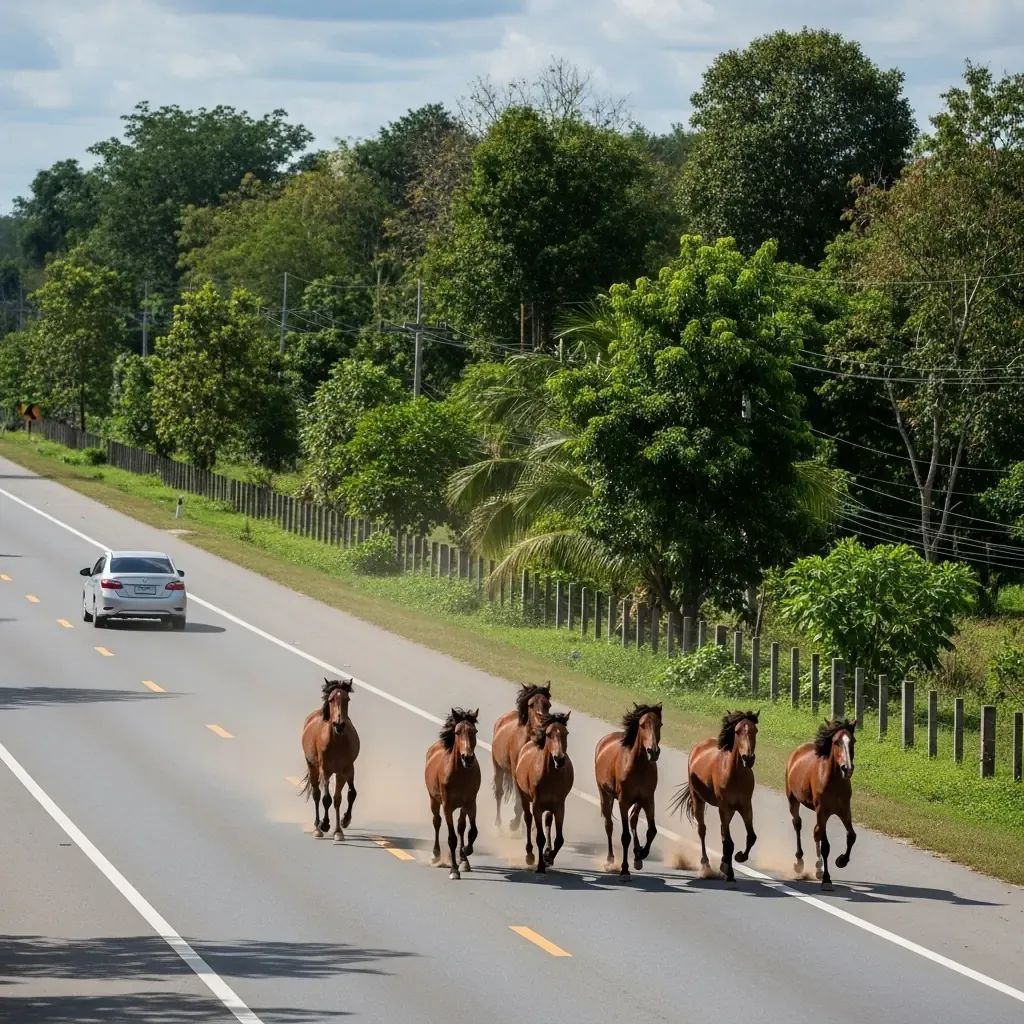
A routine weekend drive between Nakhon Pathom and Ratchaburi turned into a horrifying scene after a group of runaway horses galloped onto Highway 4, leaving 2 animals dead, 3 badly hurt and a Bangkok-registered sedan in ruins. The shockwaves are spreading beyond Bang Phae district, sparking fresh questions about livestock security, owner liability and how motorists can protect themselves when Thailand’s rural highways unexpectedly become grazing fields.
A Split-Second Collision in Bang Phae
Eyewitness dash-cam footage shows a silver Honda cresting the slight bend near the Bang Phae intersection before a blur of brown bodies darts across the tarmac. With barely 20 m to react, driver Tharat Chairath, 66, slams the brakes but still connects with the herd. Two horses die instantly; three more collapse with fractured legs and lacerations. The Honda’s bonnet crumples, airbags deploy, yet the driver escapes with minor bruises—another reminder that, at highway speeds, animal impacts behave more like collisions with motorcycles than with pets.
Where Did the Horses Come From?
Police traced the animals to a privately run stable only 800 m from the crash site. Owner Suvichaya Noikamsin, 40, tells investigators the horses “pushed through a weak side gate” during their morning exercise. Neighbours back that up, saying recent heavy rain left parts of the corral fencing loose. While the stable is popular with Bangkok day-trippers seeking riding lessons, its proximity to the four-lane Phetchkasem Road means a single lapse can put animals directly onto one of Thailand’s busiest southern corridors.
Liability: What the Law Says
The legal playbook is surprisingly robust:
• Civil Code Section 433 makes owners automatically liable for damage their animals cause, unless they prove “all reasonable care.”
• Traffic Act Section 111 bans driving or releasing animals onto a public road; fines run to ฿500, but courts routinely add compensation orders.
• If prosecutors view an unsecured horse as a “dangerous animal,” Penal Code Section 377 allows up to 1 month in jail or ฿10,000 fines.
In practice, insurance companies will chase the stable for the sedan’s repair bill, veterinary costs and potentially lost income for the driver. Police in Bang Phae have already taken statements from both parties and forwarded the brief to provincial prosecutors.
Not a One-Off: Growing Trend Along Phetchkasem
Local press archives list at least 4 serious animal-on-road crashes between Bang Phae and neighbouring Nakhon Pathom since 2023:
July 2024 – two horses killed on Borommaratchachonnani Road, Sam Phran.
March 2025 – pickup strikes stray cattle near Don Tum; driver hospitalised.
September 2025 – wild boar collision shuts a southbound lane for 45 minutes.Authorities blame rapid peri-urban expansion: fields once fenced now border six-lane highways, while stables cater to city dwellers craving countryside hobbies.
How to Keep Horses In—and Cars Out
Veterinary experts from Mahidol University outline three layers of protection:
• Reinforced fencing at least 1.6 m high, inspected daily for storm damage.
• Microchipping & registration so officers can trace owners within minutes.
• Controlled exercise schedules avoiding dawn and dusk when visibility plunges.The Department of Livestock Development is drafting guidelines that could mandate electronic gates or double-door entry systems for any stable within 1 km of a major highway.
What Drivers Can Do Right Now
While owners shoulder legal blame, motorists bear the first physical impact. Seasoned highway patrol officers recommend:
• Drop speed to 80 km/h in mixed rural zones, no matter the posted limit.
• Scan shoulders for movement; the flick of a tail or ear is often visible before a full animal emerges.
• Use your horn in short bursts—not continuous blaring—which startles animals just enough to freeze rather than bolt.
Key Takeaways for Thailand-Based Readers
• Secure fencing is non-negotiable: rural leisure businesses near highways face rising scrutiny.
• Owners pay: civil law almost always favours the driver when escaped animals cause crashes.
• Dash-cam evidence is king: video accelerates insurance payouts and court rulings.
• Expect tighter rules: a draft directive may soon require high-risk stables to install double barriers.
• For motorists, defensive driving saves lives—yours and the animal’s—when asphalt meets agriculture.


