
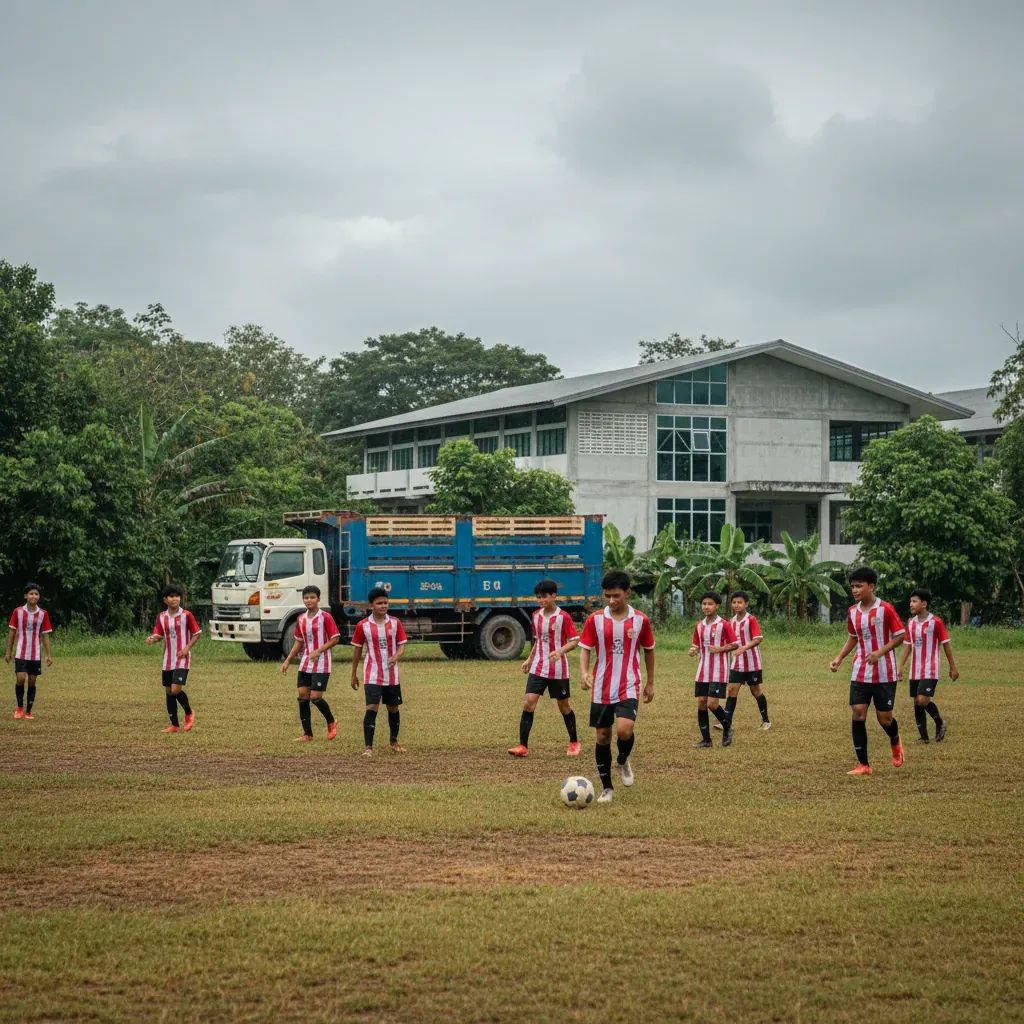
Sakol Kliangprasert, a veteran physical education teacher and celebrated football coach, is making a calculated career pivot. He is relocating from Monthong Wittaya School to Phutthirangsipiboon School in Chachoengsao Province beginning March 2026. He brings approximately 80% of the playing roster that nearly won the 7HD Champions Cup 2025—Thailand's national youth football championship.
This is not a retreat. It is an expansion.
Why This Matters
• Provincial schools now have proven infrastructure. An experienced coach with documented tournament results is explicitly choosing a non-Bangkok location over comfort, challenging the notion that elite talent requires urban academies.
• Academic integration remains mandatory. Sakol has mandated that all transferring players maintain passing grades through the current school year—establishing that sports development and education are inseparable in his model.
• The scalability question gets answered in real-time. The next three years will determine whether the **"Dream Bus" philosophy is replicable or purely circumstantial.
The Setup That Broke the Rules
Monthong Wittaya School—unremarkable by Bangkok standards, invisible in national sports conversation—became temporarily legendary through one coach's deliberate decision-making. Sakol built his championship-contending squad by design: he recruited athletes explicitly rejected by selective programs. Some faced behavioral flags. Others were physically underestimated. Many lacked family wealth to afford private academy fees. These were the reclamation projects established coaches systematically avoid.
His operation required no expensive infrastructure. The team traveled in a weathered cargo truck that became their visual identity—the now-famous "Dream Bus." When Monthong Wittaya defeated prestigious programs like Assumption College Sriracha and Debsirin School en route to the championship finals, the contrast between that utilitarian truck and the air-conditioned coaches of elite Bangkok academies crystallized a narrative: resourcefulness and collective commitment could compete against institutional privilege.
The finals loss to Chainat PAO FC (1-2) was narrow enough to sting but not so decisive as to negate what had already occurred. The national narrative had already solidified. A provincial school built on second chances had disrupted the established order.
Why a Winning Coach Leaves a Winning Program
For casual observers, Sakol's departure appears irrational. Monthong Wittaya remained publicly beloved. Tournament ambition lingered. Yet the decision reflects sophisticated competitive analysis rather than impulsive career hopping.
Elite club academies—operated by Buriram United, Muangthong United, and others—were intensifying provincial recruitment. Once players demonstrate competence in televised tournaments, professional club infrastructure becomes available to them, offering clearer pathways toward senior contracts than even celebrated school programs can guarantee. Nattawut Homkrun, nicknamed "Sauce," exemplified this dynamic: the star player transferred to Thanachart Savings Bank School in Prachuap Khiri Khan Province, which functions as a feeder academy for PT Prachuap FC, a Thai League 2 organization (Thailand's second-tier professional football league). Market logic is ruthless.
Sakol recognized the competitive window narrowing at Monthong Wittaya. Remaining meant competing for the same talent pool against better-capitalized competitors with superior institutional resources. Relocating meant acquiring those resources himself.
Phutthirangsipiboon School—sprawling across 90 rai (approximately 36 acres or 14.4 hectares) in Lat Khwang Subdistrict, Ban Pho District—offers institutional scale his previous location lacked. The campus traces its history to temple sponsorship, grounding the program within community structures that are integral to Thai school systems. More crucially, the school provides the infrastructure investment necessary for competitive sustainability in Thailand's increasingly professionalized youth football ecosystem.
The Team Transplant: Continuity and Strategic Loss
The roster transition operates on selective principles. Approximately 80% of Monthong Wittaya's core players will follow Sakol to Phutthirangsipiboon, including Warakorn Changkhiandee—known as "Te"—whom Sakol identifies as essential organizational anchor. This continuity accelerates integration. Incoming athletes already comprehend his tactical language, conditioning regimen, and cultural expectations. Sakol is not recruiting strangers; he is transplanting an established organism to expanded terrain.
However, the departure is not seamless. Some Monthong Wittaya alumni recognized the market advantage their tournament visibility created and pursued alternative trajectories. Beyond "Sauce," other players may have accepted offers from Bangkok-based academies or competing provincial programs. This dispersal reflects cold institutional logic: successful coaches become recruitment assets. Their previous programs attract rival interest not through loyalty but through demonstrated capability.
Sakol's insistence that transferring players maintain academic standing through completion of the current school year establishes a non-negotiable principle: football serves as a platform for comprehensive development, not isolated athletic specialization. Players cannot use tournament success as justification for academic neglect. Enrollment at Phutthirangsipiboon depends on passing courses.
Mapping a Three-Year Competitive Roadmap
Sakol has publicly outlined a sequenced development strategy—strategically different from tournament-chasing mentality. Year one targets provincial championship. Year two pursues regional title. Year three aims for national crown. Year four targets integration with Thai national youth teams.
This structured progression contrasts sharply with one-victory approaches. It signals that institutional systems, not individual heroics, drive his operational philosophy. The roadmap communicates intentionality to parent communities evaluating football pathways for their children. Other provincial programs across Chachoengsao Province and the eastern region are observing whether systematic, long-term development can sustain competitive results or whether initial tournament success collapses when attention shifts to newer narratives.
The Global Dimension and Entertainment Adaptation
Sakol's story has transcended Thai domestic sports. Reports indicate his team received exhibition invitations to Kelantan, Malaysia, with additional competitive opportunities emerging in the Philippines and Saudi Arabia. These international engagements expose Thai youth players to international competitive standards while showcasing Sakol's development methodology to foreign football administrators.
According to Thai media reports, a feature film tentatively titled "The Coach: Dream Truck" has been discussed as a potential project chronicling his trajectory from provincial obscurity to national sports prominence. However, production status remains uncertain—no confirmed partnerships, studios, or release timelines have been announced. The story itself already functions as cultural property in Thai media and social networks, whether or not a theatrical film materializes.
Can the Model Scale Beyond One Coach?
Replicating Monthong Wittaya's success at Phutthirangsipiboon is not assured, despite Sakol's track record and roster continuity. He brings validated methods and experienced players, yet Phutthirangsipiboon lacks the recent tournament pedigree that Monthong Wittaya established. Building institutional buy-in—among existing students, teaching staff, and parent communities—requires diplomatic skill alongside tactical acumen. Established hierarchies at any school can resist external acceleration and imported success models.
The Thai youth football calendar has intensified dramatically. The competitive window for identifying overlooked talent before well-capitalized competitors saturate provincial areas continues narrowing as Thailand's football infrastructure professionalizes around urban centers.
A deeper structural concern persists: the "Dream Bus" model appears centered on one coach's individual commitment, media profile, and reputation. Whether this methodology can survive his eventual departure or be institutionalized as transferable practice beyond a single charismatic coach remains untested. If Phutthirangsipiboon becomes dependent on his individual presence rather than developing systematic coaching depth, the program risks instability when he retires or relocates again.
Provincial Competition in a Consolidating Market
Sakol's career trajectory illuminates structural contradictions within Thailand's youth sports ecosystem. The Ministry of Education and Sports Authority of Thailand rhetorically promote decentralized talent development, encouraging provincial schools to compete with Bangkok elites. Yet market forces favor consolidation: professional clubs operate integrated academies controlling players from adolescence through senior contracts, minimizing risk of losing prospects to rival bidders.
Coaches in Sakol's position operate in the difficult space between competing pressures. They navigate bureaucratic school systems, satisfy parental expectations, and produce tournament results visible enough to sustain media attention yet achievable enough to avoid burnout.
Sakol's decision to leave an institution still commanding public goodwill—despite its tournament success—suggests that even celebrated programs face retention challenges. A successful coach becomes coveted. Rival institutions pursue them. This dynamic paradoxically destabilizes the very programs that attract exceptional talent in the first place.
What the Relocation Signals for Thai Families
For Thai families evaluating football pathways for their children, Sakol's move offers instructive case material. It demonstrates that provincial programs can compete with urban academies—provided they secure coaching talent willing to invest years in systematic development rather than prioritizing singular tournament victories. His three-year development roadmap at Phutthirangsipiboon will function as real-time examination of whether the "Dream Bus" model scales beyond its origins or remains an unrepeatable convergence of timing, circumstance, and narrative momentum.
The March 2026 transfer represents the true beginning of this experiment. Whether Phutthirangsipiboon becomes the next chapter in Sakol's underdog saga—or merely another institutional stop on a peripatetic coach's resume—depends on factors both controllable and external: institutional stability, competing recruitment pressures, player retention, injury management, and tournament randomness.
What Remains: A Provincial Alternative to Urban Monopoly
Thailand's provincial football landscape now possesses a documented template for challenging Bangkok establishment dominance. Other schools in Chachoengsao Province and across the eastern region have observed that exceptional coaching combined with systematic development philosophy and collective institutional commitment produces results previously thought the exclusive property of wealthy urban academies.
The specific outcome at Phutthirangsipiboon will reverberate far beyond that campus. Success validates the model for replication. Failure raises harder questions about sustainability of personality-driven programs and institutional capacity to retain transformative talent. Either way, Sakol's relocation represents a deliberate experiment: Can proven coaching excellence, transplanted institutional support, and roster continuity rebuild championship momentum at a new location?
The "Dream Bus" arrives in Ban Pho District this March, carrying not just players but a philosophy about provincial aspiration in a consolidating market. The next three years will determine whether the dream survives the relocation.


