
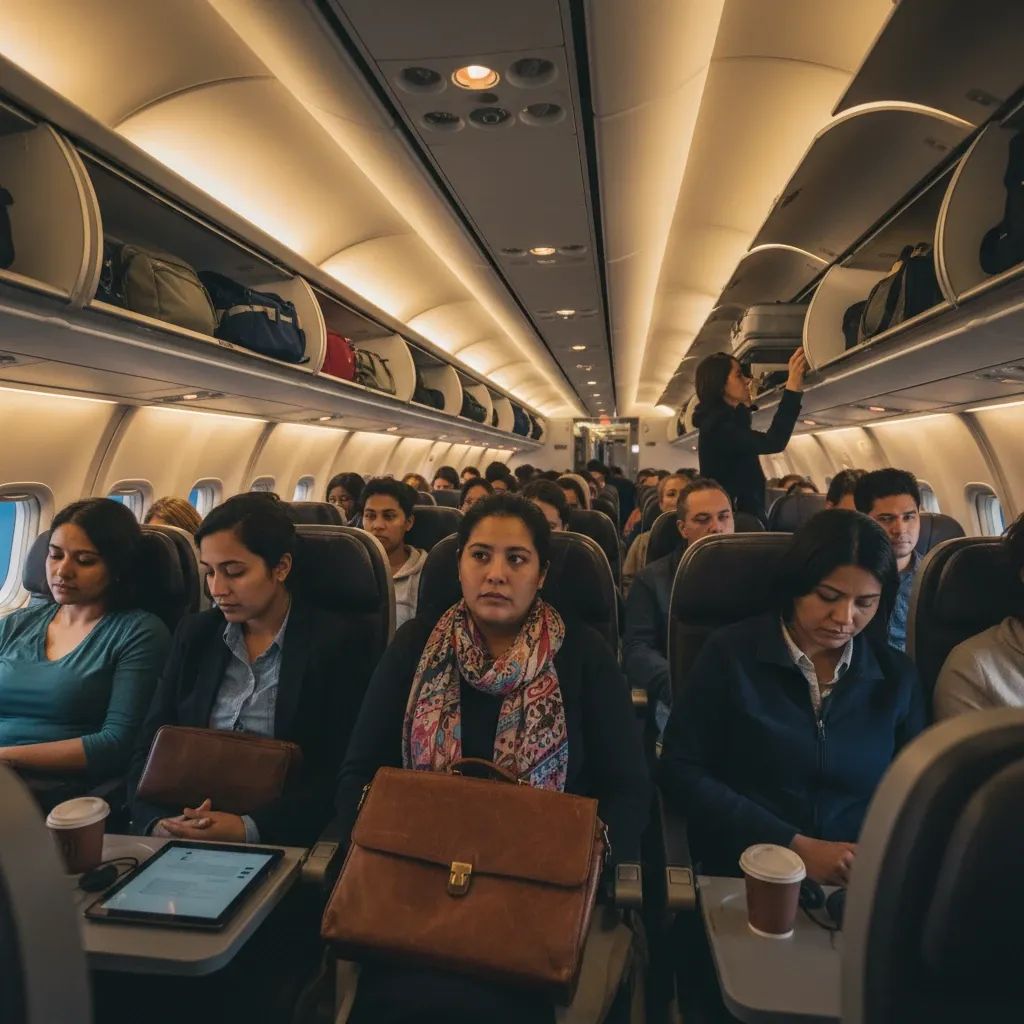
Why That Flight Seemed Different
When Dr. Songwut Promtho boarded the morning service from Udon Thani to Bangkok last month, he carried the clinic's weekly cash collection in a standard carry-on—a routine choice for thousands of provincial business owners. The one-hour flight to Suvarnabhumi should have been unremarkable. Instead, it became a stark reminder of why vigilance matters during domestic air travel.
Why This Matters
• A persistent pattern is now documented: Multiple theft incidents have targeted Thai domestic flights, with organized operations concentrating on short regional routes where victims often don't discover losses until after landing and clearing the terminal.
• Quick action is your only recourse: Unlike theft at hotels or restaurants, cabin theft occurs in an enclosed environment with limited exit routes—meaning the first 15 minutes after landing are critical for recovery.
• Overhead bins remain a high-risk target because crew focus is typically on safety protocols and service, not continuous overhead monitoring.
• Thailand's cash-dependent business culture creates opportunity: Thieves profile travelers based on flight times, routes, and departure cities. Morning flights from provincial centers to the capital carrying business funds are predictable targets.
The Immediate Aftermath
The suspect was a Chinese national traveling on a standard tourist visa, according to accounts from Thailand Royal Police officers who filed the incident report. What set this particular journey apart was not the theft itself—those occur quietly, often going undiscovered for hours—but what happened next.
As the aircraft touched down at Suvarnabhumi, the man exited with visible urgency. Dr. Songwut, maintaining a level of alertness that most travelers abandon mid-flight, immediately checked his bag and confirmed the loss. Rather than filing a routine police report hours later, he took immediate action.
Security personnel at Suvarnabhumi detained the suspect near the departure level. A search of his jacket revealed the entire amount—approximately 200,000 baht—folded into an interior pocket. The discovery was striking enough to trigger a secondary review of the same flight's passenger manifesto. A second traveler came forward independently, reporting missing personal items. Thai immigration authorities later noted that foreign currency seized from the suspect suggested this was not his first attempt.
A Persistent Problem With Limited Oversight
The broader issue is not that theft happens—it is that most theft never gets reported in any official capacity. When a passenger discovers missing belongings hours or days after a flight, they face a dilemma: reporting to Thai authorities means hours in police stations, translation needs, and minimal prospects for recovery. Most travelers simply absorb the loss.
Thailand's Civil Aviation Authority (CAAT), which oversees aviation security protocols, does not publicly release statistics on passenger-to-passenger theft. Security agencies focus regulatory attention on weapons, explosives, and contraband detection. The theft of a passenger's personal possessions inside the cabin remains largely invisible in official records.
Yet evidence of organized activity exists. In April 2025, Suvarnabhumi authorities arrested two individuals in connection with coordinated theft activity at the airport. Reports from traveler communities describe patterns of theft on short-haul domestic routes, with stolen amounts typically ranging from 50,000 to 200,000 baht per incident, suggesting operational familiarity with flight schedules and passenger vulnerability.
There have been documented security incidents involving airline staff as well. In January 2026, authorities investigated incidents related to improper conduct by airline personnel, highlighting another vulnerability in the cabin security environment.
Understanding Vulnerability: Thailand's Cash Ecosystem
Domestic air travel within Thailand operates within a unique financial context. Unlike many developed nations where cash transactions have shifted to electronic payment, Thailand's provincial economy—particularly sectors like healthcare, retail, and hospitality—remains fundamentally cash-based. A clinic in Udon Thani generates daily receipts entirely in physical currency. Depositing these funds at a Bangkok-based bank requires either hiring a courier (expensive and unreliable) or personally transporting cash. Flying to the capital with 150,000 to 300,000 baht in a carry-on is not unusual; it is standard business practice.
This normalization creates predictable patterns that organized thieves exploit with precision. They understand that morning flights from provincial centers carry higher-value targets. They recognize which routes generate consistent passenger flows and which periods see higher cash movement. The asymmetry between a traveler's casual vigilance and a professional thief's operational awareness has created a systemic vulnerability.
Official Response and Security Measures
Following reports of theft incidents, Thai authorities have acknowledged the problem. Airlines have incorporated passenger warnings into safety messaging and enhanced crew awareness of security concerns. The Civil Aviation Authority and airport operators have considered various security measures, though comprehensive cabin monitoring solutions face practical and regulatory barriers related to evacuation procedures and passenger safety protocols.
The fundamental challenge remains: theft prevention inside aircraft cabins requires sustained institutional investment and coordination that current market incentives do not fully support.
Practical Steps: What Residents Should Actually Do
For anyone living or working in Thailand who travels domestically, the actionable takeaway is personal vigilance. Treat your valuables as though you are boarding a crowded public bus, not a regulated aircraft.
Keep cash, passports, jewelry, and high-value electronics in a personal item positioned directly in front of you or on your lap. Never store cash in checked luggage. Never place significant sums in overhead compartments. If you must carry substantial cash—and the nature of provincial business sometimes mandates it—distribute it across multiple locations (front pocket, moneybelt, carry-on backpack). This increases friction for a thief and reduces the probability of total loss.
Maintain situational awareness of passenger behavior. If someone near you stands repeatedly, walks to the lavatory more frequently than typical, or lingers near overhead bins assigned to other passengers, that warrants attention. This is not paranoia; it is applied situational awareness. When you land, check your belongings before leaving your seat. Once you clear the terminal and move into ground transportation, the window for intervention effectively closes.
If you observe genuinely suspicious behavior in-flight, inform a flight attendant immediately rather than waiting. If you discover a theft before disembarking, alert cabin crew or airport security without delay—those first minutes between landing and passenger dispersal are critical.
The Takeaway: Personal Vigilance Over Systemic Trust
Domestic air travel in Thailand remains statistically safer than ground transportation, and theft incidents, while documented, remain uncommon relative to total passenger volume. The deeper issue is that security frameworks designed to prevent terrorism and weapons smuggling have left a gap for low-level organized crime that generates legitimate concern and erodes consumer confidence.
Individual travelers cannot depend on infrastructure alone to protect their belongings. Dr. Songwut's recovery was exceptional precisely because it required exceptional action: observation, immediate physical pursuit, and willingness to engage directly with a potential threat. Most passengers lack some combination of these capabilities or circumstances.
That asymmetry is the real lesson: in Thai aviation, your possessions remain primarily your own responsibility.


