
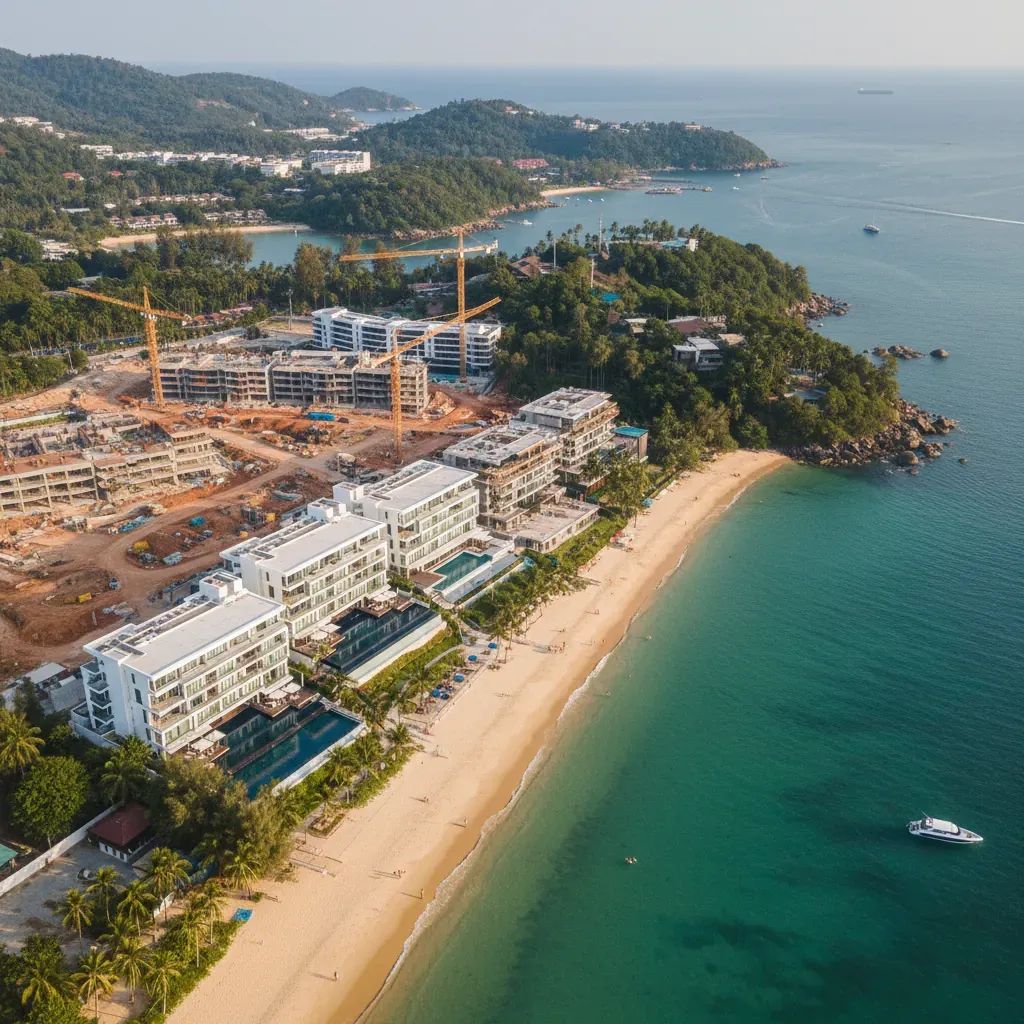
Thailand's island province of Phuket is experiencing a property value surge that could see its residential market rival secondary Bangkok districts and major resort destinations within months, driven by infrastructure megaprojects worth collectively over ฿270 billion and sustained international demand. The transformation positions the Andaman tourism hub as an emerging international economic center with property prices climbing 10-15% annually.
## Why This Matters
• Property values rising fast: Villas in key areas like Layan and Bang Tao have appreciated 15-18% year-on-year, with off-plan condos in Bang Tao and Kamala up 15-20% since early 2025.
• Land scarcity driving prices: Prime beachfront land in Patong now trades at ฿200-300M per rai (฿500,000-750,000 per square wah), representing significant appreciation but still substantially below Bangkok's central business district rates.
• Megaprojects launching: The ฿80 billion Andaman Airport, alongside entertainment complexes and branded residences, comprise over ฿270 billion in committed investment across multiple major developments.
• Foreign buyers dominating: Russian, Australian, Indian, Chinese, and Kazakh investors continue snapping up properties, with rental yields hitting 8-10% for managed villa projects.
Infrastructure Boom Reshapes Market Dynamics
The Thailand Airports Authority has greenlit construction of the Andaman Airport—Phuket's second international terminal—with an ฿80 billion budget and a 2030-2031 completion target. The facility will handle 22.5 million passengers annually, effectively doubling the island's aviation capacity and addressing the chronic congestion at Phuket International Airport.
This infrastructure anchor sits among a cluster of transformative developments. CV Group's Synthesis Ark Phuket, a ฿50 billion mixed-use complex in Thalang district, began construction in 2025 and aims for full completion by 2032. Meanwhile, the Royal Bangkok Sports Club and Monaco-Hong Kong investors are advancing a ฿140 billion entertainment complex in Thalang, featuring luxury resorts, a Formula One circuit, an equestrian center, and an offshore casino island. The first phase is scheduled to open in 2029.
Central Pattana (CPN) is committing an additional ฿7 billion between 2026 and 2028 to expand its Central Phuket mega mixed-use project, bringing total invested capital to ฿26 billion. These projects collectively signal a shift from seasonal tourism dependence toward year-round economic activity anchored by entertainment, business conventions, and permanent residents.
Property Price Trajectory Mirrors Global Gateways
Phuket's residential market has recorded 45,066 new units worth ฿469.72 billion launched between 2021 and 2025, according to Colliers Thailand. As of late 2025, developers have released more than 72 new condominium, housing estate, and vacation home projects totaling over 10,312 units with combined investment exceeding ฿81.64 billion.
The average selling price for detached homes now sits at ฿29.1M, with per-square-meter rates averaging ฿102,000—figures that place Phuket firmly in luxury territory. In premium zones like Laguna, Cherngtalay, and Bang Tao, newly built villas command $450,000-1.5M, depending on views, location, and developer branding.
Condominium units in resort-managed developments range from $120,000-220,000 for one- to two-bedroom layouts with shared amenities. Off-plan launches that debuted at $95,000-110,000 in early 2025 now resell at $120,000-135,000 in comparable projects—a reflection of tightening supply and persistent foreign appetite.
Branded residences priced above ฿250,000 per square meter are attracting multinational buyers, particularly from the Middle East, Eastern Europe, and East Asia. AssetWise, a major Thailand-based developer, plans to launch 11 new projects worth ฿17.55 billion in 2026, with six of those—valued at ฿10.1 billion—concentrated in Phuket.
What This Means for Residents and Investors
For expats, digital nomads, and long-term residents, the property escalation brings both opportunity and challenge. Rental yields remain attractive: condominiums typically deliver 5-8% gross returns, while villas offer 6-10%. Professionally managed properties with hotel-style leasing agreements are selling faster, with projected annual returns of 8-10%.
However, supply constraints are becoming acute. Land in core coastal zones—Laguna, Cherngtalay, Bang Tao, Layan, Surin, Pasak, Chalong—has appreciated at least 50% over the past two years, with prices now starting at ฿60-70M per rai (roughly ฿150,000-175,000 per square wah). In Patong, beachfront parcels command upward of ฿200M per rai. For context, Bangkok's central business district land in premium areas like Siam Square-Chidlom trades at ฿3.5-4M per square wah—approximately 5-7 times higher than Phuket's most expensive beachfront properties. While Phuket's rate of appreciation is significant, the absolute price gap reflects different market dynamics and supply-demand fundamentals between a global financial center and an emerging resort destination.
Buyers should note that foreign ownership regulations remain unchanged: non-Thais can hold condominium units on a freehold basis up to 49% of a project's saleable area, or lease land and villas for 30-year terms with renewal options. Legal structuring through Thai companies is common but requires professional advice to ensure compliance with Thailand Land Code provisions.
Emerging Neighborhoods and Strategic Locations
While established zones maintain their premium status, emerging areas are drawing developer attention. Rawai and Nai Harn offer relatively affordable villa options for those seeking permanent residence, while Kamala is becoming synonymous with luxury sea-view condominiums and new branded projects.
Pru Chom Pa and Thalang (the corridor between international schools and the Heroines' Monument) are experiencing rapid growth, with multiple pool villa estates under construction. These zones benefit from larger land parcels at accessible price points, proximity to international schools, and improved road networks.
Phuket now hosts 16 international schools, a figure that underscores the influx of expatriate families and permanent residents from Russia, Kazakhstan, the UAE, China, Singapore, and increasingly the United States. Developers are responding with family-oriented projects near educational hubs, such as AssetWise's Casa de Monte and Villa del Luna (combined value ฿5.7 billion) on Ko Kaew, and Sansiri's D Condo Cove (฿2.1 billion) and Setthasiri Ko Kaew Retreat (฿1.7 billion).
Resort-style condominium towers like Coralina Kamala (564 units, ฿3.9 billion), The Title Sierra (452 units, ฿2 billion), and The Title Balcony Naiyang (542 units, ฿3.8 billion) launched in late 2025 and are targeting both end-users and investors seeking managed rental programs.
International Tourism Fuels Sustained Demand
Phuket welcomed 12 million international visitors in 2025, a recovery that has stabilized post-pandemic and continues to underpin property fundamentals. The Thailand Tourism Authority projects steady growth, particularly from long-haul markets and regional hubs, as expanded flight capacity from the new Andaman Airport comes online.
The visitor mix is diversifying beyond traditional beach tourism. Digital nomads, remote workers, and semi-retirees are increasingly purchasing rather than renting, attracted by lifestyle amenities, tropical climate, and competitive cost of living relative to Western cities. The government's ongoing digital nomad visa initiatives further support this demographic shift.
Analysts at Colliers Thailand forecast residential property values will grow 8-12% annually through 2026-2027, with megaproject completions and infrastructure upgrades acting as accelerants. The consultancy notes that Phuket's price trajectory is beginning to mirror patterns seen in established resort markets like Miami, Dubai, and the French Riviera, where land scarcity, lifestyle appeal, and international capital combine to sustain long-term appreciation.
Smart City Ambitions and Digital Infrastructure
Beyond physical megaprojects, Phuket is advancing smart city initiatives that include digital port facilities, upgraded road networks, and integrated tourism-business platforms. The Thailand Board of Investment has designated the province as a pilot zone for technology-driven urban management, aiming to position it as both a leisure destination and a business convention center.
The expansion of Central Phuket and the upcoming ICONSIAM Phuket—a landmark retail and mixed-use development—signal a maturing retail and lifestyle sector that caters to both tourists and the growing resident population. These projects are expected to anchor new residential clusters and drive secondary commercial development in surrounding districts.
Risks and Considerations
Despite bullish sentiment, prospective buyers should weigh several factors. Exchange rate volatility can affect returns for foreign investors, particularly those repatriating rental income. Thailand's property transfer taxes and fees—stamp duty, registration fees, and withholding tax—can total 6-7% of transaction value, eroding margins on short-term flips.
Market liquidity varies by segment: luxury villas and branded residences often take longer to resell than mid-market condominiums near beaches or international schools. Buyers should verify developer track records, construction timelines, and legal title status, particularly for off-plan purchases.
The Thailand Land Department has increased scrutiny of foreign ownership structures, and penalties for non-compliance with nominee shareholder laws have become stricter. Engaging a qualified Thai lawyer is essential for due diligence and contract review.
Outlook Through 2026 and Beyond
With major infrastructure projects totaling over ฿270 billion in committed investment, Phuket's property market is entering a phase of sustained, broad-based growth. The convergence of limited land supply, robust international demand, and major public-private investment is likely to push residential prices in prime zones upward significantly. While Phuket will not replicate Bangkok's CBD pricing, it is establishing itself as a premier resort and lifestyle destination where property values reflect scarcity, amenities, and international appeal.
For residents and investors, the opportunity lies in timing: entering the market before the Andaman Airport opens and the entertainment complexes launch their first phases. As Phuket transitions from a tourism-dependent economy to a diversified international lifestyle and business hub, its property market is poised to reflect that transformation in both value and sophistication.


