
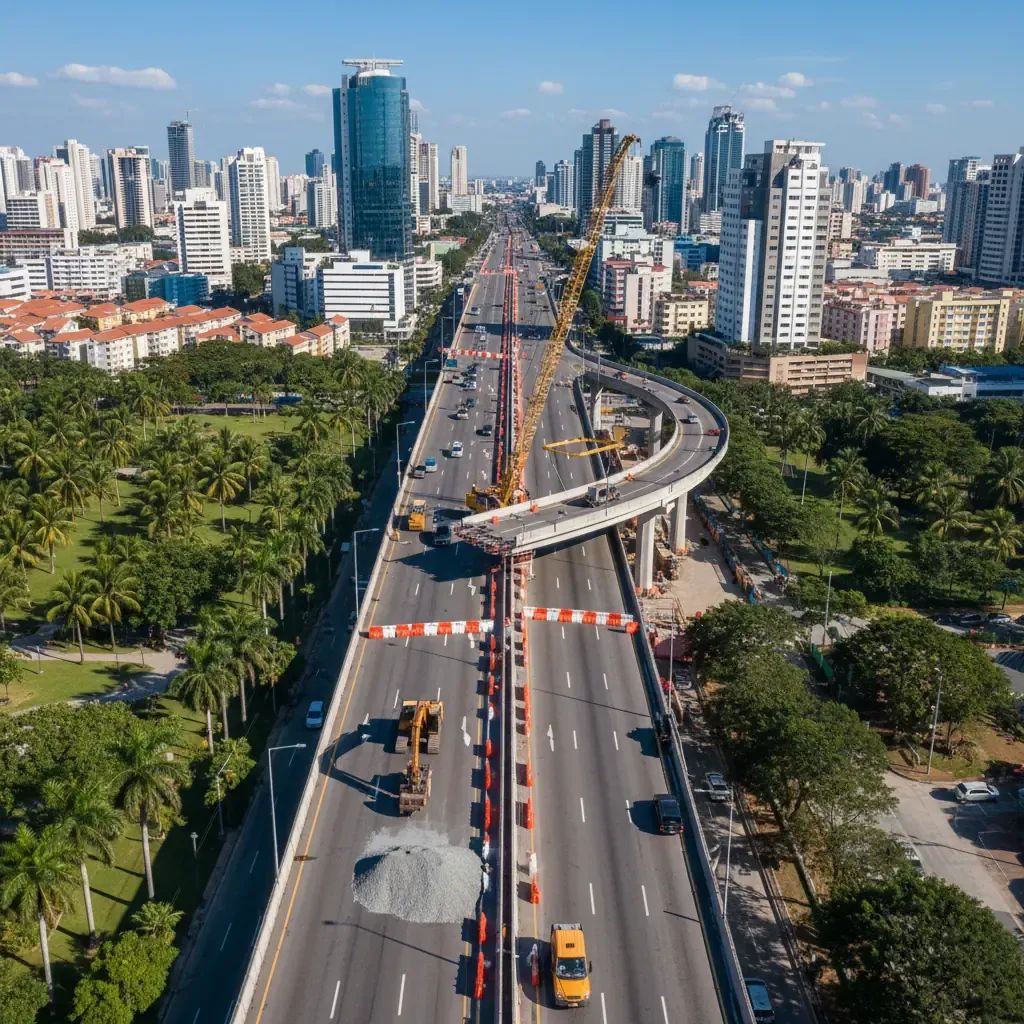
Pattaya is about to inject nearly ฿35 million into road infrastructure across multiple districts over the next nine months, with the most disruptive phase—a 4-kilometer demolition and rebuild of Sukhumvit Road's westbound lanes—kicking off in late April and lasting through December. The scale of this commitment reveals how seriously the city is treating the collision between tourism-driven congestion and aging infrastructure that was never designed to handle this volume.
Why This Matters
• April 19 launch date through approximately December 2026: Westbound traffic on Sukhumvit Road (heading toward Chonburi) will face lane closures; plan alternate commutes now via Sukhumvit Third Road, Pattaya Second Road, or Soi Buakhao, knowing all will experience elevated congestion.
• Business exposure during 200-day construction window: Retailers, hotels, and restaurants along the corridor should prepare for 20-30% foot traffic declines based on recent Sukhumvit Soi 32 project data; advance digital marketing and flexible inventory strategies are essential.
• Immediate safety upgrades already underway: Power pole removal and underground cable installation at high-risk junctions like Nong Ket Yai are proceeding simultaneously, eliminating vehicle-collision hazards before monsoon season intensifies.
The Infrastructure Crisis Behind the Urgency
Pattaya's road network is failing. Not metaphorically—literally cracking, rutting, and separating at subsurface levels. When Mayor Poramet Ngampichet walked Sukhumvit Road's westbound lanes on March 18, he encountered potholes measuring over 30 centimeters across, truck ruts so deep they channeled water, and sections where the road base had begun to separate from the compacted earth beneath. This was not surface wear; it was structural collapse in slow motion.
The westbound direction absorbs the heaviest punishment. Heavy-haul trucks bound for the industrial parks of Thailand's Eastern Economic Corridor rumble through Pattaya in continuous streams. Tour buses, numbering in the dozens daily, park along the shoulder and reload passengers outside oceanfront hotels. Local delivery vans, motorcycles, and private cars compress the remaining space. A road designed in the 1990s for moderate traffic—perhaps 15,000 vehicles daily—now processes over 45,000 daily movements during peak season. The physics of wear are unforgiving: damage accelerates exponentially as load exceeds design capacity.
Suwalee Company Limited, contracted by Pattaya City Hall, will not overlay fresh asphalt over the deteriorated base. That approach failed repeatedly over the past decade. Instead, the company will perform full-depth reclamation—removing roughly 20 centimeters of existing pavement, grinding it into recycled aggregate, blending it with binder, and recompacting it into a stabilized foundation. An 8-centimeter layer of virgin asphalt will cap the work. This technique, deployed successfully on Bangkok's Rama IX Road, Chiang Mai's Superhighway expansion, and Rayong's Port Industrial Road, extends the service life from 5-7 years (typical overlay lifespan) to 10-12 years under comparable traffic loads.
The 26,500-square-meter project area spans 4 kilometers. The 200-day timeline reflects not laziness but the physical constraints of milling, processing, stabilization, compaction, and curing under Thailand's tropical heat and humidity cycles. Work cannot be compressed without sacrificing durability.
The Collateral Infrastructure Crisis: Downed Power Poles
While Sukhumvit dominates planning discussions, an equally critical—and less visible—problem has forced parallel emergency action. The Nong Ket Yai railway junction, a chaotic convergence of train crossings, truck traffic, and local congestion, has become notorious for vehicle-pole collisions. On March 18, the same day the mayor inspected Sukhumvit, residents reported a severely damaged utility pole that had been struck multiple times by motorcycles and cars. The structure was compromised, listing at an angle that threatened imminent collapse onto the roadway.
The mayor's office responded the same day, coordinating with the Provincial Electricity Authority to remove the pole and secure the site. This was not bureaucratic sluggishness followed by urgent action; it was practiced crisis response.
Power pole accidents cascade through Pattaya with alarming regularity. In January 2026, a pickup truck in North Pattaya's Soi Peniad Chang swerved to avoid another vehicle and toppled three consecutive poles, severing electricity to surrounding neighborhoods for hours. The driver's decision to dodge rather than brake triggered a domino collapse. In March, another truck in nearby Sattahip hit a pole while avoiding traffic cones—the driver died at the scene. These are not anomalies; they are predictable failures of overhead infrastructure exposed to chaotic traffic patterns.
The Provincial Electricity Authority recognizes the problem is structural, not incidental. Overhead lines strung between poles remain vulnerable to repeated strikes, weather damage, and vehicle swerves. Once struck and weakened, poles become acute hazards—not immediately obvious to drivers until the moment of collision.
Pattaya's response is ambitious: underground cabling of all electrical and communication lines along major corridors by year-end 2026. Early phases targeting Nong Ket Yai and surrounding commercial zones are already underway. Poles will be removed sequentially, and lines transitioned into buried conduits. This eliminates the collision hazard, improves aesthetics by removing visual clutter, and reduces maintenance demands during monsoon season when falling branches and wind damage frequently compromise overhead networks.
The Cascading Projects: Pattaya's Infrastructure Reset
Sukhumvit is merely the flagship of a citywide refresh. Pattaya Second Road, a 3.3-kilometer stretch from Terminal 21 to South Pattaya Intersection, commenced recycling asphalt work in January 2026 under a ฿34.33 million contract. This project will conclude by mid-2026, operating on a phased 90-day schedule designed to preserve traffic flow. Milling depth here is more modest—approximately 5 centimeters—because Second Road, while busy, absorbs less heavy truck traffic than Sukhumvit. The recycled aggregate will be reinforced, two fresh asphalt layers applied, and road samples sent to the Department of Highways for structural validation before reopening.
The Western Rail-side Road corridor stretching 16 kilometers through the Khao Talo district has undergone selective full-depth recycling, with particular attention to low-lying sections prone to monsoon flooding. One section, completed in late February, was not only recycled but also raised in elevation, then topped with an overlay—a hybrid approach addressing both structural and drainage concerns. Soi 5 Thanwa, a connector between commercial zones, is being widened and overlaid as utility poles are relocated to accommodate additional lanes.
This is not reactive maintenance. It is a coordinated multi-year reset aligned with the Thailand Eastern Economic Corridor development plan. The corridor aims to position Pattaya as a high-capacity transportation and logistics node. Crumbling roads contradict that ambition. City officials are investing capital now to build the infrastructure that regional commerce and tourism will demand over the next decade.
The Business Test: Quantifying the Disruption
The recent Sukhumvit Soi 32 project offers a data point. From February 23 to March 5, this secondary connector underwent a two-phase asphalt overlay with a 7-centimeter layer. The work lasted approximately two weeks. During the work window, shop owners reported losing 20-30% of daily foot traffic. Customers rerouted deliberately. One boutique hotel operator stated that walk-in bookings collapsed entirely during the construction period, forcing increased reliance on social media advertising and online booking channels to compensate. The work created noise, dust, and access complications that prompted people to delay shopping or dining visits.
The Sukhumvit project multiplies this disruption across a much larger area and extends it over seven months. Delivery trucks will need to time arrivals to avoid lane closures or accept substantially longer routes through congested secondary streets. Tourists seeking beachfront restaurants and retail shops may find access complicated and defer visits. Hotels may report increased cancellations or reductions in late-night walk-up traffic. Convenience stores and fuel stations lose impulse traffic.
Pattaya City Hall is aware of the risk and has committed to phased construction, off-peak work scheduling where feasible, and continuous signage informing motorists of lane status and alternate routes. Traffic police will be deployed at critical junctions during peak hours. These mitigation measures provided only modest relief during previous projects, but they signal institutional recognition of the tension between infrastructure necessity and commercial disruption.
The counterargument from city planners holds validity: deteriorating roads ultimately damage commerce far more severely than temporary construction disruption. Potholes and congestion deter repeat visitors. Unreliable road conditions complicate logistics for delivery-dependent businesses. A smooth, efficient corridor serves long-term merchant interests even if short-term visibility declines.
Smart Traffic and the Technology Bet
To prevent gridlock during the construction window, Pattaya City Hall is deploying AI-powered traffic management systems at key intersections across the city. Smart poles equipped with cameras and vehicle detection sensors feed data to a centralized command center where traffic engineers monitor real-time flows. The system dynamically adjusts signal timing based on congestion patterns, attempting to route vehicles away from bottlenecks and toward underutilized secondary streets.
This approach is gaining traction across Thailand's secondary tourism hubs. Phuket launched similar AI traffic light systems ahead of peak season. Rayong's port district has implemented comparable smart intersection controls. The technology is most effective during structured hours—morning commutes, school runs—when traffic patterns are predictable. It loses power during chaotic tourist season surges or accident-triggered pile-ups when drivers behave unpredictably.
Pattaya's edge lies in integrated coordination: the city is not simply upgrading traffic lights but synchronizing them with phased construction scheduling, enhanced parking enforcement, and aggressive public communications campaigns. Digital signboards warn of delays and alternate routes. Social media, local radio, and printed flyers saturate the market. Odd-even parking restrictions have been expanded in high-density zones to preserve lane capacity. Enforcement against roadside parking has intensified, freeing critical space for traffic flow.
Even the most sophisticated traffic management cannot eliminate delays when a primary 4-kilometer corridor is partially closed for 200 days. Rush-hour commutes will lengthen. Tourists driving rental cars will experience frustration. Some businesses will suffer quantifiable revenue losses.
Implications for Residents and Commuters
If you commute along Sukhumvit westbound, add 15-25 minutes to your usual travel time and familiarize yourself with alternate routes immediately. Pattaya Second Road, Soi Buakhao, and Sukhumvit Third Road function as partial workarounds, though all will experience elevated traffic as construction progresses. Build buffer time into your schedule, particularly during the 7-9 a.m. and 4-7 p.m. windows when congestion peaks.
If you operate a business in the construction zone, prepare for reduced foot traffic and logistical complexity. Many proprietors are expanding online ordering, offering temporary promotions, and adjusting inventory strategies to compensate. Staff schedules may require flexibility to manage reduced customer volume during daylight hours while maintaining evening service quality.
Residents near construction sites should expect daytime noise and possible temporary water or electricity interruptions as utilities are relocated. The city promises phased, off-peak work, but practical constraints may require occasional nighttime operations. Communication from your building management about disruption windows will be important.
For tourists, Pattaya remains accessible despite construction. Alternate routes exist. Navigation will be more complex, but the city's traffic management systems and increased officer presence should prevent complete gridlock, even if efficiency declines during peak hours.
The Long-Term Payoff
Once the 200 days conclude around November or December 2026, a reconstructed Sukhumvit Road will function more efficiently. City transport planners estimate traffic flow will improve by 15-20%, meaning shorter commutes, faster supply chains, reduced fuel consumption for delivery fleets, and smoother tourist experiences. Fewer potholes translate to fewer accidents and lower vehicle maintenance costs for residents. The road will require less frequent patching over the next decade, reducing municipal maintenance budgets.
The underground cabling initiative adds resilience. No more downed power lines cascading blackouts through neighborhoods when a truck sideswipes a pole. No more traffic paralysis when overhead lines fall onto the roadway.
This is the implicit bargain: seven months of temporary disruption yield years of operational stability and safety. Whether residents view the trade-off as equitable depends largely on how well city officials execute the promised traffic management and how quickly conditions normalize once work concludes. The stakes are real for both sides.


