
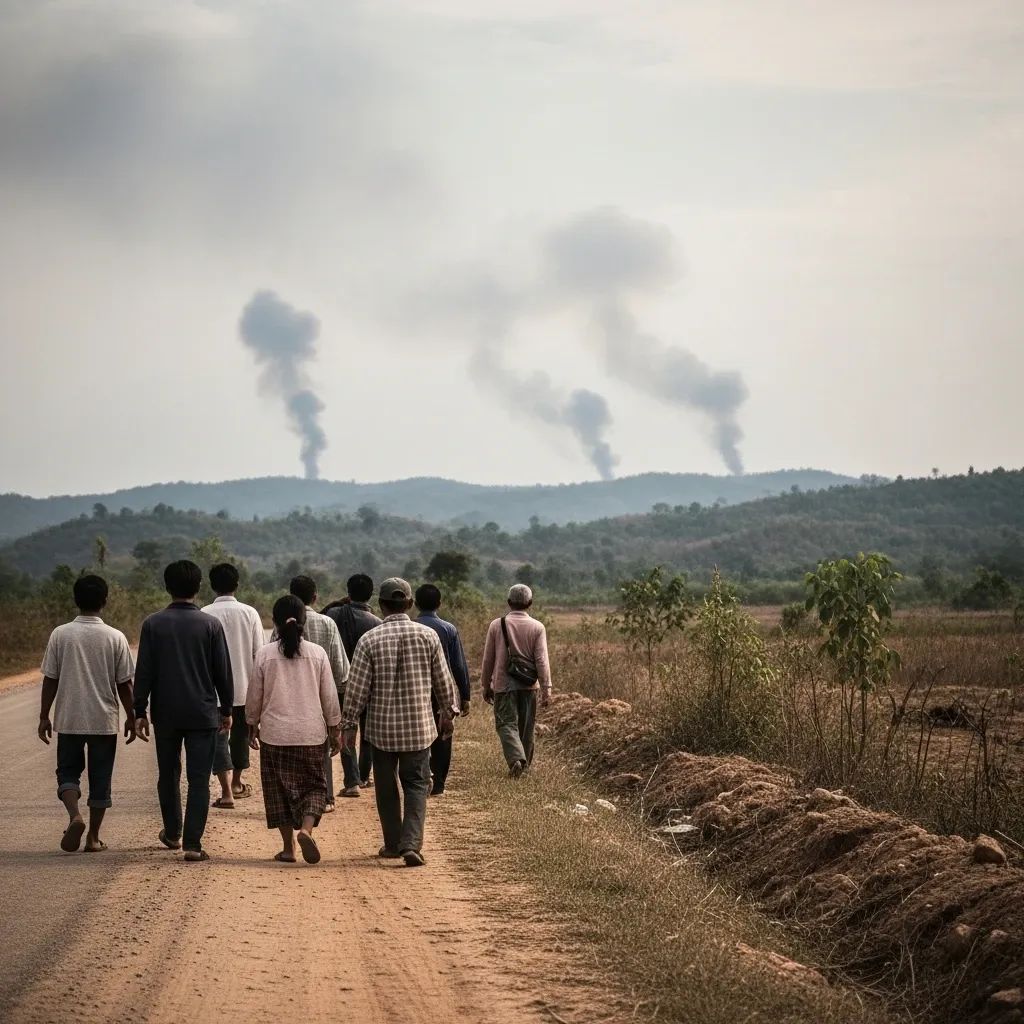
The emergency gathering of ASEAN foreign ministers in Kuala Lumpur ended with no ceasefire in hand, leaving communities from Sisaket to Siem Reap bracing for more artillery fire while diplomats search for common ground. Bangkok’s team walked away insisting on the same three pre-conditions it tabled before the meeting even began, and Phnom Penh left without signing on the dotted line. In short: the guns are still talking, villagers are still running, and ASEAN’s credibility is once again under the microscope.
Snapshot of a stalemate
• No formal truce emerged from the 22 December session.
• Three Thai conditions—Cambodia must declare the first halt, prove it will stick, and cooperate in mine clearance—remain unmet.
• Half a million people have now fled their homes on both sides of the 817 km frontier.
• A follow-up General Border Committee (GBC) meeting is scheduled for 24-26 December in Chanthaburi.
• External players—United States, China, Russia, France—are nudging both armies to step back, but artillery continues to rumble across the Dangrek range.
Inside the Kuala Lumpur talks
Malaysia, this year’s ASEAN chair, brought all 11 foreign ministers to the same table for the first time since clashes reignited on 8 December. Foreign Minister Mohamad Hasan floated a revival of the earlier Malaysia-brokered truce, bolstered by US satellite imagery and an ASEAN observer report. Yet after six hours behind closed doors the communiqué was thin: Bangkok and Phnom Penh “agreed to continue discussions”. Diplomats privately admitted that ASEAN’s consensus model offered little leverage once the two protagonists dug in.
Thailand’s three non-negotiables
Bangkok’s delegation—led by Foreign Minister Sihasak Phuangketkeow and Gen Natthaphong Phraokaew—reiterated what officials now call the “3 C’s”.
Cambodia must call the ceasefire first, as the side Thailand blames for the 8 December flare-up.
Any halt in shelling must be continuous and verifiable, with joint patrols documenting compliance.
Phnom Penh must enter a serious de-mining partnership, after Thai engineers recorded the eighth limb-loss casualty this month.
Until those steps occur, the Royal Thai Armed Forces say they will keep the pressure on key supply arteries such as the O’Chik Bridge linking Siem Reap to Oddar Meanchey. Air Marshal Chakkrit Thammavichai signalled the bridge could be bombed again if rockets keep landing in Surin’s Phanom Dong Rak district.
Human toll along the frontier
The border provinces of Sisaket, Surin and Buriram have absorbed the heaviest blow. Thai military relief units counted 222,548 evacuees in 751 shelters by 11 December; the figure has since climbed to roughly 400,000. Fatalities on the Thai side stand at 22 soldiers and an unknown number of civilians, while Cambodian media claim similar numbers but offer few verified details. Aid agencies warn that continued displacement during the cool season could compound health risks, especially for the elderly sleeping in makeshift camps.
Big-power diplomacy in play
Washington’s carrot-and-stick strategy—tariff threats paired with shuttle diplomacy by Secretary of State Marco Rubio—is matched by Beijing’s quieter manoeuvres. Special Envoy Deng Xijun spent the weekend in both capitals reminding them that Chinese investment in regional infrastructure hinges on stability. Analysts say the duelling superpowers highlight ASEAN’s limited muscle: the bloc can convene rooms, but cajoling battlefield concessions still requires outside heft.
What to watch next
The spotlight now shifts to the GBC talks starting 24 December in Chanthaburi. If working-level officials can stitch together inspection protocols, a ministerial-level signing—featuring Defence Minister Natthaphon Nakphanich and Cambodian counterpart General Tea Seiha—is pencilled in for 27 December. Thai negotiators caution that they will not ink anything unless Phnom Penh’s rockets go silent first.
For residents in the lower Northeast, the metric is simpler: quiet nights instead of the thud of BM-21s. Until that happens, schools will stay shuttered, harvests will rot in the fields, and ASEAN’s lofty declarations will ring hollow across the rice paddies of the Mekong rim.


