
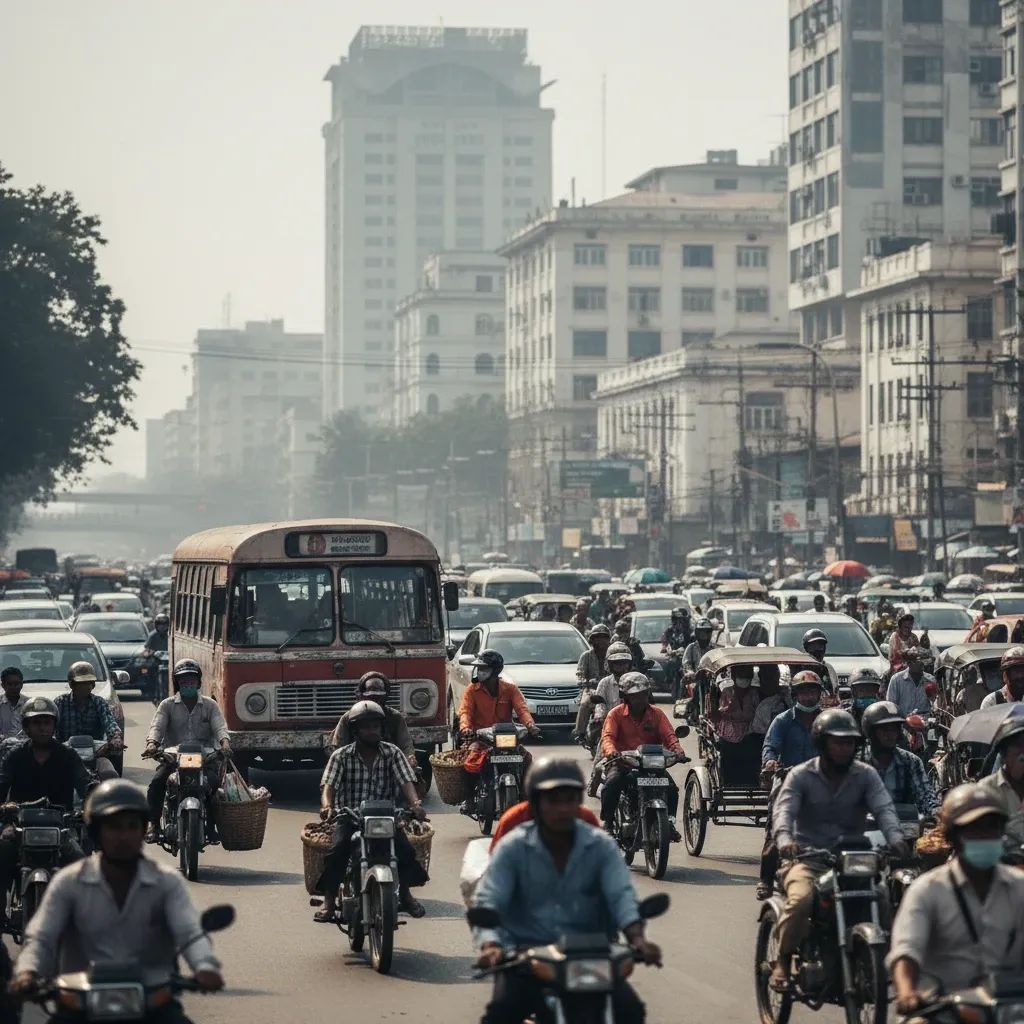
Myanmar's fuel rationing scheme, starting March 7, will disrupt cross-border trade and travel for Thai border communities and businesses with Myanmar operations, as the military junta implements odd-even license plate restrictions to manage dwindling petroleum supplies. The move will curtail mobility in a country already grappling with power outages and economic turmoil, with particular consequences for foreign residents, businesses, and border communities dependent on automotive transport.
Why This Matters
• Driving restrictions begin Saturday: Vehicles with even license plates operate only on even dates; odd plates on odd dates. Electric vehicles are exempt.
• Fuel stockpiles limited: The junta reports roughly 40 days of reserves, and border towns like Myawaddy ran dry as early as March 3.
• Price pressure ahead: Diesel trades at MMK 2,571 per liter (USD 0.79), but hoarding and black-market resale could spike costs further.
• Duration unclear: Officials say rationing stays "until further notice," with no firm timeline for lifting the policy.
The Rationing Mechanics
The National Defence and Security Council announced an even-odd plate system that mirrors fuel-saving schemes used during past global energy crises. Private cars with license plates ending in even digits may drive only on the 2nd, 4th, 6th, and so forth through the month. Odd-numbered plates take the road on the 1st, 3rd, 5th, and onward. Electric motorcycles and fully electric passenger vehicles escape the restriction, as do taxis, buses, cargo trucks, emergency services, and sanitation vehicles.
Enforcement mechanisms remain vague. The junta has not clarified penalties for violators, nor detailed which agencies—military police, traffic units, or local checkpoints—will oversee compliance. Observers expect spot checks at major intersections in Yangon, Mandalay, and provincial capitals, though enforcement capacity in conflict zones and rural areas is likely to be sporadic.
The rationing applies nationwide, a challenge in a country where public transit infrastructure is limited and ride-hailing apps face intermittent internet shutdowns. For expatriates and foreign business personnel accustomed to daily commutes, the system introduces fresh logistical friction: coordinating two-car households, sharing vehicles with colleagues, or paying premium rates for exempt taxis and ride services.
Supply Chain Rupture
Myanmar imports 90% of its refined fuel, primarily from Singapore and Malaysia, which process crude from the Persian Gulf. Escalating conflict between the United States, Israel, and Iran has disrupted tanker traffic through the Strait of Hormuz, driving international shipping costs upward and diverting vessels to longer, costlier routes. The junta blames "global political situations" for the shortfall, a reference to the Middle East tensions that have frozen roughly 20% of the world's oil transit.
The disruption compounds an already fragile supply picture. Thailand recently banned petroleum exports to Myanmar, cutting off an overland lifeline that had cushioned earlier shortages. Secondary channels via Russia remain open but depend on circuitous rail and pipeline routes that add weeks to delivery schedules. In Myawaddy, a key border trading hub opposite Thailand's Mae Sot, pumps went dry March 3, forcing residents to cross into Thailand to refuel—a workaround that underscores the unevenness of the junta's distribution network.
Fuel prices have held relatively steady in recent weeks, with Octane-95 gasoline at MMK 2,546 per liter (USD 0.78) as of March 2, but analysts warn that scarcity will embolden smugglers and hoarders. The military government has issued stern warnings against stockpiling for resale, threatening prosecution under unspecified statutes, yet the legal framework for enforcement remains opaque.
Impact on Thailand Border Communities
For Thai border residents and businesses, Myanmar's fuel crisis creates both challenges and opportunities. Cross-border trade flows—especially in Tak, Chiang Rai, and Ranong provinces—will face delays as trucking schedules adjust to the rationing calendar. Thai exporters shipping goods through Myawaddy and Mae Sot should expect longer border-crossing times and potential vehicle holdups.
Thai-registered vehicles traveling into Myanmar will operate under the same restrictions as Myanmar-plated vehicles; exemptions apply only to electric vehicles. Thailand residents planning short-term visits should refuel before crossing the border and avoid traveling on restricted days if their vehicle's plate would be prohibited.
Thai businesses operating in Myanmar—from garment factories in Yangon to logistics firms serving the broader region—must now plan operations around the odd-even roster. This may require expanding vehicle fleets, switching to exempt commercial transport licenses, or restructuring delivery schedules. The additional costs will likely translate to higher product prices or delayed shipments to Thailand.
Mae Sot and other gateway towns face new economic pressures. Border traders historically relied on quick turnaround trips to Myawaddy for wholesale purchases; rationing will compress business hours and reduce transaction volume. Fuel smuggling into Thailand is expected to increase, though Thai authorities maintain strict controls at checkpoints.
What This Means for Thailand Residents
For those planning Myanmar travel: Monitor fuel availability in gateway towns before crossing the border. Avoid traveling during dates when your vehicle plate would be restricted. Expect longer transit times through affected areas and higher ride-hailing costs in Yangon.
For Thai businesses with Myanmar operations: Review your fleet composition now. Coordinate vehicle schedules around the odd-even system or negotiate premium rates for exempt commercial transport. Alert Myanmar-based staff to plan commutes accordingly.
For border community residents: Anticipate delays on cross-border shipments. If you engage in small-scale fuel transfers for personal use, understand that Thai authorities tolerate modest amounts but prosecute large-volume smuggling. Consider stocking modest fuel reserves in Thailand to avoid shortages.
Longer-Term Energy Strategy
Recognizing the vulnerability of its import-dependent fuel model, the Myanmar military government has accelerated renewable energy plans. The junta aims to commission 51 new solar projects with a combined capacity of 3,000 megawatts, building on 11 existing plants that contribute 340 MW to the national grid. Contracts for 16 projects at 20 MW each have been awarded, with tenders for nine more totaling 1,060 MW in the pipeline.
These solar initiatives revive proposals from the pre-coup civilian government in 2020 and align with a stated target: 11% of electricity from renewables by 2030 (2,000 MW), rising to 17% (3,070 MW) if international funding materializes. Myanmar also operates 28 hydropower plants generating 3,225 MW, and officials have floated mini-hydro, wind, biomass, and tidal concepts, though none have advanced beyond pilot stage.
Electric vehicles figure prominently in the junta's contingency planning. The exemption for EVs and electric motorcycles signals an intent to steer consumers toward battery-powered transport, though Myanmar's rudimentary charging infrastructure and high upfront costs limit adoption. Yangon counts fewer than a dozen public charging stations, and electricity blackouts undermine the reliability of home charging.
Global Precedents
Myanmar's even-odd rationing echoes policies deployed during past energy shocks, with mixed results. During the 1973 OPEC embargo, the United States instituted license-plate-based fuel rationing that spawned hours-long queues and public frustration. Denmark, Italy, and West Germany banned Sunday driving; France cut television broadcasts after 11 PM to save electricity. Sweden's rationing and public awareness campaigns trimmed petroleum use by 16% by 1980, demonstrating that short-term restrictions can foster lasting behavioral shifts if paired with clear communication and alternative infrastructure.
More recent examples highlight pitfalls. Venezuela's ration cards in 2014 failed to prevent black-market profiteering amid broader economic collapse. Cuba's decades-old rationing system, reactivated during the COVID-19 pandemic, relied on centralized control that Myanmar's fragmented governance cannot replicate. The junta's challenge is enforcement: without a unified bureaucracy or public trust, rationing risks uneven application and heightened corruption.
Practical Considerations
Residents in Thailand with business or family ties across the border should monitor fuel availability in gateway towns like Mae Sot and Ranong. Cross-border fuel smuggling is likely to increase, raising the risk of checkpoint detentions and confiscations. Thai authorities have historically tolerated small-scale fuel transfers for personal use, but large-volume smuggling draws prosecution.
For those inside Myanmar, stocking a modest fuel reserve—within legal limits—may smooth the transition, but officials warn that hoarding invites legal action. Electric scooters and bicycles offer rationing-exempt mobility, though Yangon's chaotic traffic and limited cycling lanes pose safety concerns. Ride-hailing apps like Grab remain operational but expect surge pricing as demand outstrips the pool of exempt taxis.
The junta has not announced a review date for the rationing policy, leaving residents to plan for an indefinite duration. Historical precedent suggests that once imposed, fuel restrictions tend to outlast the crises that triggered them, particularly when governments lack the fiscal resources or diplomatic leverage to secure alternative supplies quickly.


