
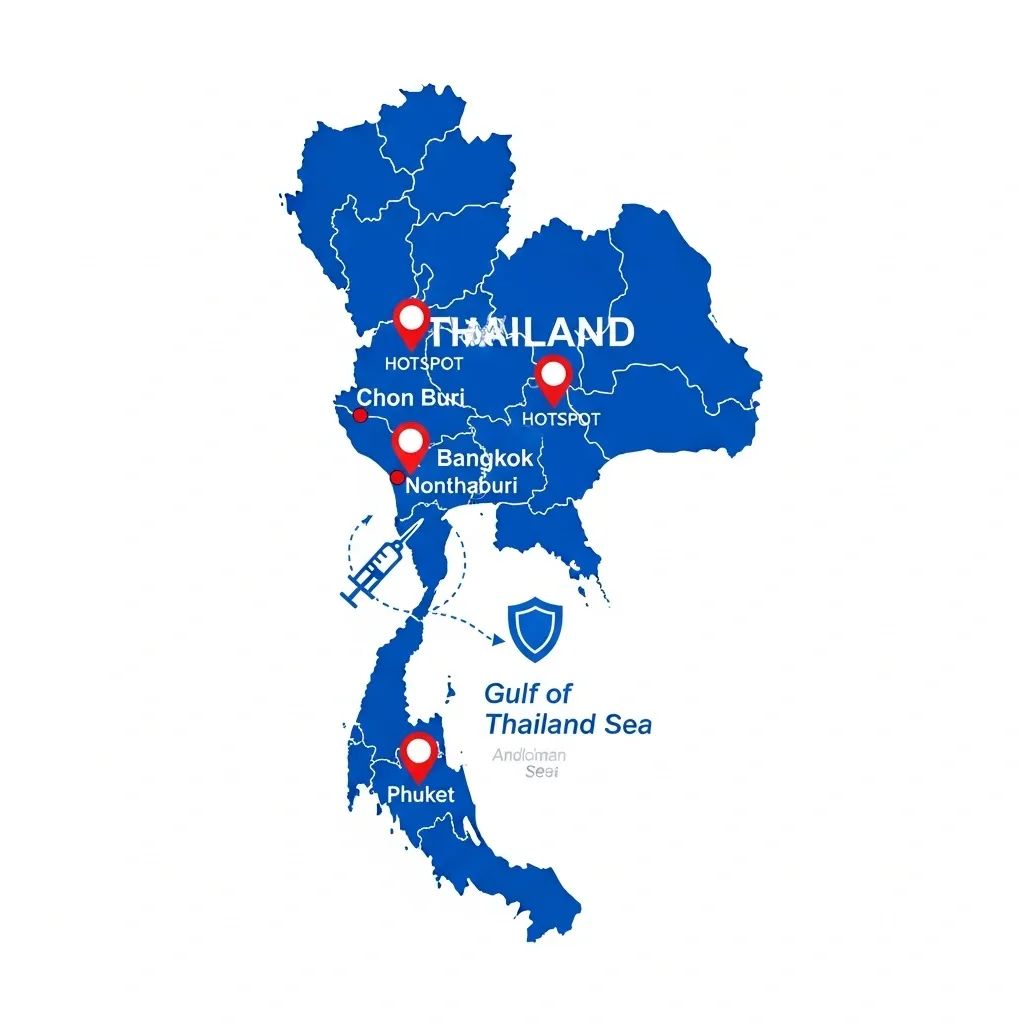
The World Health Organization has documented a worrying evolution in the global mpox outbreak, with 16 African nations reporting active transmission and a rare hybrid viral strain now identified in three countries. For residents and travelers in Thailand, where cumulative cases approach 1,000 infections with an upward trajectory since mid-2025, the shifting epidemiology signals a need for heightened vigilance—particularly in Bangkok, Phuket, Chiang Mai, and Chon Buri, where tourism and nightlife create transmission hotspots.
Why This Matters:
• Three viral clades now circulate simultaneously worldwide, including the more severe Clade I and a recombinant Ib/IIb hybrid detected in Qatar, India, and the UK
• Thailand recorded its first mpox death in February 2026—a 44-year-old inmate with HIV—followed by two secondary prison infections
• Singapore confirmed two Clade Ib cases in April with no travel history, indicating community spread has reached Southeast Asia
• High-risk groups in Bangkok, Chon Buri, Chiang Mai, and Phuket now have access to vaccines through the Thailand Department of Disease Control
A Fractured Global Picture
Between March 9 and April 19, 2026, the WHO logged 969 confirmed cases and three deaths across Africa alone, representing 70.4% of the global burden. Madagascar, the Democratic Republic of the Congo, Guinea, Kenya, and Burundi drove case counts during this six-week window. Yet the epidemiological map is far from uniform: while the Americas, Europe, Southeast Asia, and Africa saw declines in March compared to February, the Eastern Mediterranean and Western Pacific regions reported increases.
This patchwork reflects divergent transmission dynamics. Clade IIb, the strain behind the 2022 global surge, continues to move primarily through sexual networks, disproportionately affecting men who have sex with men outside Africa. Meanwhile, Clade I—historically linked to animal contact and household transmission—remains endemic in Central Africa, with case fatality ratios historically ranging from 1% to 10%, compared to less than 1% for Clade II in settings with adequate medical infrastructure.
The emergence of Clade Ib complicates this picture further. First observed in the Democratic Republic of Congo in September 2023, Clade Ib spreads more readily through sexual contact across diverse demographics, including heterosexual transmission via sex trade networks. By early 2026, imported Clade Ib cases appeared in Colombia, Denmark, Ecuador, Singapore, Argentina, Germany, Pakistan, Portugal, Spain, and the United Kingdom—with several countries documenting community transmission among men who have sex with men, a pattern previously dominated by Clade IIb.
The Hybrid Threat
In a rare evolutionary twist, Qatar reported a recombinant Clade Ib/IIb strain in late 2025, marking only the third known global occurrence of such a hybrid. Recombination occurs when two related viruses co-infect the same individual, swapping genetic material to create a new variant. The UK and India subsequently identified similar cases, all linked to recent travel. While patients experienced mild illness and no secondary transmission was documented after contact tracing, the hybrid's long-term transmissibility and clinical severity remain under investigation.
Virologists caution that recombinant strains can inherit unpredictable traits from parent clades—potentially combining Clade Ib's enhanced transmissibility with Clade IIb's established sexual network spread. For now, the WHO treats these cases as isolated events, but the detection mechanism itself—contact tracing and genomic sequencing—reveals how frequently mpox circulates undetected in populations with high mobility.
What This Means for Residents
For those living in Thailand, the practical implications center on three risk categories: sexual health, household transmission, and healthcare settings.
Sexual Networks: Approximately 97% of Thailand's reported cases involve working-age males who disclosed sexual contact with unfamiliar partners. The Thailand Department of Disease Control has prioritized vaccine distribution to medical personnel and high-risk groups in Bangkok, Chon Buri, Chiang Mai, and Phuket—provinces where international tourism and entertainment venues create dense contact networks. Both pre-exposure prophylaxis (PrEP) and post-exposure prophylaxis (PEP) using the JYNNEOS vaccine are now available in these zones.
Household Spread: Once mpox enters a home, transmission to cohabitants becomes likely through shared bedding, towels, or direct contact with lesions. The February 2026 prison outbreak illustrates this: two health volunteers contracted the virus after caring for an infected inmate, despite wearing personal protective equipment. Families with immunocompromised members—particularly those with HIV, hepatitis, or undergoing chemotherapy—face elevated risk.
Healthcare-Associated Transmission: Pakistan's outbreak in Sindh province, which involved neonates, infants, and adults with a high fatality ratio among infants under six months, underscores the vulnerability of healthcare settings. Thai hospitals have received updated infection prevention and control guidance, but travelers returning from regions with active Clade I transmission should disclose their travel history during medical consultations.
Surveillance and Testing
The Thailand Department of Disease Control has expanded mpox surveillance in tourist destinations, but case detection hinges on individuals recognizing symptoms and seeking care. Early mpox presents as fever, headache, muscle aches, and swollen lymph nodes, followed by a distinctive rash that progresses from macules to pustules before scabbing. Unlike chickenpox, mpox lesions often begin on the face and extremities, though genital and perianal rashes are common in sexually transmitted cases.
Laboratory capacity for clade-specific testing remains limited in Southeast Asia, meaning most domestic cases are classified generically as Clade II without genomic sequencing. This creates a blind spot: imported Clade Ib cases, like those in Singapore with no travel history, can evade detection until community spread is established.
Global Vaccination Push
By 2026, the WHO and Gavi, the Vaccine Alliance, aim to establish a global mpox vaccine rapid deployment mechanism and stockpile, prioritizing countries with active outbreaks and limited resources. Africa CDC is simultaneously investing in local vaccine manufacturing to reduce dependence on imported doses, which have historically arrived too late to contain outbreaks.
In Singapore, the National Centre for Infectious Diseases began offering mpox vaccines this month, integrating them into routine sexual health services. Thailand's rollout follows a similar model, embedding vaccination within HIV clinics and sexual health centers to reach the most vulnerable populations without requiring separate appointments.
The Path Forward
Rapid containment requires a combination of early case detection, contact tracing, and community engagement—particularly with populations historically marginalized by public health systems. The WHO's Strategic Framework for enhancing prevention and control of mpox (2024-2027) emphasizes risk communication tailored to local contexts, acknowledging that generic public health messaging often fails to resonate with those at highest risk.
For residents of Thailand, the immediate action items are straightforward: individuals with multiple sexual partners should consider PrEP vaccination, those exposed to confirmed cases within 14 days should pursue PEP, and anyone developing unexplained rashes should seek medical evaluation rather than self-diagnosing. Travel to Central Africa or regions with active Clade I transmission warrants heightened vigilance, particularly for those planning to engage in close-contact activities.
The global case fatality ratio currently stands at 0.4%, but this figure masks stark disparities. In settings with advanced medical care, deaths are rare and concentrated among immunocompromised individuals. In resource-limited environments, particularly for Clade I infections, mortality climbs sharply. Thailand's first fatality—a 44-year-old with HIV, hepatitis B and C, and syphilis—illustrates how underlying conditions amplify risk.
As three viral clades and one hybrid strain circulate simultaneously, the epidemiological landscape grows more complex. The recombinant Ib/IIb strain, though currently rare, represents a biological wildcard whose behavior remains unpredictable. For public health officials in Thailand and across Southeast Asia, the challenge lies in maintaining surveillance infrastructure and vaccine access while the virus evolves in real time—a race that demands sustained funding, political will, and community trust in equal measure.


