
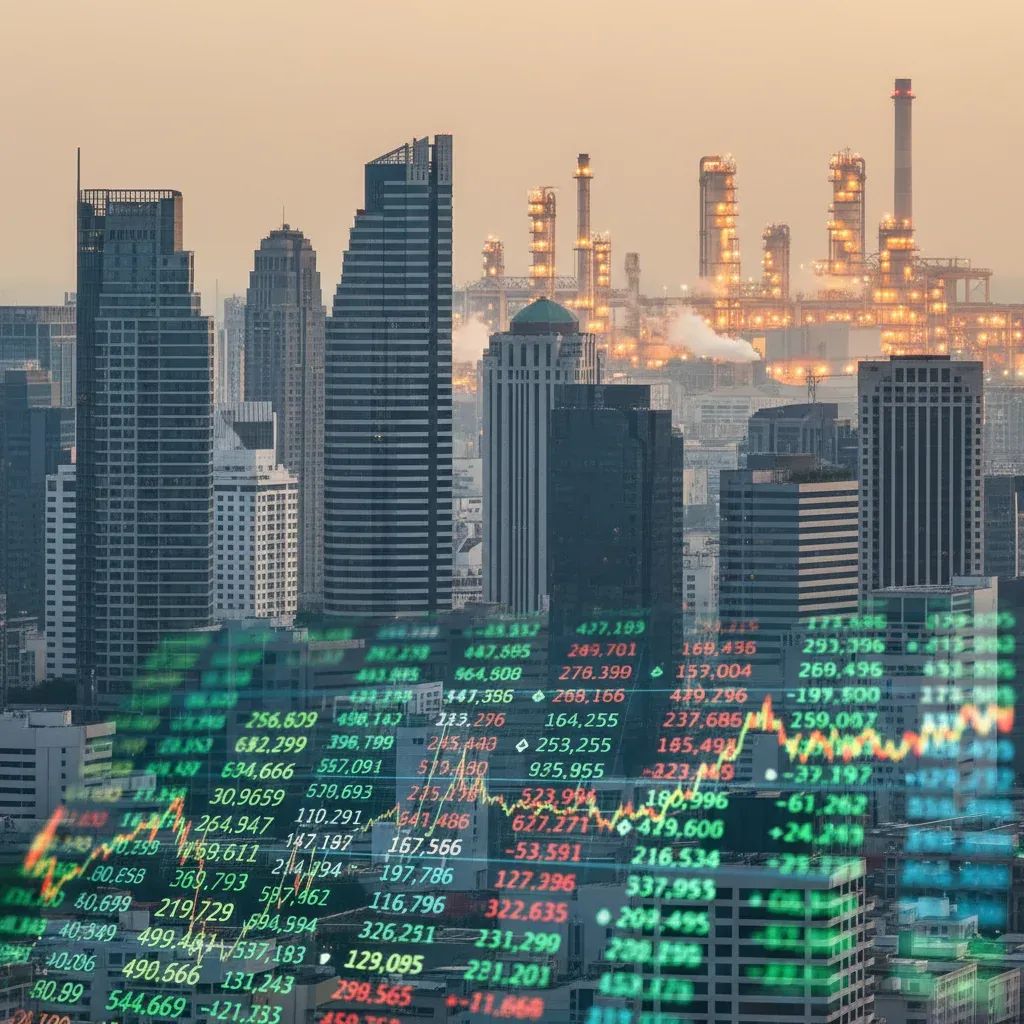
Middle East Crisis Drives Thailand's Inflation to 38-Month High
Thailand's economy is facing mounting pressure from the escalating Middle East conflict, with inflation hitting its highest level in 38 months and government officials slashing growth forecasts. Rising oil prices—surging 61% to above $115 per barrel—are filtering through to consumer prices and threatening household budgets already strained by high debt levels. In response, the Thai Cabinet approved a $12.2 billion (400 billion baht) emergency borrowing package in early May to support vulnerable groups and stabilize the economy.
The most immediate impact is visible in everyday costs. Inflation climbed to 2.89% in April, up from the government's earlier projection of 0.3% for 2026, with the Ministry of Finance now forecasting full-year inflation of 3.0%. The surge stems primarily from energy costs, as Thailand imports roughly 52% of its energy from the Middle East. Residents are already feeling the pressure: airfares have climbed 10-15% as airlines reroute around conflict zones, and transportation and food costs are rising alongside fuel prices.
What the Crisis Means for Your Wallet
Every $10 increase in crude oil prices potentially adds 0.5 percentage points to inflation and shaves 0.1% off economic growth, according to economic modeling. For Thai residents and businesses, this translates into tangible daily pressures. The World Bank estimates that a $20 increase in crude prices could raise inflation by approximately 0.67 percentage points within six months—further eroding purchasing power at a time when household debt hovers near 87-92% of GDP, among the highest rates in Southeast Asia.
Energy-intensive industries are already feeling the squeeze. Factory operations face rising input costs as margins compress, and small businesses, farmers, and low-income households confront acute pressure from both elevated costs and softer demand.
Economic Growth Under Threat
The government's growth forecasts have deteriorated sharply. The Ministry of Finance lowered its 2026 GDP growth forecast to 1.6% from a previous 2.0%, with estimates ranging between 1.1-2.1% depending on conflict duration. The Office of the National Economic and Social Development Council (NESDC) has modeled even bleaker scenarios, suggesting growth could plummet to 0.2% if hostilities persist and deepen.
The International Monetary Fund cut Thailand's 2026 outlook to 1.5%, while the Bank of Thailand has adjusted its estimates between 1.3% and 2.1% as government stimulus measures kick in. The wide variance reflects profound uncertainty about the conflict's trajectory and its economic spillovers.
Tourism, a critical revenue source for Thailand, is also expected to decline. Foreign arrivals are forecast at 33.5 million for 2026, down 2 million visitors from earlier projections. This represents a significant reduction in a sector that contributes substantially to government revenue and employment. European and Middle Eastern visitor numbers dropped 18% in early March alone, and industry experts now brace for potential losses of up to 3 million tourists and multi-billion baht revenue shortfalls.
Export Markets Facing Headwinds
Export performance presents a mixed picture. While the Ministry of Finance projects 6.2% growth in export value for 2026 driven by recovering demand from major trading partners, analysts warn this figure could collapse below 1% if tensions escalate further. Food exports—critical for rural communities—have already contracted 10.5% in the first two months of 2026, with shipments to Iraq and other Middle Eastern markets suspended due to the conflict. The region's market for Thai food products is projected to shrink by 50.7% this year, directly impacting farmers and agricultural exporters who depend on these markets.
Government Response and Structural Supports
The $12.2 billion emergency package targets vulnerable groups including farmers, low-income households, and small enterprises, while also supporting alternative and renewable energy initiatives aimed at reducing long-term dependence on imported fossil fuels. This represents a critical lifeline for those most vulnerable to economic shocks.
Thailand maintains structural advantages that provide some insulation from the crisis. The country holds $238.4 billion in international reserves as of March, equivalent to 7.7 months of import coverage—a critical buffer against external shocks. The Thailand banking sector maintains high standards for non-performing loans (bad debts held by banks are well-covered), strong capital positions, and sufficient liquidity to weather turbulence. The Thailand Stock Exchange (SET) has shown relative stability, falling only 0.3% since the conflict intensified despite a 5.6% single-day plunge in early March.
Moody's Ratings has singled out Thailand as one of five emerging economies with structural resilience to absorb global shocks, crediting the nation's strong financial sector and substantial international reserves.
Managing Long-Term Risks
The government has activated the Oil Fuel Fund to stabilize retail fuel prices and maintains petroleum reserves sufficient for approximately 65 days of domestic consumption. Authorities are temporarily restricting petroleum exports to secure local supply while pursuing long-term diversification of import sources.
However, Thailand faces real vulnerabilities. The Strait of Hormuz, through which 34% of global crude oil trade and 24% of Thailand's LNG imports flow, represents a critical chokepoint. Any prolonged disruption could push oil prices to $120-150 per barrel in worst-case scenarios, with cascading effects on production costs, freight rates, and insurance premiums across supply chains.
Public debt has climbed to approximately 65-66% of GDP by December 2025, edging closer to the statutory 70% ceiling and constraining fiscal space for additional government support. The Bank of Thailand has implemented interest rate cuts to support economic activity and ease debt burdens, but elevated inflation may limit further rate reductions.
Regional Comparisons
Thailand's response reflects strategies employed across Southeast Asia. Malaysia, a net energy exporter, enjoys greater insulation from oil price volatility and focuses on diversifying palm oil markets. Singapore relies on its strong fiscal position and role as a refining hub. Indonesia uses fuel subsidies to cushion consumer impacts and pursues diplomatic mediation. Vietnam operates a dedicated energy security task force. ASEAN economic ministers are discussing coordinated measures to strengthen regional oil storage capacity, diversify energy sources, and advance power grid integration.
Looking Ahead
The consensus among financial analysts is cautious optimism tempered by vigilance. Thailand's solid international reserves and strong influx of foreign direct investment—particularly in emerging industries including electric vehicles, robotics, and digital infrastructure—provide structural support for longer-term resilience. Market analysts anticipate continued volatility in the months ahead, with potential for stabilization if geopolitical risks ease, but ongoing pressure if conflicts escalate.
For Thai residents and businesses, the path forward requires preparation for sustained uncertainty. Portfolio strategies emphasizing energy beneficiaries, defensive sectors like telecom and healthcare, and selective growth opportunities appear prudent. The government's emergency measures and long-term energy diversification plans offer some relief, but household and business-level adaptation—from managing transportation costs to finding efficiency gains—will remain necessary as the geopolitical landscape remains fluid.


