
When a person in acute distress ends up in police custody in Thailand, it's rarely about breaking the law. On February 23, officers in Jomtien responded to something more complex: a foreign national in psychological crisis, alone and unable to communicate. The outcome reveals how Thailand's emergency systems work—or sometimes don't—when tourists and residents hit rock bottom far from home.
Why This Matters
• Police detention for mental health is standard practice, not criminal: Pattaya officers can hold individuals for observation when they pose immediate danger to themselves or the public, though this is a temporary measure pending medical assessment.
• Language barriers create dangerous delays: First responders cannot diagnose crises and often cannot communicate with distressed non-Thai speakers, meaning proper care is delayed while authorities sort out who can help.
• Psychiatric services in Thailand are almost entirely private and paid: Unlike Western systems, there's no free emergency mental health option, leaving uninsured people to face astronomical bills or deportation.
The Incident: February 23 in Jomtien
What started as a report to Jomtien municipal enforcement officers escalated quickly. Security personnel at D Varee Hotel on Soi 14 called authorities after witnessing a woman striking her head repeatedly against a wall—a visible sign of acute distress that raised immediate concern for both her safety and public order. When Pattaya City Police Station units arrived, the situation presented the kind of ambiguity that routine policing is unprepared to handle.
The woman was visibly distressed but refused interaction with officers. She offered no identification, no explanation, no words that might have pointed toward a solution. Without context—was this intoxication, a medical emergency, severe anxiety, psychosis—officers faced a decision: leave her in a public space where she was actively harming herself, or move her somewhere she could be monitored while proper assessment could happen.
They chose the latter. The woman was transported to the police station under protective custody, a precautionary mechanism that keeps someone safe for a limited period while authorities coordinate with medical facilities, embassies, or other agencies. Investigations are ongoing to determine whether intoxication, underlying mental illness, medication reactions, or extreme stress triggered the episode.
How Thailand Actually Responds to Mental Health Crises
The response that unfolded isn't unique to this case—it's the system that operates whenever a foreign national visibly deteriorates in a Thai public space. Understanding it matters for anyone living in or visiting the country.
Pattaya City Police Station contacted the Russian Embassy following standard protocol for foreign nationals in custody. That embassy liaison is critical because without it, there's often no way to understand what happened or what comes next. Thai authorities can provide immediate safety but typically cannot diagnose, treat, or determine disposition alone.
The Mental Health Act B.E. 2551 (2008), amended in 2019, gives police and doctors legal authority to detain individuals without consent if they pose "serious harm to themselves, others, or property" or lack the capacity to consent to treatment. This applies to Thai nationals and foreigners equally, though execution differs sharply. Involuntary admission is restricted to government psychiatric facilities, but foreign nationals typically end up in private hospitals if they can pay or if insurance covers it. Without either, options narrow considerably.
What makes this genuinely challenging: Thai police are not mental health professionals. They can observe, they can prevent immediate harm, but they cannot diagnose depression, anxiety, psychosis, medication-induced crisis, or intoxication-related behavior. That gap between what they can do and what the person needs creates a vulnerable window where safety depends on luck, communication, and whether the person has consular support or insurance.
Healthcare Access in Pattaya: The Reality for Foreigners
The foreign nationals who navigate mental health emergencies best in Pattaya are those with two things: insurance that covers psychiatric services and proximity to English-speaking care.
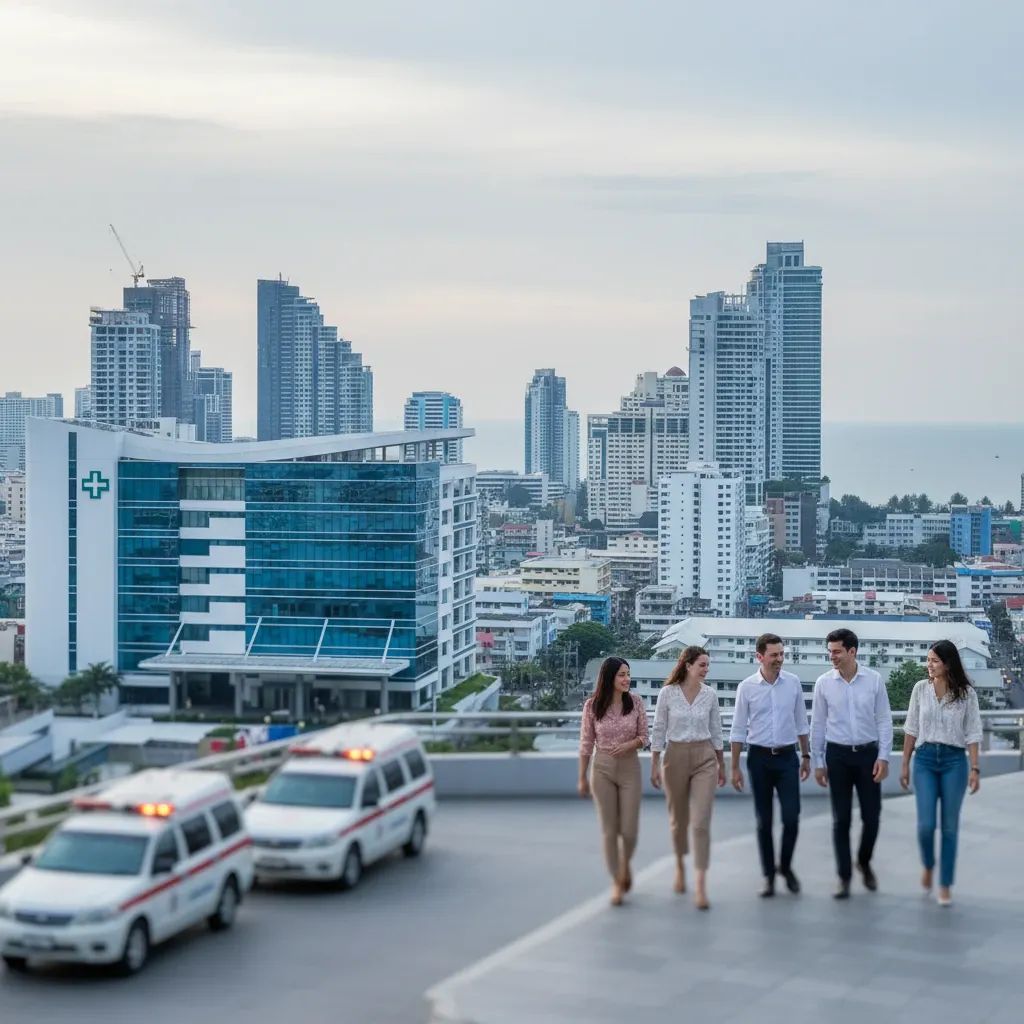
Bangkok Hospital Pattaya operates a 24-hour Emergency Medical Service Center staffed by critical care specialists. It's JCI-accredited, supports 20+ languages, and has infrastructure built explicitly for international patients—worldwide insurance coordination, repatriation assistance, embassy liaison. Pattaya International Hospital lists psychiatry as a core specialty, maintains its own ambulance fleet, and staffs English-fluent doctors and senior nurses. Pattaya Memorial Hospital also operates 24/7 emergency services. All three accept walk-ins, require no referral, and can begin psychiatric assessment immediately.
This matters immensely because no, there is no free emergency mental health care in Thailand for foreigners. Treatment at private hospitals costs thousands of baht. A simple psychiatric evaluation can run 2,000–5,000฿. Medication, observation, or admission compounds that rapidly. Uninsured tourists have documented bills exceeding 100,000฿ for a single crisis admission. Even insured individuals face denials if their policy excludes mental health, which many do.
The path forward for the Russian woman likely involves medical evaluation at one of these private facilities, coordinated through Pattaya City Police Station and the Russian Embassy. If she lacks insurance, Russia's consular services may cover costs. If not, she faces both a medical debt and potential immigration complications.
Support Infrastructure That Actually Exists
For anyone living in or visiting Pattaya who recognizes a mental health crisis—in themselves or someone else—there are actual resources, though none are intuitive and all require advance knowledge.
Samaritans of Thailand operates a free, confidential hotline at 02-113-6789 (press 2 for English). You can leave a message; they return calls within 24 hours. It's anonymous and designed for anyone experiencing anxiety, depression, or suicidal ideation. The Department of Mental Health Hotline at 1323 offers 24/7 support with English-language options for stress, panic, or insomnia. The Mental Wellness Center at 1667 provides additional listening lines.
For life-threatening crises, bypass the hotlines. Go directly to the emergency room of an international hospital, request the psychiatrist on duty, and have insurance information or a payment guarantee ready. Bangkok Hospital Pattaya, Pattaya International Hospital, and Pattaya Memorial Hospital all operate these services continuously.
The Tourist Police at 1155 can assist with language barriers, ambulance coordination, and embassy notification during emergencies. The national ambulance number is 1669. If you're experiencing thoughts of self-harm or suicide, calling these numbers isn't weakness—it's survival infrastructure that exists precisely for moments like this.
Legal Landscape for Foreign Nationals in Crisis
The Immigration Act Section 12 (4) technically allows denial of entry to anyone deemed "mentally unstable," though in practice this is applied only when someone poses danger to others. For people already in Thailand on tourist visas or visa-exempt entry, a mental health crisis alone does not trigger immigration action. Immigration enforcement activates mainly for documented overstays or illegal entry, not health status.
Foreign nationals seeking long-term visas—such as the Thailand Privilege visa—may face background checks requiring proof of mental stability, typically through consent forms rather than mandatory medical certificates. This creates a perverse incentive: people on long-term status may avoid seeking help precisely because they fear visa repercussions.
If extended mental health treatment is needed, visa options exist. The Medical Tourist Visa (MT) and Non-Immigrant O Visa (Medical) both require a confirmation letter from a qualified Thai medical facility describing the treatment plan and proof of financial capacity. A specialized PTSD treatment visa is also available. These require advance planning, not crisis response.
Undocumented migrants face the cruelest calculus: fear of arrest and deportation prevents them from seeking healthcare, and Thai law classifies refugees and asylum seekers as "illegal aliens." Immigration detention centers offer only basic healthcare; outside referrals require approval and self-payment. This gap—between those with consular backing and those without—is where vulnerable people quietly suffer.
What This Means for Residents
If you live in Pattaya or anywhere in Thailand, the Jomtien incident underscores a harsh reality: mental health support infrastructure here operates nothing like Western systems. There's no robust public option, no safety net that catches everyone. It's private hospitals, insurance, and personal preparedness.
Before a crisis happens—and statistically, some residents will face one—establish three specific things:
Verify your insurance covers psychiatric services. Read the fine print. Many policies exclude mental health entirely or cap it at absurdly low amounts. If you're uninsured, research the cost: 2,000–5,000฿ for a psychiatric evaluation at a private hospital in Pattaya. Budget accordingly.
Save these numbers in your phone right now. Samaritans of Thailand: 02-113-6789 (press 2). Department of Mental Health: 1323. Tourist Police: 1155. Ambulance: 1669. Save the names of these hospitals in your phone and verify current emergency contact numbers: Bangkok Hospital Pattaya, Pattaya International Hospital, Pattaya Memorial Hospital.
Register with your embassy and keep contact information current. Embassies facilitate medical assessment and coordination when foreign nationals are in distress. They also help with repatriation if someone becomes unable to stay in Thailand. They can't help if they don't know you exist.
Understand that police detention for mental health observation is temporary and precautionary, not criminal. If you or someone you know is held at a police station after a mental health crisis, that detention typically lasts until medical evaluation can happen or embassy coordination is arranged. It's not a mark against you; it's a holding pattern while the system figures out next steps.
What Comes Next
The Russian woman remains under monitoring at Pattaya City Police Station pending medical evaluation and embassy consultation. Her case will likely conclude with either medical admission at a private facility or arrangement for repatriation through official channels. Similar situations moving forward will follow the same protocol: police coordination with hospitals, embassies, and international resources to ensure both immediate safety and appropriate care.
Living in Thailand as a foreigner requires accepting this: when things go wrong medically or psychiatrically, you are largely responsible for your own coordination and costs. The police will keep you safe temporarily. Hospitals will treat you if you can pay. Your embassy will help if you're registered and lucky. But no one catches you automatically. That's the reality this incident illustrates starkly, and it's a reality worth understanding before crisis arrives.


