
The Thailand Royal Irrigation Department and local Chiang Rai authorities are racing to repair temporary flood barriers along the Sai River before monsoon rains intensify, but residents and officials alike fear the border district of Mae Sai may be defenseless against the kind of flooding that devastated the region in 2024. Governor Chuchip Pongchai has ordered all reinforcement work completed by June 2026—a deadline that looks increasingly uncertain as structural, diplomatic, and budgetary obstacles pile up.
Why This Matters
• Immediate risk: Heavy rain forecast for May 8-10 could trigger flooding if just 40 millimeters falls upstream in Myanmar; 90 millimeters would inundate the Sai Lom Joy market district.
• 2024 baseline: Last year's floods killed 14 people, damaged 175 buildings in Mae Sai alone, and submerged more than 247,500 rai of farmland across Chiang Rai.
• Deadline pressure: Temporary "big bag" levees at five critical points must be repaired by June 2026, but a ฿39.36M demolition project to clear flow-blocking buildings is stuck in land-title disputes.
• Cross-border complication: Myanmar has erected a permanent concrete wall exceeding 6 meters on its side of the river, accelerating current flow and deepening riverbed erosion on the Thai bank.
A Border Town Built on Borrowed Time
Mae Sai sits at the confluence of geography and geopolitics. The Sai River, which originates in Myanmar, runs narrow and shallow through the town center, passing beneath the cramped arches of the Thai-Myanmar Friendship Bridge No. 1. During the catastrophic floods of September 2024, water rose more than 1.5 meters in parts of the market district—a level unseen in three decades—sweeping away bridges, severing roads, and leaving the Sai Lom Joy border market under muddy floodwater for days. Losses in that market alone topped ฿100M.
Now, with the 2026 monsoon season beginning in earnest, Thailand's Department of Public Works and Town & Country Planning is midway through a master-plan study for the Sai River, budgeted at more than ฿2.95 billion and slated for completion in 2032. But that timeline offers little comfort to shopkeepers and residents who remember last year's chaos. The question on everyone's mind is simpler: Will the sandbag levees hold this June?
Five Critical Gaps, One Month to Patch Them
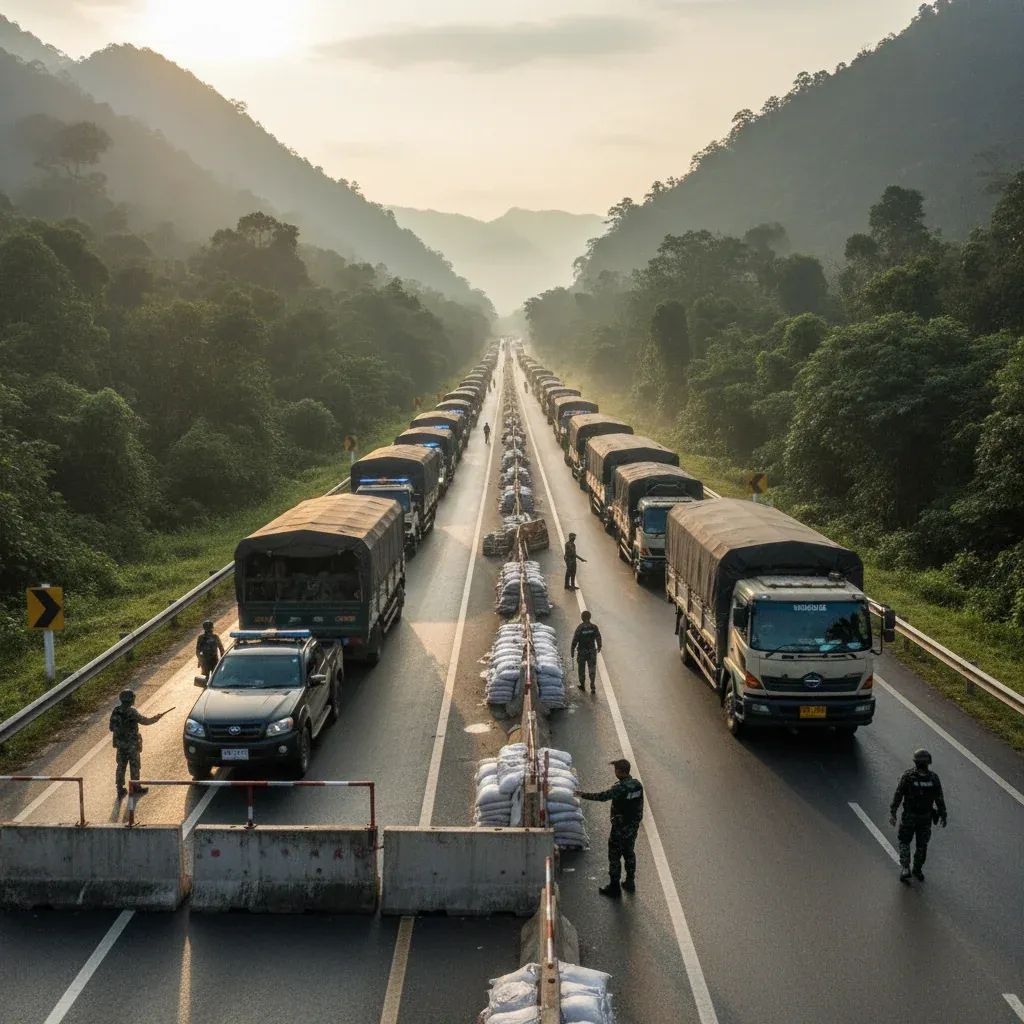
Governor Chuchip Pongchai convened an emergency coordination meeting earlier this week with commanders from the Third Army Region and officials from Mae Sai and Wiang Phang Kham subdistrict municipalities. The immediate focus: surveying and pricing repairs to five temporary flood barriers—locally known as "big bag" levees—that were hastily erected by the Royal Thai Army Corps of Engineers after the 2024 disaster.
Survey and design work is due to wrap by May 10, 2026, with repairs targeting completion by the end of June. Local municipalities have pledged funds for materials, equipment, and labor. Yet the structures in question remain fundamentally provisional. Built from sand-filled geotextile bags and lacking the reinforcement of concrete or steel, they are designed to buy time, not provide certainty.
The Building That Won't Come Down
A separate short-term initiative—budgeted at ฿39.36M in fiscal year 2025 and approved by the Thailand Ministry of Interior—aims to demolish buildings that obstruct the river channel near the Friendship Bridge. These structures, some commercial and some residential, narrow the flow path and create dangerous bottlenecks when debris accumulates.
But demolition has stalled. The buildings sit on Crown Property Bureau land, and Chiang Rai province is still compiling documentation to secure usage rights from the Treasury Department. Officials now concede the demolition may not happen before the 2026 rainy season ends, leaving a known choke point unaddressed.
What This Means for Residents
If you live, work, or invest in Mae Sai district, the practical implications are stark:
• Flood insurance gaps: Most Thai property policies exclude flood damage. Business owners in the border market have limited recourse beyond government relief, which in 2024 averaged ฿5,000–฿10,000 per damaged household.
• Early-warning system: The Thailand Department of Disaster Prevention and Mitigation (DDPM) operates a refined alert system providing roughly eight hours' notice when upstream rainfall exceeds 50 millimeters. Key alert channels include the DDPM LINE official account (@ddpm_thailand) and local provincial disaster-response networks. Follow your district's emergency notification groups for real-time updates.
• Evacuation logistics: Authorities plan a large-scale drill involving field hospitals, helicopter lifts, and waterborne evacuations. Vulnerable groups—elderly residents, hospital patients, and families with young children—will be moved first if the 50-millimeter threshold is breached upstream. Contact your local subdistrict office (อำเภอ) for evacuation site locations and registration.
• Commercial disruption: The Sai Lom Joy market, Thailand's busiest border crossing with Myanmar for small-scale trade, faces probable closure during heavy rain. Cross-border commerce, already constrained by Myanmar's civil unrest, will freeze entirely if water levels rise.
Myanmar's Wall and the Hydraulic Squeeze
The most contentious factor is one Thailand cannot control. Over the past year, Myanmar authorities in Tachileik (the town opposite Mae Sai) have constructed a permanent reinforced-concrete flood barrier exceeding six meters in height—roughly double the height of Thailand's temporary levees in some sections. Thai engineers and environmental scholars who briefed the governor this week described the structure as a hydraulic wall that channels water faster and with greater force toward the Thai bank.
Because the wall prevents lateral overflow on the Myanmar side, the river's energy concentrates in a narrower channel, scouring the Thai riverbed and accelerating erosion. Dredging the Sai River within the urban zone is Myanmar's responsibility under bilateral agreements, but officials report only 10% of planned dredging has been completed; Myanmar has prioritized levee construction over channel maintenance.
Thailand and Myanmar do maintain a joint working group for the Sai-Ruak river basin, but diplomatic friction and Myanmar's internal instability have slowed coordination. Thai officials lack real-time rainfall data from upstream monitoring stations, all of which are located in Myanmar territory, making it nearly impossible to model flood arrival times with precision.
The ฿2.95 Billion Plan—and the 2032 Wait
The long-term solution is a multi-phase civil-works program now in detailed study by the Department of Public Works and Town & Country Planning. Budgeted at more than ฿2.95 billion, the plan envisions:
• 2026–2030 (Short Term): Permanent levees, flood-defense embankments, and internal/external drainage systems for target zones.
• 2030–2034 (Medium Term): Riverbank erosion control, landscape restoration along flood corridors, and land management for resettlement of affected families.
• 2035–2046 (Long Term): Wastewater collection and treatment systems, integrated with broader urban redevelopment.
A steering committee is preparing to present the package to the Thailand Cabinet in June 2026. If approved, the first phase could begin in fiscal 2027. That means the earliest permanent protection for Mae Sai's core district arrives in 2030—four monsoon seasons away.
How Neighbors Are Coping
Regional flood management has evolved significantly. Vietnam's Can Tho City, in the Mekong Delta, operates a sophisticated automated system with sluice gates and sensor networks, while Laos and Thailand have piloted community-based initiatives emphasizing local preparedness. Myanmar's border regions access a bilingual (Thai-Myanmar) flood-warning app, though its reach depends on mobile coverage. For Mae Sai specifically, the practical lesson is clear: top-down infrastructure (levees, dikes) must pair with grassroots coordination (social-media alerts, community drills) to bridge the gap until permanent solutions arrive.
The Climate Wild Card
While Thailand has entered an El Niño phase—typically associated with below-average rainfall—climate scientists warn that extreme-weather events, including "rain bombs" (sudden, intense convective downpours), are becoming more frequent and less predictable. A 40-millimeter deluge in Myanmar's headwaters can reach Mae Sai in under eight hours; a 90-millimeter storm guarantees inundation.
The Thailand Meteorological Department has flagged May 8–10 as a period of heightened risk for the northern provinces, including Chiang Rai. If that forecast holds, the temporary levees will face their first serious test of 2026 before repairs are even complete.
What Comes Next
Governor Chuchip Pongchai has pledged daily situation reports from all district-level disaster-response centers and instructed the Royal Thai Police, Provincial Electricity Authority (PEA), and Provincial Waterworks Authority to pre-position crews and equipment. The Third Army Region has mobilized heavy machinery to clear debris from bridge piers—a chronic choke point during past floods.
Authorities have set a June deadline for completion of emergency repairs. But the fundamental vulnerabilities remain: a shallow, debris-prone river; a temporary levee system; a stalled demolition project; and a diplomatic impasse with Myanmar over dredging and data-sharing. For the 51,000 households that bore the brunt of the 2024 disaster, the next three months will determine whether last year's chaos was an anomaly or the new normal.
Practical action steps for residents: Monitor the Department of Disaster Prevention and Mitigation's LINE alerts (@ddpm_thailand) and your local subdistrict notifications. Secure valuables above ground level, photograph inventory for insurance purposes, and prepare evacuation kits with essentials (documents, medications, cash). Business owners in flood-prone zones should review insurance exclusions and establish off-site data backups. Contact your local municipal office for evacuation-site registration and drill schedules.


