
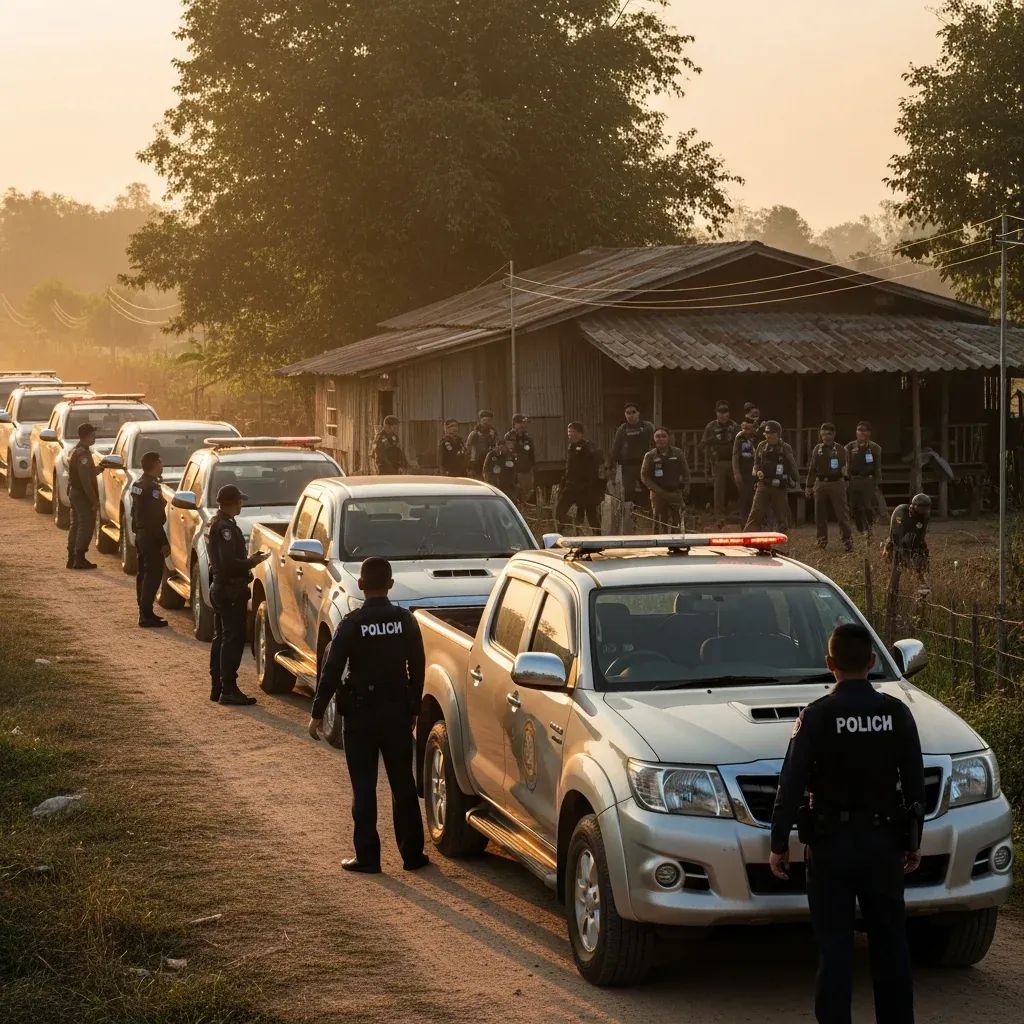
A mid-week police sweep in rural Kamphaeng Phet has pulled back the curtain on how far-flung victims of online scam factories slip through Thailand’s backroads—and how local villagers are quietly enlisted to hide them.
Why this matters to people in Thailand
• Fifteen African escapees from a notorious Myanmar scam compound were caught hiding in Thepnakhon, Kamphaeng Phet
• Their arrest exposes a well-oiled smuggling corridor running from Myanmar’s Karen State through Tak and into Thailand’s heartland
• Police say the same pipeline is now being used to ferry fugitives onward to Laos and Cambodia, turning Thailand into a regional transit hub
• Authorities face a double challenge—protecting victims while punishing traffickers—under the glare of an upcoming U.S. TIP Report that still keeps Thailand on Tier 2
The raid that startled a quiet subdistrict
The convoy of pickup trucks arrived just after dawn, guided by GPS coordinates supplied by an African embassy worried that its citizens were being held in a house. Officers from Provincial Police Region 6 fanned out around a one-storey property on Soi 8 in Thepnakhon. Inside they found four Namibians, one Zimbabwean, and ten South Africans—their passports intact but their Thai visas weeks or months out of date.
Neighbours told reporters they had seen the group only at night. “We thought they were language students,” said one resident. Police now believe the landlord was paid ฿30,000 a week by a Tak-based trafficking ring to supply beds and meals.
From KK Park’s smoke-blackened rooms to Kamphaeng Phet
Interviews with the detainees paint a harrowing escape narrative. All said they had been forced to work at KK Park, the sprawling scam city outside Myawaddy that Myanmar troops bombed in late October. When the compound’s rooftop generators exploded, the Africans slipped out through a side gate and followed Thai brokers across the Moei River under cover of darkness.
Their three-day trek was emblematic of paths used by thousands of scam workers:
Phop Phra district, Tak – entry via forest trails; brokers charge roughly $300 per head.
Ban Phaphueng, Wang Chao – temporary stash houses for regrouping.
Highway 101 & backroads into Kamphaeng Phet, where private vans distribute escapees to rented homes.
Police intelligence suggests that more than 100 foreign workers from KK Park have already been pushed onward toward the Lao border, bound for casinos in Bokeo or Sihanoukville.
Thailand’s northern gateway: asset or Achilles heel?
Smuggling experts say Thailand’s success in trade and tourism is a double-edged sword. Well-paved highways, soft-border communities, and patchy enforcement after dark make it easy for brokers to move people faster than authorities can mount checkpoints. Dr. Warunee Chaidet of Mae Fa Luang University warns, “If we do not close the Tak-Kamphaeng Phet corridor, Thailand risks becoming the default transit state for cyber-crime manpower.”
Legal crossfire: victims today, illegal migrants tomorrow
Police have charged the Africans with overstay and illegal re-entry—offenses carrying a maximum ฿20,000 fine and banishment. Yet anti-trafficking NGOs argue the group should be treated as trafficking victims eligible for temporary shelter, work permits, and witness protection under the 2008 Anti-Trafficking Act. A provincial prosecutor will decide which label sticks within 14 days.
Government pressure points
• Immigration Bureau is mapping safehouses between Tak and Nakhon Sawan, aiming for a single operation to roll up the entire transport network within Q1 next year.
• Ministry of Labour is drafting a pilot programme that lets rescued foreigners take up short-term agricultural jobs rather than languish in detention centres.
• Foreign Affairs teams are negotiating fast-track travel documents with Namibia, Zimbabwe and South Africa, none of which operate resident embassies in Myanmar.
What local residents can do
If you live along the Tak–Phitsanulok route and notice:
• Vans off-loading foreigners at odd hours
• Large grocery deliveries to seldom-occupied houses
• Brokers offering cash for short-term rentalscall the Labour Ministry hotline 1506 (press 2) or the anti-trafficking task force 1300. Timely tips have already led to three safe-house busts since October.
The bigger picture
The Kamphaeng Phet arrests are not an isolated footnote. They illustrate how Thailand sits at the centre of a shifting regional cyber-crime map—one in which illicit call-centre syndicates relocate quicker than governments can draft MOUs. The fact that African nationals, rather than Chinese or Vietnamese, were the latest to surface underscores the truly global reach of these scam factories.
If Bangkok can match its economic ambitions with smarter border management, victim-centred protocols, and corruption-free policing, the country may yet turn a vulnerability into a showcase for regional cooperation. For now, villagers in Thepnakhon and truck stops along Highway 101 are the unlikely front-line in a cat-and-mouse game that stretches from Somerset West to Shwe Kokko.


