
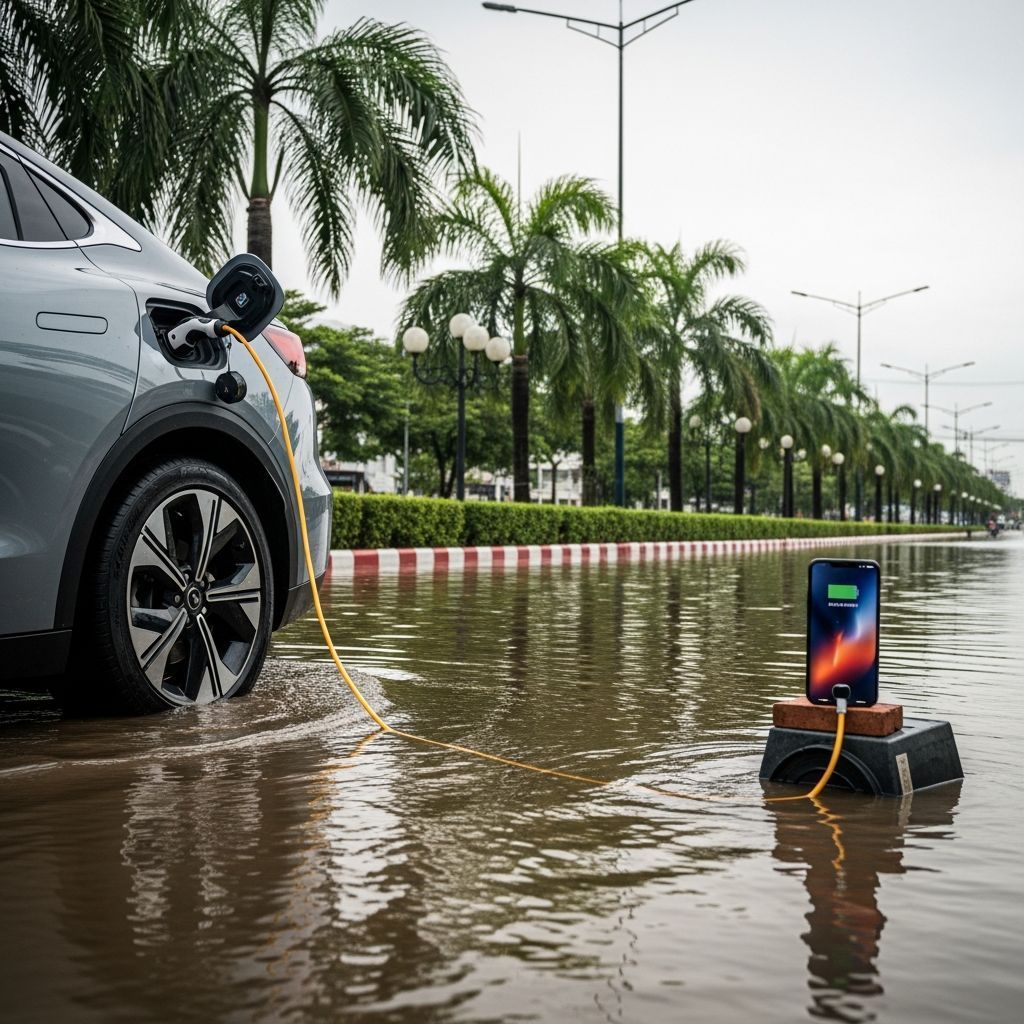
In the aftermath of the deluge that engulfed Hat Yai, one local driver has transformed his electric vehicle into a mobile lifeline, offering stranded residents a way to power up their dying phones and reconnect with loved ones. At a time when standing water still blocks main roads and network signals falter, this impromptu service highlights both the resilience of community spirit and the untapped potential of EV technology in crisis response.
Charging Lifeline on Wheels
When floodwaters rose above 2 m on the outskirts of the city, hundreds found themselves cut off from relief corridors and emergency bulletins. Into this void drove Newz Pattrawut, whose compact EV became a pop-up charging station, its outlets humming under the open sky. By midday, he had recharged over 50 phones, restoring calls, texts and vital access to weather updates. Local residents, once isolated by battery drain and flood barriers, streamed to his roadside spot, greeted by the hum of clean power rather than sputtering generators.
Newz shared screenshots of grateful messages on social media, spotlighting how a single electric battery pack can bridge communication gaps. He chose corners where cell towers were still live and parked where rising water couldn’t reach his tires. For families juggling scant supplies and fading light, those extra minutes of talk time meant door-to-door rescue instructions, updates on relief centers and emotional comfort.
Solidarity from Telecoms and Authorities
Beyond individual acts of goodwill, corporate and government agencies have scrambled to shore up telecom resilience. True Corporation deployed its mobile base stations (COW units) to high-ground shelters near Prince of Songkla Hospital, coupling Free WiFi with battery-swap kiosks. AIS volunteers handed out more than 1,100 power banks alongside charging adapters, while reinforcing connectivity at evacuation hubs on the university campus. Provincial Electricity Authority teams placed mobile generators at five relief sites, ensuring lights stayed on for medical care and phone charging alike.
Vocational schools pitched in by fabricating portable chargers that tap into both car and motorcycle batteries, ensuring basic comms gear can run in the most remote pockets of waterlogged zones. Combined efforts have delivered a patchwork of power solutions—some high-tech, others cobbled together—but all aimed at keeping critical lines open.
EVs: Powerbanks on Four Wheels
Songkhla province now ranks among Thailand’s top ten for EV registrations, a trend driven in part by affordable Chinese imports. By June, the province saw an average of 2,000 new EVs registered per month, up from 1,614 in 2023. With battery capacities commonly at 65 kWh or higher, these vehicles have become more than transport: they are rolling energy reservoirs.
Technologies like Vehicle-to-Load (V2L) allow cars to serve as large-scale power banks, dishing out 2.5 kW to 3.6 kW for appliances or phone chargers. More advanced setups, such as Vehicle-to-Home (V2H) and Vehicle-to-Grid (V2G), promise to sustain entire households or feed surplus energy back into the grid. As disaster planners eye these systems, EVs could soon complement traditional generators in national emergency toolkits.
Specialists on the Frontline
Energy experts caution, however, that flood use carries risks. Most EVs boast an IP67 rating, resisting brief immersion, but prolonged exposure can corrode high-voltage components. Dr. Chana Yengkamsing of the Thai Electric Vehicle Association urges owners to avoid restarting cars submerged past the axle line and to defer any self-servicing until professional checks of HV batteries, inverters and DC–DC converters are completed.
Thammasat University’s Professor Sanan Icharot stresses infrastructure needs: without widespread installation of bi-directional chargers and upgraded distribution schemes, large-scale V2G programs remain years away. Yet in emergency pockets—temporary shelters, remote villages, roadside havens—single EVs are already proving their worth.
What Comes Next?
As water levels drop and relief shifts to recovery, the impromptu charging posts remind policymakers of EVs’ wider role in public safety. Calls are growing for incentives that equip vehicles with built-in V2L sockets and for streamlined permits allowing private owners to offer energy services during crises.
For Hat Yai residents, Newz’s roadside charger was more than convenience—it was reassurance that even in isolation, connections endure. As Thailand accelerates its electric transition, these mobile power hubs may soon be as common on flood routes as lifeboats and relief convoys, uniting clean-energy promise with on-the-ground solidarity.


