
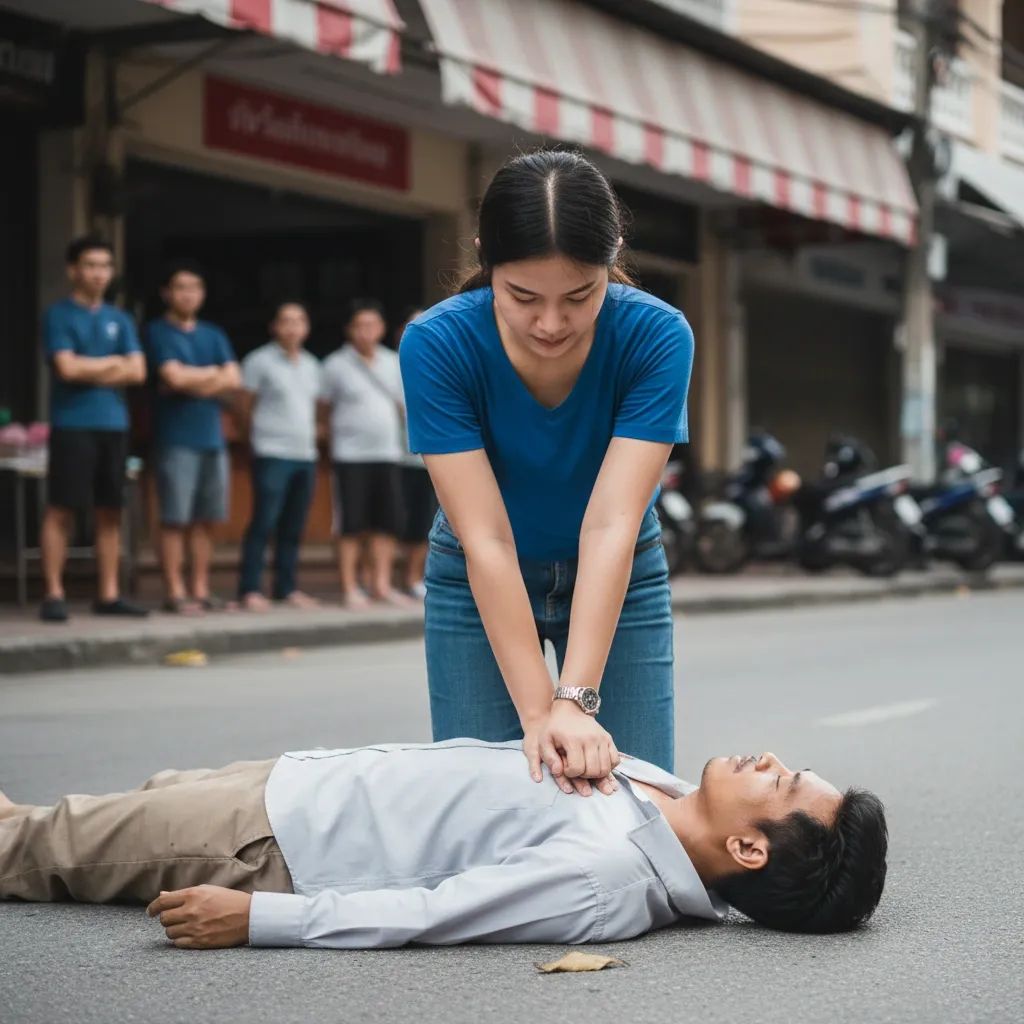
A Grade 12 student's quick thinking and CPR skills likely saved a tourist's life in Phuket's Kathu district on May 8. The incident underscores how Thailand's expanding school-based CPR training programs are creating a more prepared population to respond in medical emergencies.
The Rescue
The foreign visitor collapsed suddenly outside a small tea establishment in Kathu mid-afternoon. Jojo Savel, a student working a nearby portable grill stand, recognized the medical emergency and moved to help. Using CPR techniques learned through his school's training program, Savel performed chest compressions on the unconscious man at approximately 100 beats per minute. Within three to five minutes, the tourist showed signs of consciousness—his pupils responded to light and his body showed vital responses. Paramedics arrived shortly after and transported him to a local medical facility where he remained under observation for head injuries and the underlying condition that triggered his collapse.
CPR Training in Thai Schools
Thailand's secondary schools have systematically incorporated CPR and basic first-aid training into their curricula in recent years. This initiative aims to create a generation of young people equipped to respond effectively in cardiac emergencies. Savel credited his school's collaboration with medical professionals for embedding this technical knowledge into his training. He noted that instructors emphasized a key principle: attempting CPR offers a chance at survival, while inaction virtually guarantees a poor outcome.
This approach mirrors programs now adopted across Asia, including Taiwan, South Korea, and Singapore, where embedding CPR training in schools has proven effective.
Why Bystander Response Matters in Thailand
For residents in Thailand—both Thai citizens and expatriates—understanding bystander CPR's importance is practical. In many areas outside Bangkok, ambulance response times can stretch 15-20 minutes during peak hours. In medical emergencies, the first few minutes are critical for survival.
Thailand's legal framework protects citizens who provide emergency assistance in good faith. Both Thai nationals and foreign residents who perform CPR on an injured person are shielded from civil and criminal liability provided they exercise reasonable care. This legal protection exists to encourage intervention rather than hesitation.
A Growing Pattern
This wasn't Phuket's first such instance. In January 2025, a secondary student from another local school attempted CPR on an elderly motorcyclist who collapsed mid-ride. Though the outcome differed, hospital records confirmed the student's technique was correct, demonstrating that the training is reaching multiple schools across the province.
These incidents reflect an intentional policy shift: what a decade ago would have been framed as individual heroism is now increasingly recognized as the intended outcome of systematic training in schools. As Thailand's tourism continues to grow—bringing visitors unfamiliar with local medical infrastructure—having trained young people positioned across the country represents a genuine resilience advantage for emergency response.
For anyone living or working in Thailand, knowing that CPR training is now standard in schools is worth noting as one practical layer of preparedness in the health system.


