
Why This Matters
• Temporary exemption expired: The Thailand Civil Aviation Authority's temporary waiver for one-way charter flights expired on March 14 as planned, restoring normal charter regulations after the immediate crisis passed. Future evacuations will require case-by-case approval.
• Revenue at stake: If Middle East tensions persist through Easter, the Ministry of Tourism and Sports projects annual visitor losses between 2–25%, translating to potential revenue damage exceeding ฿40 billion.
• Operational flexibility now standard: Independent resorts have adopted shortened cancellation windows (down from 30 days to 5–7 days) as a competitive response, a shift likely to become industry practice if demand remains fragile. For long-term residents: maintain documented proof of cancelled flights and consider travel insurance covering geopolitical disruptions.
• Temporary relief ended: Tourists who overstayed past the grace period from the March amnesty now face the standard ฿500-per-day penalty again, capped at ฿20,000.
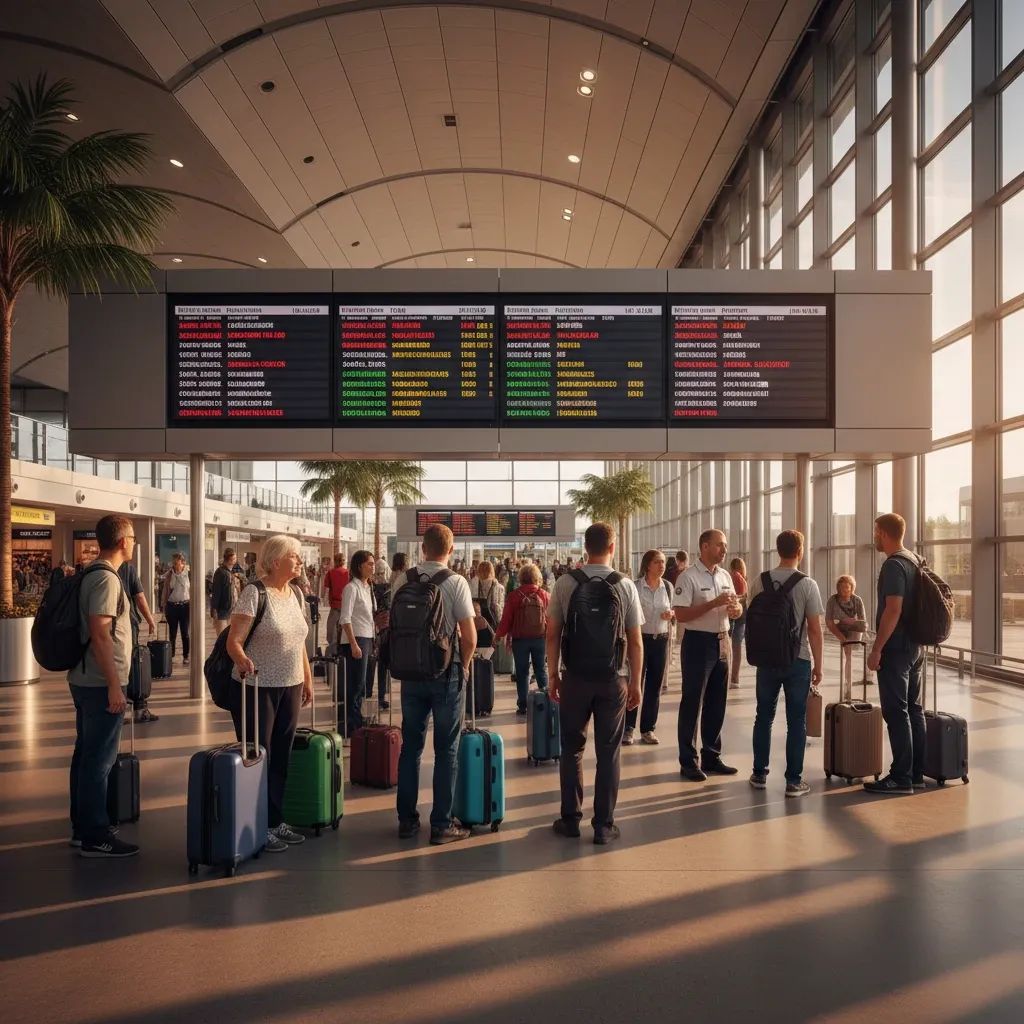
Across the first two weeks of March, the Thailand tourism sector performed an improvised rescue operation after Middle East airspace closures stranded more than 40,000 foreign visitors with no exit routes. The crisis tested both the country's regulatory flexibility and the resilience of its hospitality market—revealing vulnerabilities that may reshape how Thailand attracts and retains travelers going forward.
The Bottleneck That Triggered the Crisis
When military conflict in the Middle East intensified on February 28, European and Scandinavian tour operators found their clients scattered across Southeast Asia—some in Thailand, others in Cambodia, Vietnam, and island destinations—all unable to proceed toward homebound connections through the Persian Gulf. The problem wasn't seats on aircraft; it was a regulatory restriction built into Thai aviation law.
Thailand's aviation regulations prohibited charter operators from selling one-way tickets. The logic was sound in peacetime: if an airline leased an aircraft to drop off tourists, the plane couldn't legally carry paying passengers home, leaving the operator with an empty, unprofitable return leg. The economics collapsed under crisis conditions.
Recognizing the humanitarian situation, Suladda Sarutilavan, the Tourism Authority of Thailand's executive director for Europe, rapidly escalated the issue. TAT's Prague office fielded calls from ITAKA, Poland's second-largest tour operator, which had 18 citizens stranded after their Doha connection became unavailable. Rather than watch them remain stranded, ITAKA rerouted the group to Bangkok, then applied to Thailand's Civil Aviation Authority for an emergency charter permit.
On March 3, the CAAT approved a narrowly tailored waiver: charter flights could land empty, load stranded tourists, and depart with one-way fares through March 14. The decision bypassed normal rule-making procedures, justified by the principle that human evacuation transcends commercial restrictions during crises.
Coordinated Retrieval and Secondary Market
The first major test case involved 315 Nordic travelers scattered across Indonesia, the Maldives, and Thailand after their Copenhagen-bound flights became unavailable. The Ving Group, a Scandinavian leisure operator, deployed Sunclass Airlines to Bangkok on March 8. The charter collected the entire cohort and reached Copenhagen the following day—a logistical achievement possible only because the host government had removed the regulatory restriction.
Between February 28 and March 8, Thailand's airports—primarily Suvarnabhumi and Phuket—absorbed roughly 620 flight cancellations. Airports of Thailand (AOT), the state operator of major hubs, reported no physical congestion at terminals; the airline industry's accommodation protocols and voluntary rebooking prevented terminal overcrowding. Still, the disruption rippled through late-February bookings, particularly affecting Easter holiday plans finalized weeks earlier.
TAT's newly established Tourism Crisis Monitoring Centre tracked requests but acknowledged a gap: independent travelers, digital nomads on extended visas, and retirees who booked directly sidestepped official channels. No central registry captured their numbers. For these long-term residents: documenting cancelled flights and obtaining travel insurance that covers geopolitical disruptions became essential protections.
Market Bloodletting and the Tourism Forecast
Data from early 2026 revealed the geographic damage pattern. Middle Eastern arrivals plummeted 76.51% year-over-year; European entries fell 14.39%—both populations heavily dependent on Gulf transit routes. By contrast, Asian-origin travelers from China, Japan, and South Korea largely avoided the affected corridors, sustaining steady daily intake.
The Tourism Authority of Thailand modeled a worst-case scenario: if Middle East tensions sustained for 8 weeks, the kingdom could lose approximately 600,000 visitors and face revenue damage near ฿40.9 billion. Full-year forecasts suggested a 2–25% decline in foreign arrivals, contingent on conflict duration and media coverage.
For Thailand's working hospitality sector—resort owners, tour guides, rental agents, and transport operators—the arithmetic was straightforward. A 14–15% reduction in European guests compounds with oil-price volatility pushing Thai Airways to contemplate 10–15% airfare increases, which further constrains budget-conscious travelers. Luxury segments held steadier, but the volume impact mattered more to overall revenue.
Tactical Retreat in Hotel Policy
Pimalai Resort & Spa on Koh Lanta, a 200-room beachfront property, exemplified the sector's defensive repositioning. The hotel offered discounted three-night extensions to March-stranded guests at cost-recovery rates, a margin sacrifice justified by protecting the property's reputation. Most guests eventually departed as airspace reopened; the hotel absorbed the loss as a reputation investment.
More significant was the cancellation policy overhaul. Pre-crisis, Thai resorts required 30-day advance deposits, providing cash-flow certainty and deterring last-minute withdrawals. The crisis inverted guest psychology: travelers demanded the ability to cancel 5–7 days before arrival without financial penalty, betting that another geopolitical shock could eliminate flights again. Resorts that refused flexibility watched Easter bookings evaporate in real time; those that capitulated kept tentative reservations alive, betting on eventual stability.
The shift is economically challenging but strategically defensible. A 30-day locked deposit that never materializes generates zero revenue; a flexible 5-7 day window that yields 60% occupancy outperforms the alternative.
Charintip Tiyaphorn, Pimalai's owner, announced a pivot in the hotel's 2026 European marketing strategy. Rather than generic "tropical paradise" messaging, campaigns now emphasize alternative routing—direct flights from Nordic capitals that bypass Middle East hubs entirely. Travel-insurance bundling, Thai port security messaging, and April weather advantages became centerpieces. The message: travel to Thailand with confidence; we have contingency measures in place.
Government Countermeasures and Market Hedging
Beyond the CAAT's charter waiver, the Thailand Ministry of Tourism and Sports coordinated with hotel associations to stage discounted accommodation packages for stranded visitors. The Thailand Immigration Bureau suspended overstay fines and granted 30-day extensions through March upon presentation of cancelled flight documentation—a relief measure that softened immediate hardship for those unable to depart.
Simultaneously, TAT redirected marketing budget toward short-haul Asian markets untouched by Middle East volatility. Daily arrival numbers from China, Japan, and South Korea "remained stable," according to the ministry's permanent secretary, offsetting some European shortfall and signaling that crisis-driven repositioning could mitigate full-year damage.
Aviation Structural Fragility
The episode exposed a Thailand-specific vulnerability: the kingdom's long-haul air accessibility depends heavily on Middle East hub dynamics. Emirates, Etihad, and flydubai have engineered efficient networks that funneled European and Australian traffic through Dubai and Abu Dhabi, undercutting ticket prices through network scale. When those airports entered a restricted military posture, carriers scrambled to reroute via Singapore or Kuala Lumpur, or deploy direct long-haul missions—all costlier, all passed to consumers as surcharges or absorbed as margin compression.
The CAAT's decision to allow the charter waiver to expire on March 14 signaled confidence that immediate crisis had subsided and that normal aviation regulations could resume. Future evacuation charters will require case-by-case exemptions, a return to processes that prioritize procedure over speed—friction that could prove costly if another disruption emerges.
Divergent Outcomes for Competing Destinations
Thailand's crisis management—emergency regulation, inter-agency coordination, hotel flexibility, and visa relief—was demonstrably sharper than responses in Vietnam or the Philippines, both of which also absorbed stranded tourists but offered fewer policy adjustments. That operational effectiveness may help Thailand retain market share as risk-averse travelers reevaluate destination choice.
Yet the deeper strategic question lingers: can Thailand diversify away from Middle East connectivity without sacrificing its low-cost airline advantage? Bangkok's position as a Southeast Asian hub has long rested on affordable Gulf-routed entry, a model now exposed as dependent on geopolitical stability.
The Bottom Line
The successful evacuation of 40,000 tourists validated Thailand's crisis-response infrastructure: flexible regulators willing to suspend rules for humanitarian purposes, networked tourism agencies that mobilize quickly, and hotel operators prepared to adjust policies for reputation preservation. The ordeal also confirmed that Thailand's tourism vulnerability runs deep—not because of poor policy, but because the nation's air-access model depends critically on geopolitical stability in regions beyond its reach. For foreign residents and entrepreneurs whose incomes rely on visitor spending, the takeaway is clear: the next disruption is not a question of if but when. Diversifying revenue streams, documenting cancelled flights, obtaining geopolitical-disruption insurance, and exploring secondary markets are no longer optional considerations—they are operational necessities.


