
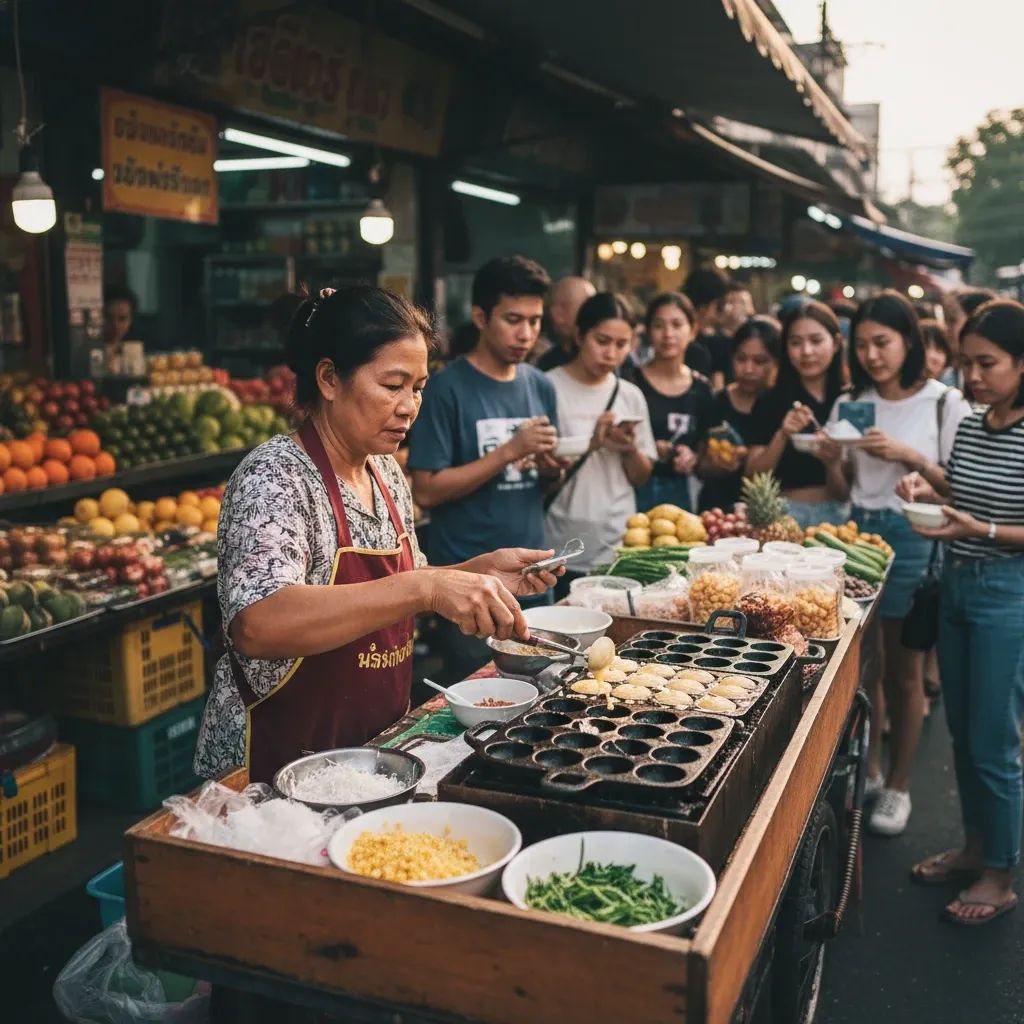
A traditional street-corner treat once purchased for spare change has suddenly become a diplomatic statement. The Thailand government is now mobilizing around a simple fact: an obscure coconut pancake called khanom khrok has outranked the nation's most famous export on the world stage. On February 25, 2026, TasteAtlas, a Vienna-based food platform with global reach, positioned khanom khrok at number 24 among all desserts worldwide—and solidly at the top of the Thai dessert hierarchy. The ranking signals something deeper than culinary preference: it represents a genuine shift in how international food culture values authenticity over celebrity, discovery over familiarity. For Thailand's tourism apparatus and food entrepreneurs, the implications are both immediate and structurally consequential.
Why This Ranking Reshapes the Conversation
• A recalibration of Thai culinary identity: Khanom khrok's ascendancy displaces mango sticky rice from its traditional position as Thailand's signature dessert globally, suggesting that food enthusiasts are now actively seeking depth and regional diversity rather than relying on a single iconic dish.
• Street vendors positioned as cultural architects: The government is reframing neighborhood market sellers—typically informal, unbranded operators—as custodians and ambassadors of Thai heritage, worthy of international visitor interest and government support programs.
• Soft power meets bottom-line economics: Tourism revenue now hinges on whether khanom khrok's profile attracts sufficient visitor spending to support the government's food and beverage sector development goals.
What Khanom Khrok Actually Is—and Why That Matters
The dessert exists at a peculiar intersection of simplicity and technical precision. At first glance, khanom khrok is just six to eight small, round pancakes wrapped in paper or banana leaf—pedestrian enough that most travelers pass by dozens of street vendors without noticing. The experience transforms, however, once you understand the mechanics behind it.
Vendors work in pairs or alone, wielding specialized cast-iron pans divided into hemispherical molds. The process unfolds in two distinct stages, each requiring skill developed over years of practice. First comes the rice flour batter, thinned to a precise consistency and poured into the heated indentations. As heat acts on the liquid, it transforms into a thin, crispy golden shell—the structural integrity that gives the dessert its textural identity. The base must crisp without burning, a balance that depends on pan temperature, ventilation, humidity, and the vendor's intuitive reading of timing.
Once the shell firms, the vendor swiftly dispenses a second mixture: sweetened coconut milk custard, spooned into the center of each pancake. This filling remains semi-liquid inside the crispy exterior, creating the signature contrast that earned TasteAtlas recognition. The filling is where regional variation accelerates into culinary complexity. Central Thailand introduces finely sliced scallions, which add salinity and savory counterpoint. Northern versions incorporate taro or pumpkin, bringing earthiness and visual depth to the otherwise pale custard. Bangkok vendors experiment with sweet corn kernels for textural disruption. Some traditional makers still include ground peanuts or shallots for additional fragmentation and flavor.
Pricing remains remarkably stable across Thailand: typically 20–40 baht per serving—roughly the cost of a specialty coffee. This affordability has historically embedded khanom khrok into the daily rhythm of urban life. Office workers grab a packet during midday breaks. Students purchase them as post-school snacks. Domestic workers stop at vendor stalls during market runs. The dessert has always occupied the quotidian foodscape, not the celebratory one.
The Government's Strategic Mobilization
Within days of the TasteAtlas announcement, the Thailand Ministry of Culture framed the ranking as validation of centuries-old culinary wisdom achieving global recognition. Officials emphasized that khanom khrok represents not a modern invention for tourist consumption but rather a living expression of Thai cultural heritage—a distinction that anchors the narrative in authenticity rather than marketing.
Behind bureaucratic declarations, the Thailand Tourism Authority and the Ministry of Foreign Affairs are integrating khanom khrok into strategic initiatives. The government has positioned Thailand's culinary sector as a vehicle for cultural promotion and economic development. The institutional infrastructure to execute this strategy has already been established. The "Global Thai" program, operational since 2002, manages a network of Thai restaurants worldwide, standardizes menu offerings, and certifies chefs as cultural representatives. The "Thai Select" certification ensures that establishments meeting authenticity standards receive official endorsement. More recently, the government launched the "One Village, One Thai Food Chef" initiative, targeting the training of culinary professionals as both business entrepreneurs and cultural ambassadors.
Embassies have begun direct participation. The Royal Thai Embassy in Doha hosted "Thai Restaurant Week 2025" as a showcase for Thai culinary traditions in Qatar. Parallel promotional calendars are scheduled across Europe, Japan, and China—affluent markets where food-tourism spending translates into measurable import revenue and destination association.
Mango Sticky Rice's Decline in a Crowded Ranking
The displacement of mango sticky rice from the top Thai dessert position marks a genuine strategic shift in global food preference. TasteAtlas ranked mango sticky rice at 64 globally—a respectable placement, yet subordinate to khanom khrok's 24th position. The shift is particularly notable given that mango sticky rice achieved international prominence relatively recently, accelerated by its viral appearance at Coachella in 2022 via a Thai performer. Prior to this period, it had dominated conversations about Thai desserts at a level that khanom khrok never approached.
The data doesn't diminish mango sticky rice's enduring popularity. It remains available in virtually every Thai restaurant globally, and surveys consistently rank it among visitors' favorite dessert memories from Thailand. Rather, the TasteAtlas results suggest that international food enthusiasts are developing more sophisticated palates, moving beyond singular, celebrity-driven choices toward appreciating breadth of regional tradition.
For restaurant operators and food stall managers, the implication is clear: diversification has become strategically prudent. Menus now benefit from featuring multiple Thai desserts—not just mango sticky rice as the anchor, but also khanom khrok, khanom chan (pandan-coconut layer cake), lot chong (pandan rice noodles in coconut milk), kluai thot (fried banana), and pa thong ko (Thai doughnuts). All of these made TasteAtlas's 2026 Thai dessert index, indicating international appetite for variety rather than repetition.
Street Vendors: Visibility Without Guaranteed Income
The recognition creates genuine visibility but uncertain economic translation. Vendors in high-traffic locations like Chatuchak Weekend Market and Yaowarat (Chinatown) have already reported inquiries from foreign visitors specifically asking for "the number-one Thai dessert." However, this attention concentrates in tourist-accessible areas. Most khanom khrok sellers operate in neighborhood markets and residential zones—locations requiring visitors to venture beyond guidebooks and hotel concierge recommendations.
The structural advantage lies in affordability of inputs. Rice flour, coconut milk, sugar, and scallions remain inexpensive and widely available. Short-term price inflation is unlikely given vendor competition for volume. However, a secondary risk deserves attention: if sustained tourism demand raises commercial real estate costs and labor expenses in high-traffic neighborhoods, vendor margins could erode despite higher transaction volumes. The equation shifts from "more customers, higher profit" to "more customers, same price per unit, compressed margins."
The preparation itself—requiring skill, timing, and understanding of thermal dynamics—creates both opportunity and vulnerability. Vendors who have invested years perfecting technique possess genuine competitive advantage. Conversely, if demand spikes rapidly, newer entrants attempting to scale operations may compromise the textural balance that generated the ranking in the first place. Mass production techniques, industrial-scale pan systems, or cost-cutting shortcuts could degrade the product quality that justified the international recognition.
Domestic consumers face a less visible but equally real risk: crowding-out during peak hours. If vendors prioritize tourists—who carry higher spending capacity and fewer price sensitivities—local customers may encounter reduced availability or informal price stratification. The government's rhetoric emphasizes that khanom khrok's success represents "triumph for all Thai people," yet that narrative only holds if economic benefits distribute beyond vendors to encompass the broader community.
The Macroeconomic Context Thailand Cannot Ignore
The timing of khanom khrok's ranking deserves scrutiny in light of Thailand's recent culinary industry challenges. Throughout early 2025, the domestic restaurant sector experienced measurable contraction. Establishments closed at elevated rates, particularly in tourism-dependent neighborhoods. Consumer purchasing power declined domestically, compressing vendor margins and accelerating closures. This suggests that international culinary promotion, while strategically valuable, cannot operate in isolation from macroeconomic realities.
Visitor inflow generates revenue, but currency volatility, inflation pressures, and local economic stress constrain operators' ability to capitalize on that traffic. A foreign tourist may visit a khanom khrok stall, but if the vendor operates on a 5-10% margin and faces rising ingredient costs and rent pressures, conversion of visibility into sustainable income remains uncertain.
Thailand's government has positioned itself as the "Kitchen of the World," a branding initiative that requires consistent support across multiple initiatives. Culinary excellence and food tourism rank among the top factors influencing travel decisions to Thailand. Yet without alignment between international promotion and domestic business sustainability, the culinary soft-power narrative becomes performative rather than economically transformative.
The Coming Months: Measuring Translation
The announcement occurred recently enough that transaction-level data remains unavailable. The Thailand Tourism Authority and Ministry of Culture are expected to amplify the khanom khrok story in advertising campaigns targeting food enthusiasts in China, Japan, Europe, and the Middle East. The genuine test begins now: Will international recognition drive behavioral change?
Will visitors specifically navigate to residential neighborhoods and street markets to experience khanom khrok, or will the ranking remain a media curiosity? Will they return home as advocates, creating durable cultural currency for Thai desserts among their peer networks? Will sustained demand create economic incentive for younger Thais to learn traditional preparation techniques, or will the dessert face generational erosion as vendors age and potential successors pursue higher-income work?
For residents of Thailand, the practical implications depend entirely on geography and business model. Vendors in tourist-accessible locations may benefit from genuine foot-traffic increases and higher inquiries. Those in purely residential markets may experience negligible change. Food entrepreneurs considering entry into the khanom khrok market confront a binary decision: assess whether this represents a durable trend or a temporary publicity spike. The answer hinges on whether the current street-food pricing structure can sustain expanded production and vendor income without quality degradation.
The Broader Signal Beyond One Dessert
Khanom khrok's ranking matters less as an individual dessert achievement and more as data confirming a strategic direction. Thailand's government views culinary recognition as both cultural validation and economic infrastructure. The dessert's ascendancy demonstrates that investment in authentic food traditions—unglamorous, unpackaged, accessible to the poor—can generate international interest as effectively as aggressively marketed celebrity dishes.
This reframing has implications for other Thai foods currently positioned below the tourism mainstream: regional curry preparations, fermented vegetable traditions, regional noodle dishes, and neighborhood specialties that exist outside standard restaurant menus. If khanom khrok can achieve global recognition by remaining unpolished, hyperlocal, and accessible, then hundreds of other Thai food traditions potentially occupy similar opportunity space.
The sustainability of this moment—whether khanom khrok maintains momentum or recedes into obscurity once media attention moves elsewhere—will determine whether Thailand's culinary soft-power strategy proves replicable or represents a singular viral moment without structural foundation.


