
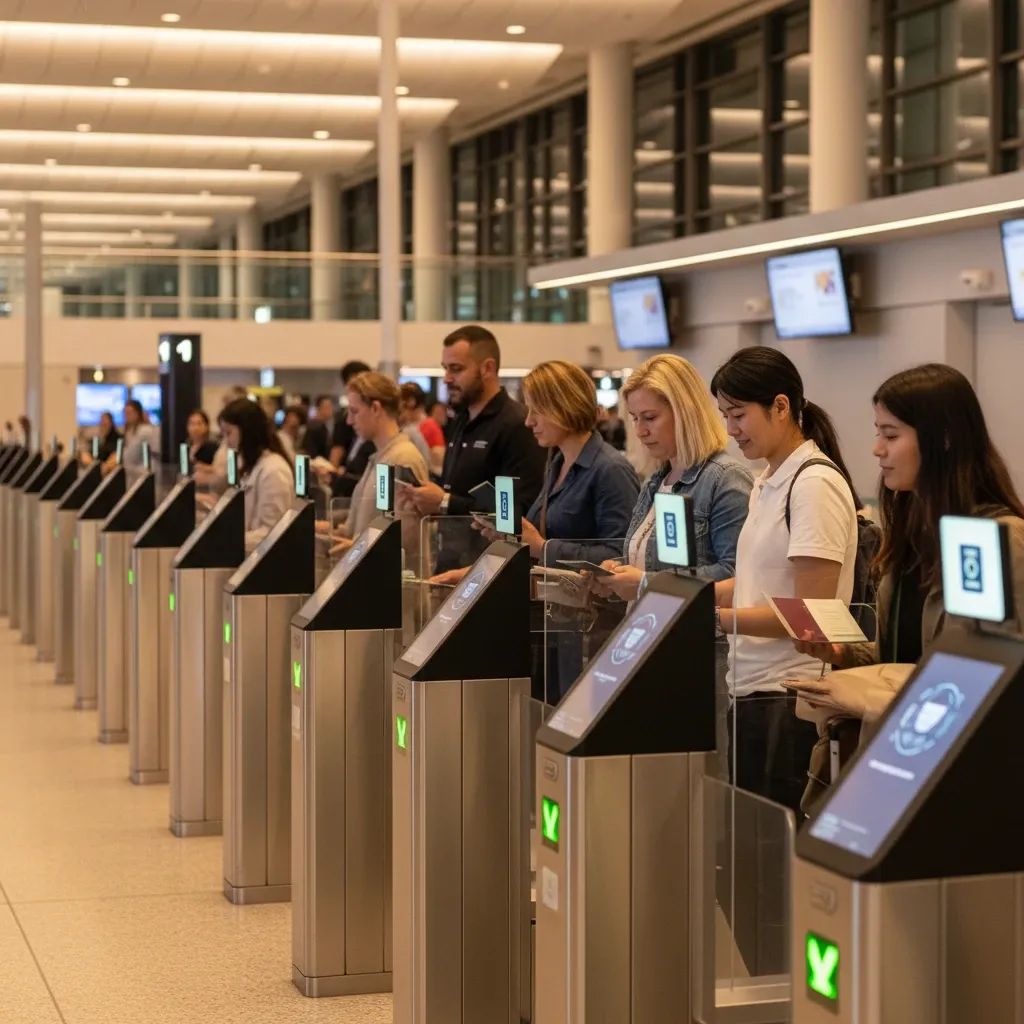
Don Mueang International Airport has activated full 24-hour biometric departure processing as of March 5, 2026, deploying 31 automated gate terminals designed to process eligible travelers in approximately one minute. For the roughly 40 million passengers who cycle through Bangkok's secondary gateway annually, this infrastructure shift directly addresses bottleneck hours (5–7 a.m., 9–11 a.m., 3–6 p.m.) when manual queues can stretch past 20 minutes.
Why This Matters
• Measurable time recovery: Travelers using automated gates report saving 10–30 minutes per departure, with some travelers gaining a full hour—time typically redirected to airport retail and dining.
• Capacity strategy: The 31-unit installation anchors Don Mueang's expansion roadmap targeting 50 million annual passengers by 2029, positioning it as a credible secondary hub alongside Suvarnabhumi.
• Eligibility gate: Approximately 90 countries' biometric-enabled passports qualify; traditional passport holders remain in conventional queues, making adoption rates critical to system success.
How the Automated Gate Actually Functions
The ABC (Automated Border Control) process begins when a traveler inserts an e-passport. An integrated camera captures facial geometry in real time, the passport chip validates identity data, and the barrier gate unlocks within seconds. The entire sequence targets sub-60-second clearance—a dramatic compression compared to manual counters where an agent interrogates, verifies, and physically stamps each document in 2–3 minutes.
Suvarnabhumi Airport, which activated its ABC system in October 2024, has consistently delivered on this timeline. Don Mueang's 31 units will operate on identical technology. The key difference: Don Mueang's deployment is confined to departures; arrival immigration remains manual. A full bidirectional automation layer—entry and exit processing through the same technology—would amplify efficiency gains but demands policy alignment with Thailand's immigration authority and is not yet scheduled.
The system's speed advantage depends entirely on public adoption. If signage proves unclear or passengers default to habit and join familiar staffed queues, ABC lanes risk operating at partial capacity while traditional lines backlog. Airport management has flagged adoption monitoring as a critical first-quarter metric.
Eligibility Restrictions and Real-World Friction
Not all travelers can use the gates. Don Mueang's ABC system requires passengers to meet five conditions: minimum height of 120 centimeters (roughly a typical five-year-old child), luggage under 120 centimeters tall, passport validity exceeding six months, no newly issued passport (applicants must wait 14 calendar days for biometric chip recognition), and compliance with biometric facial capture standards.
Three groups are explicitly excluded. Pregnant travelers cannot proceed through automated lanes—unclear whether this reflects policy caution or technical limitations around biometric consistency during pregnancy. Passengers requiring a physical exit stamp in their passport must use staffed counters; the system produces no inked documentation, only digital transaction logs. Technically, Thai law recognizes these digital records as legally sufficient for visa reapplication and employer documentation. Practically, many travelers psychologically prefer tangible proof of departure, and staff at manual counters can issue printouts on request—adding a processing step that undermines automation's speed advantage.
Families with young children face predictable friction. A toddler under 120 centimeters must accompany an adult through a manual queue. A parent traveling with an ineligible child, traveling alone, cannot utilize the automated lane and defaults to staffed service alongside the child.
For newly issued passport holders, the 14-day holding period creates a scheduling constraint. A traveler receiving a replacement passport mid-week cannot use the gate until two weeks later—a minor inconvenience for most, but a genuine friction point for those departing within days of passport renewal.
Regional Context: Where Don Mueang Stands
Don Mueang occupies a peculiar position in Southeast Asia's aviation hierarchy. It processes 600–650 flights daily during 2026 peak periods, making it Asia-Pacific's busiest low-cost carrier hub. Suvarnabhumi, Don Mueang's larger counterpart, activated its ABC system in October 2024, and this parallel upgrade at Don Mueang echoes identical logic: automation generates measurable metrics that improve passenger experience and operational efficiency.
Don Mueang has received notable recognition for passenger satisfaction among regional airports. The ABC rollout directly targets ongoing efforts to improve immigration processing, addressing a common pain point for travelers using Bangkok's secondary gateway.
Deployment Timeline and Installation Status
Pilot testing began in mid-February 2026 at the International Terminal, Building 1, 3rd Floor, initially operating 7 a.m. to 7 p.m. Full 24-hour operations commenced March 5, 2026. The airport aims for all 31 units to be installed by April 2026, though the sequence is incremental—each gate becomes operational immediately upon installation and receives passenger traffic without delay.
Thailand's dual-airport system collectively processes over 100 million passengers annually; any friction point at either gateway cascades across the entire Bangkok aviation complex. The ABC rollout is calibrated to offload approximately 30–40% of departing passenger volume, freeing staff to manage complex cases—overstays, visa irregularities, document anomalies—that resist automation.
Broader Airport Modernization Across Thailand
Don Mueang's ABC deployment is one piece of a coordinated infrastructure refresh across Thailand's aviation network. Thailand's major airports are implementing biometric identification systems that reduce redundant document verification, accelerating both check-in and security screening for domestic and international passengers.
Other Thai airports including Phuket and Chiang Mai are planning dedicated ABC departure lanes, while others are introducing self-service check-in kiosks and biometric verification to compress queue duration. Leading international airports report efficiency gains with digital systems—fewer operational errors, reduced labor costs, faster throughput. Thailand's dual-airport strategy—leveraging both Suvarnabhumi and Don Mueang as interrelated nodes—aims to position Bangkok as a resilient, high-capacity regional gateway. The ABC rollout narrows operational differences and strengthens the network.
Practical Impact on Residents and Frequent Travelers
Expats, retirees, and business travelers cycling in and out of Thailand regularly gain an immediate, repeatable advantage. Once an e-passport is enrolled—a single biometric capture—future departures become a 60-second event. That is meaningful when catching a 6 a.m. flight or managing a tight connection.
Faster immigration processing also benefits airport businesses and concessionaires. When travelers clear immigration efficiently, they have more time to spend at duty-free shops, cafés, and restaurants—creating economic benefit for airport vendors. For travelers, it means less rushed purchasing and better dining options available before boarding.
Non-e-passport holders face no immediate change. Roughly 10 countries' traditional passports remain unsupported by the ABC network; citizens of those nations continue staffed queues. Yet as eligible travelers divert, manual queues will measurably shorten, improving the experience for non-participating travelers as a secondary benefit.
The 14-day grace period for newly issued passports introduces administrative friction. A traveler receiving a replacement passport cannot instantly leverage the gate; two weeks must elapse. For those planning a departure within days of renewal, the traditional queue becomes mandatory.
Pregnant travelers and those requiring an inked exit stamp face no system workaround—staffed counters remain their only option. For visa sponsorship cases or employer reimbursement documentation where a physical stamp carries psychological or organizational weight, the digital record alone may not suffice in practice, despite legal validity.
Adoption Rate: The Critical Metric
Success hinges on whether Don Mueang achieves strong adoption among eligible passengers within the first three months. High uptake validates the business case for further automation expansion across Thailand's airport network. Low adoption signals that signage, passenger education, staff training, or incentive structures require recalibration.
The airport's deputy government spokesperson has emphasized that pilot testing through February 2026 identified no technical deficiencies—hardware and software operated reliably. The next challenge is behavioral: converting habit-driven travelers accustomed to staffed counters into self-service biometric users. International airports report that adoption curves typically steepen after the first 30 days as word-of-mouth and airport campaigns build awareness.
What Remains Unresolved
Arrival immigration at Don Mueang remains entirely manual. Travelers landing in Bangkok queue through traditional lanes for entry processing. A comprehensive arrival-and-departure automation layer would amplify efficiency gains substantially—incoming passengers, many of whom are fatigued after long flights, would benefit from rapid biometric processing. Yet that infrastructure expansion demands new hardware, extended testing, policy coordination with Thailand's immigration directorate, and an adjacent investment cycle. Don Mueang's roadmap includes it, but full bidirectional ABC is not yet resourced or scheduled.
The absence of physical exit stamps presents an administrative burden for a minority of travelers. Some employers require tangible proof; some visa sponsorship processes informally expect stamped documentation. Thai law recognizes digital records, but bureaucratic friction persists. Manual counters can issue printouts, but the extra step undercuts automation's time advantage for those requiring it.
Signal to Investors and Expat Communities
For expats weighing relocation to Bangkok or business investment in Thailand, the ABC rollout signals concrete infrastructure execution. Thailand's government and AOT are not merely discussing digital transformation; they are implementing it on schedule. The airport's capacity expansion roadmap—targeting 50 million passengers annually by 2029—depends on upgrades exactly like this. Investors assessing Thailand's readiness for sustained growth in tourism and international commerce can view ABC gates as institutional follow-through on long-term strategy.
The rollout also underscores AOT's commitment to point-to-point aviation expansion—a strategy favoring low-cost carriers and secondary regional hubs over traditional hub-and-spoke models. Don Mueang, historically a domestic and budget-carrier hub, is repositioned to compete for international low-cost traffic. Faster immigration processing makes that competitive pitch credible.
Looking Ahead
Don Mueang's ABC system will stabilize over the next two months. The real story unfolds in Q2 2026, when adoption rates become visible. If the airport achieves strong uptake, expect announcement of expansion to arrival halls and accelerated ABC rollout to other Thailand airports. If adoption lags, recalibration campaigns and possibly incentive structures will follow.
Longer term, watch for facial recognition integration at check-in and boarding gates, biometric baggage tracking, and real-time passenger flow analytics—technologies that leading regional hubs deploy routinely. For now, Don Mueang's 31 gates represent a decisive operational step forward, one that saves eligible travelers meaningful time and positions Thailand's secondary airport as a genuine competitor in Southeast Asia's increasingly automated aviation landscape.
For anyone departing Don Mueang with an eligible e-passport, the practical advice is simple: use the automated gate. For everyone else, traditional channels persist—but expect shorter waits as diverted traffic thins the manual queues.


