
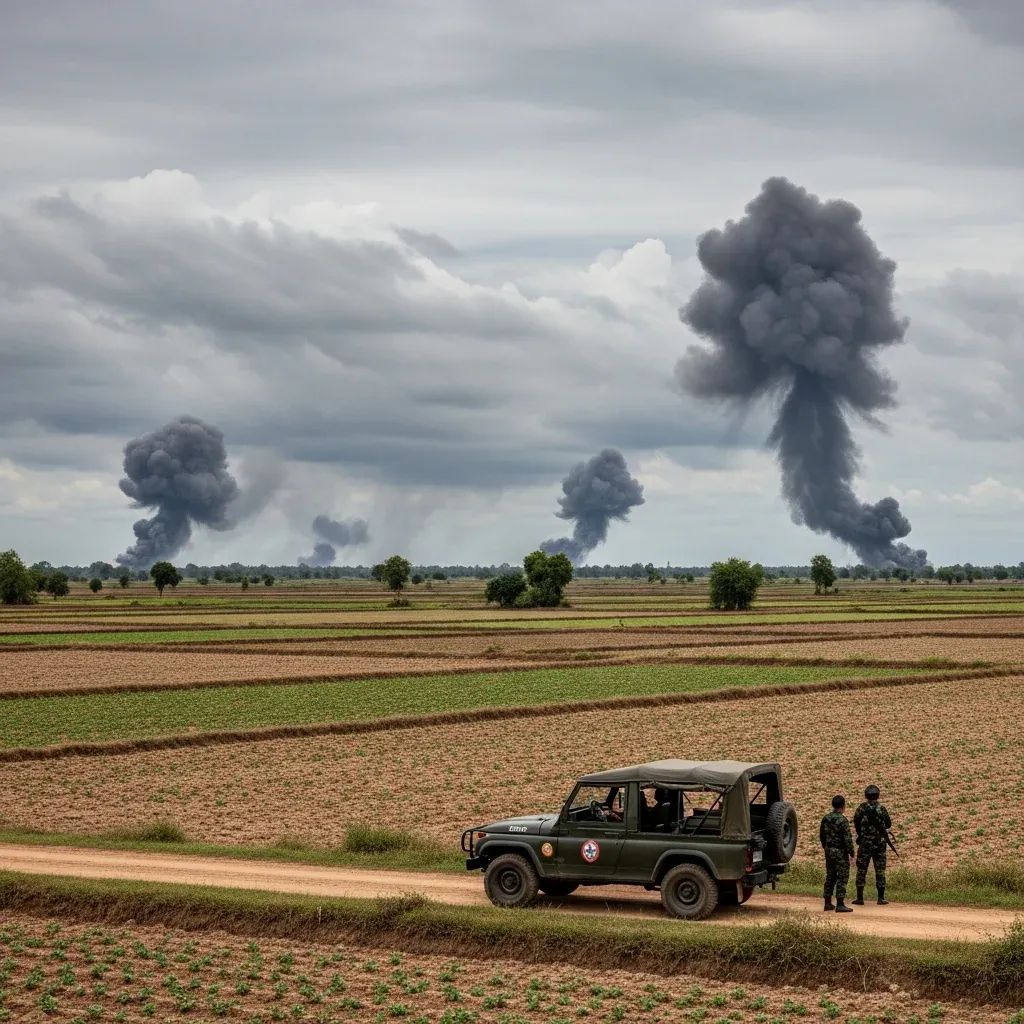
Thailand’s eastern villages can still hear the boom of artillery, yet behind closed doors diplomats scramble to give exhausted communities at least a pause for the New Year. Beijing has parachuted its special envoy back into Phnom Penh and Bangkok, ASEAN foreign ministers are urging restraint from Kuala Lumpur, and senior Thai–Cambodian officers will sit down today in a last-minute bid to sketch an enforceable truce.
Snapshot: where the conflict stands
• 21 days of uninterrupted clashes along the 817 km frontier
• ≥500,000 residents displaced from Sisaket, Surin and Sa Kaeo provinces
• General Border Committee (GBC) meets this afternoon on Thai soil
• China’s Deng Xijun shuttling between the two capitals, offering a “neutral platform”
• ASEAN observer team likely to be re-activated if a deal emerges
Incoming GBC talks overshadowed by daily shelling
For frontline commanders the cease-fire paperwork feels distant. Overnight, Thai radar tracked more than a dozen BM-21 rockets fired from Cambodian territory toward Ban Khun Han in Sisaket; counter-battery guns and armed UAVs answered within minutes. The army confirmed 1 soldier killed and 6 civilians wounded in the exchange. Bangkok insists every retaliatory strike is “strictly limited to military targets,” while Phnom Penh accuses Thailand of using F-16 sorties to keep pressure on its forward posts. Either way, the rhythm of fire has become routine enough that border schools now conduct evacuation drills twice a day.
China steps forward, but faces scepticism
Beijing’s intervention is couched in the language of friendship. Special Envoy Deng Xijun met Prime Minister Srettha Thavisin on Sunday, then flew directly to meet Hun Manet, reiterating China’s readiness to host or “provide any venue” for talks. Analysts at Chulalongkorn University note that “economic self-interest and soft-power optics” make Southeast Asia’s stability a priority for Beijing; China remains the largest trading partner of both combatants and its factories in Cambodia rely on undisrupted land corridors through Thailand’s eastern seaboard. Yet critics question Beijing’s neutrality. Bridget Welsh, a regional scholar, argues that outside mediators are “treating symptoms, not the colonial-era map dispute driving the war.” Thai diplomats quietly echo that view, demanding that any facilitator must be unambiguously even-handed.
ASEAN’s balancing act
Malaysia, as current chair, convened a rare emergency retreat of foreign ministers on 22 December. The bloc’s joint communiqué used unusually direct language, calling for an “immediate halt to all forms of violence.” Kuala Lumpur also floated re-deploying the ASEAN Observer Team (AOT)— dormant since the October truce collapsed — to police any new agreement. Vietnam and Singapore backed the idea, stressing that a verified cease-fire would free border economies that are shrinking by 10–15 %. Still, ASEAN’s consensus model means implementation hinges on Bangkok and Phnom Penh signing off first.
Human cost and economic fallout along Thai border
Beyond the diplomatic choreography lies a grinding humanitarian crisis:
• 23 Thai civilians dead, mainly from rocket strikes, according to the Interior Ministry.
• ≥30 homes destroyed; 20 hospitals and 201 rural clinics damaged, with Panom Dong Rak District Hospital hit twice.
• Cross-border trade plunged 99 % at Chong Jom and Aranyaprathet checkpoints, wiping out an estimated ฿500 M per day in revenue.
• Local tourism has vanished: guest-house occupancy in Surin’s elephant villages sits below 5 % despite the festive season.
Provincial administrations have opened temples and school halls as temporary shelters while the army clears unexploded ordnance scattered across rice paddies. Farmers worry that unexploded BM-21 shells will keep fields off-limits well into the coming planting season.
What might unlock a lasting truce?
Thai Foreign Minister Sihasak Phuangketkeow laid out three pre-conditions yesterday: Cambodia must declare the first stop to firing, allow independent verification, and cooperate on land-mine clearance. Phnom Penh counters that hostilities must cease simultaneously and that displaced villagers — nearly 1 M people by its count — should be allowed home immediately, with border troops pulled at least 10 km back. Diplomats suggest a compromise could involve:
A 48-hour “cooling-off” period monitored by the ASEAN observer team.
Real-time drone feeds shared with both military headquarters.
A phased withdrawal tied to reopening the Highway 48 corridor, vital for Cambodian exports.
Whether generals on the ground accept those guardrails remains uncertain. Previous truces—Malaysia’s in October and the short-lived US-brokered deal in November—collapsed within days.
The next 48 hours
If today’s GBC session produces even a limited accord, residents from Khun Han to O Smach might enjoy the first quiet night since 7 December. Failure, however, would almost certainly invite heavier weapons and deepen a conflict now priced at >฿15 B in direct losses. Diplomats can only nudge; the final decision rests with officers dug into red-soil trenches along a border both nations still read through different colonial-era maps.


