
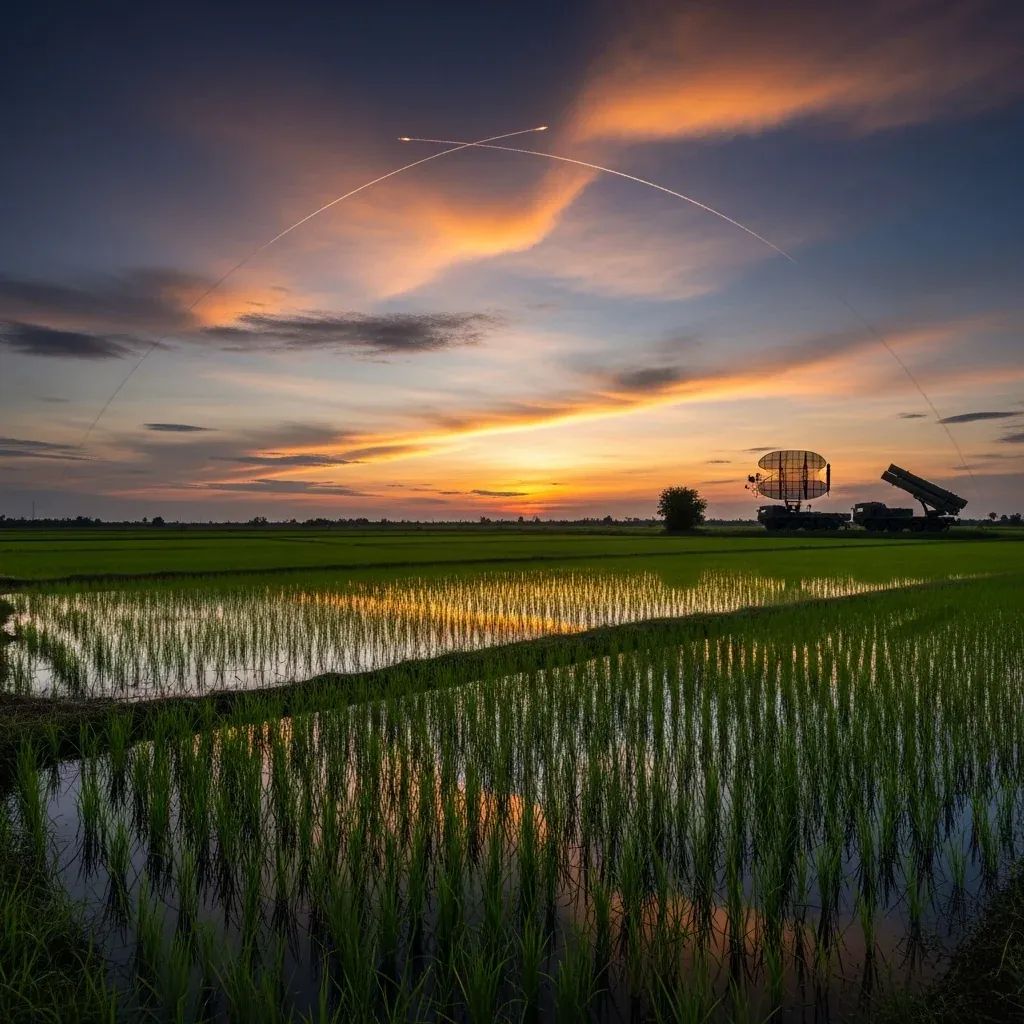
In the rice-growing heartland of Surin and Buriram, residents awoke to headlines about Cambodia’s long-range rocket batteries edging closer to the border. Thai generals, however, are adamant that the kingdom’s layered air-defence network, from mobile cannons to the soon-to-arrive BARAK MX interceptors, can swat down anything fired their way.
Snapshot of the new border crisis
• PHL-03 launchers have been detected in Kampong Thom, roughly 120 km from Thai soil.
• The weapons’ 130 km reach puts provincial airports, hospitals and command posts in play.
• Thailand has countered with round-the-clock surveillance, Gripen patrols and reinforced air-defence radar.
• Diplomats in Bangkok, Phnom Penh and Jakarta are racing to prevent a wider conflict, even as artillery duels continue in Sa Kaeo and Surin.
An uneasy December along the eastern frontier
Border skirmishes that flared on 7 December have now morphed into the heaviest gun-duels since the 2011 Preah Vihear dispute. Cambodian forces opened with BM-21 “Grad” salvos, followed by drone strikes on Thai forward positions. Thai infantry replied with counter-battery fire, later seizing Ban Nong Ya Kaew and disabling a Cambodian observation post near the disused Khanar temple. The clashes pushed roughly 11,000 villagers toward makeshift shelters inside Huai Thap Than district.
**Whispered fear became palpable the moment locals heard that Phnom Penh’s six Chinese-built PHL-03 trucks had rolled into Kampong Thom. While only one launcher is confirmed destroyed by a Thai precision strike, five remain on the move, each able to shower a 600,000 m² area with cluster or fuel-air warheads.**
Why the PHL-03 matters
The PHL-03 fires 300 mm rockets at nearly Mach 4, guided by BeiDou/GPS for pinpoint accuracy. In theory, a single battery parked on National Highway 6 could threaten Buriram airport, Prasat District Hospital, command bunkers in Surin and even the crucial Route 24 logistics corridor. Thai analysts say the weapons are designed for “shoot-and-scoot”; a crew can fire twelve rounds and relocate in under six minutes, complicating counter-fire. For Thailand, the system’s mix of speed, range, heavy warheads and digital fire-control means the first line of defence must be interception, not just retaliation.
How Thailand plans to keep the sky clean
The Royal Thai Armed Forces have knitted together a multi-layered shield that blends western and Chinese technology:
VL MICA launchers stationed around Surin and Sisaket cover the inner 40 km bubble, ideal for mopping up remnants rather than catching the first wave.
Newly delivered FK-3 batteries extend the protective dome to 100 km, able to engage rockets in their mid-course arc at Mach 6.
The game-changer is the Israeli-designed BARAK MX network—its 150 km ER missiles will, once fully activated, give Thailand a shot at intercepting PHL-03 rounds almost the moment they leave Cambodian airspace.
Complementing the missiles are JAS-39 Gripen CAP sorties, forward-deployed counter-battery radars and an expanded sensor web from civilian weather radars and privately owned drone feeds.
Air-force spokesman AVM Jakrit Thammavichai told reporters the service has drafted “deep-strike packages” that can hit rocket farms, drone depots and command vehicles well inside Cambodia if intelligence confirms imminent launches. He noted that Gripen jets already demonstrated that reach by destroying a fortified casino complex in O’Smach last Sunday.
Living in the cross-fire: voices from Surin and Buriram
Teachers in Prasat’s Ban Nong Ku school now conduct morning assembly in an underground parking lot. “We practise duck-and-cover drills between English and science classes,” principal Kanyarat Limsakul said, pointing to a newly painted red-and-white evacuation route. In Ban Kraruad, Buriram, farmers delay evening harvest until army loudspeakers confirm “all clear” after each flare of distant gunfire. Provincial health officials have pre-positioned mobile trauma units, IV fluids and blood bags in case the rockets land.
Yet not everyone is fleeing. Tour operators along Khao Kradong say the December festival crowds are thinner but still materialise on weekends. “Thai tourists trust the army’s shield,” said Somboon Sangchai, who rents bicycles near the extinct volcano. “The real hit is from foreign travellers who read the travel advisories and cancel.”
Regional and diplomatic chessboard
ASEAN has issued only a terse call for “maximum restraint”. Observers note that the bloc’s quiet stance allowed a Trump–Anwar Ibrahim tandem to broker last year’s cease-fire, which has since unravelled. Bangkok’s Foreign Ministry has now floated the idea of an observer mission under the ASEAN Defence Ministers’ Meeting-Plus, but privately officials concede that hard security, not paper communiqués, will decide the next 48 hours. China, the rocket supplier to Cambodia and missile vendor to Thailand, has publicly urged both sides to “avoid escalation” while maintaining back-channel talks with the Thai defence attaché.
What happens next?
Military planners believe Cambodia must choose between holding fire—risking the humiliation of losing more launchers on the ground—or attempting a symbolic strike before Thailand’s BARAK MX grid goes fully operational early next year. For Thai civilians, the message from the 2nd Army Area is clear: stay vigilant, follow evacuation instructions, but do not panic. As one colonel on the frontier put it, “Rockets may be loud, but integrated defence is louder.”


