
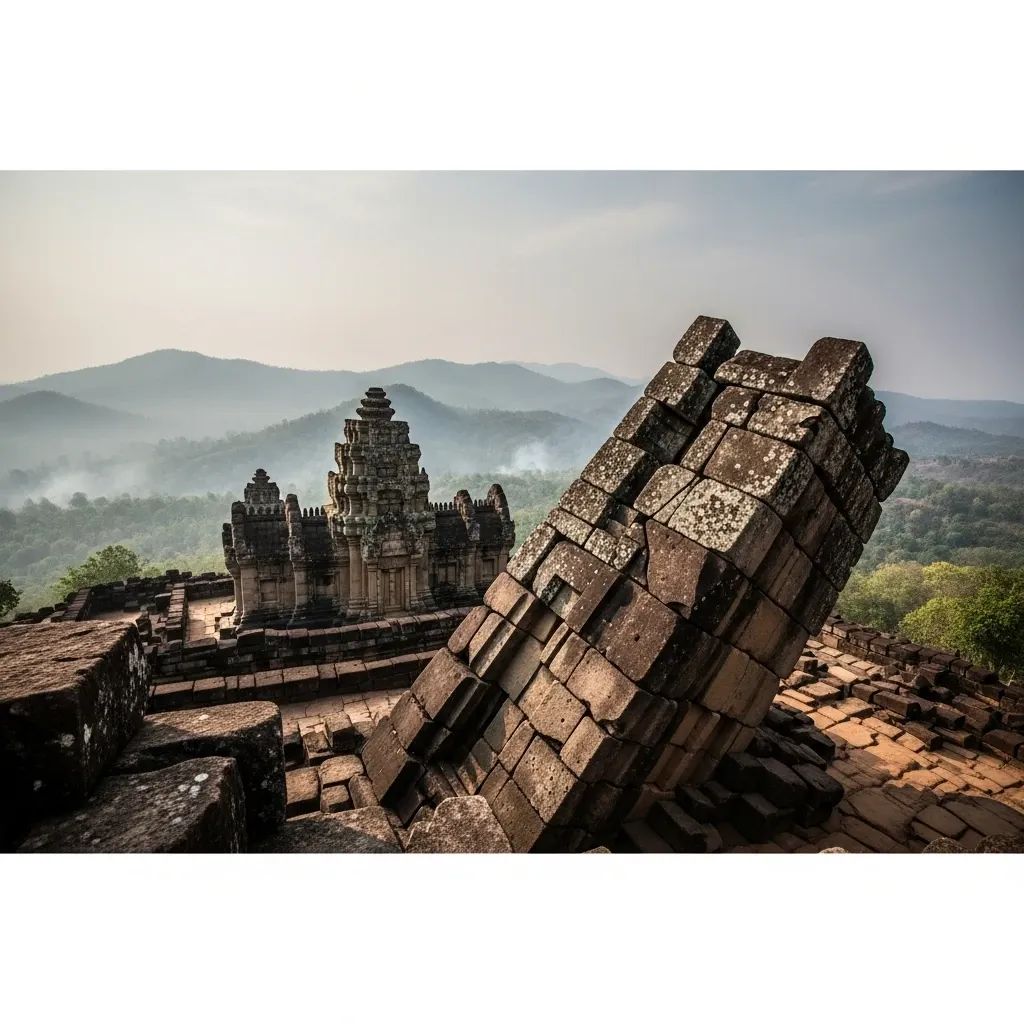
The fragile peace along the Thai-Cambodian frontier is once again being tested, and with it the fate of Prasat Ta Kwai—a sandstone sanctuary that predates Bangkok by 8 centuries. Weeks of artillery duels have left the monument tilting, farmers displaced and soldiers inching through mine-infested scrub. For residents of Surin and anyone hoping to visit the province soon, the message from officials is blunt: stay away for now, but don’t give up on the temple’s future.
Quick Dispatch: What Matters Most
• Structure at risk: New cracks in the 11th- to 13th-century shrine could lead to partial collapse.
• Minefields expanding: Thai sappers have cleared just 59 % of suspected explosives along this border sector.
• Restoration ready, not launched: Fine Arts Department teams have blueprints and trained staff standing by.
• Tourism freeze: The entire hill line around Ta Kwai remains a live military zone.
• Local anxiety: Border villagers report sleepless nights and stalled harvests as shelling sporadically resumes.
Why a Quiet Frontier Turned Loud Again
Surin’s mountainous edge, roughly 430 km from Bangkok, has long been a patchwork of overlapping maps, Khmer-style ruins and competing memories. The latest flare-up began late last year when Cambodian rocket fire from BM-21 launchers hit Thai territory near Prasat Ta Muen Thom. Thai infantry retaliated, pushing Cambodian units back from Hill 350, a ridge that overlooks Ta Kwai and two smaller passes. Military planners say the high ground prevents further encroachment, but archaeologists warn it also exposes the temple to artillery shrapnel.
The Hidden Enemy Beneath the Soil
While the gunfire grabs headlines, landmines pose the deadlier, longer-term threat. Reports compiled by the National Mine Action Centre show that more than 996,000 m² around Surin’s border remain “suspect”. In the Ta Kwai sector alone, Thai engineers recently unearthed four freshly laid PMN-2 antipersonnel mines—proof, they claim, that new devices are being planted even as old ones are cleared.
Lt Col Sarayut Malasai, whose 22nd Infantry Battalion patrols the area, walks journalists along a narrow concrete strip. “Step off either side,” he says, “and you’re in a field we haven’t verified yet.” The battalion’s priority is to push the safe perimeter out far enough for civilian technicians to follow. Until then, the temple’s lintels, libraries and collapsed gopura are strictly off-limits.
Culture Meets Combat: A High-Stakes Balancing Act
Heritage specialists compare the site’s carved pediments—narratives from the Ramayana in laterite and sandstone—to those at Phanom Rung. But unlike its famous cousin, Prasat Ta Kwai sits squarely in a contested corridor. Experts fear cultural destruction can be weaponised: erasing monuments erodes local identity and undercuts territorial claims. The Hague Convention of 1954 calls such attacks war crimes, yet enforcement on a remote ridge is tenuous at best.
“Each lost bas-relief is a page torn from the shared history of two nations,” says Prof. Orasa Rattanakul, a Khmer-art scholar at Silpakorn University. She adds that looters often follow conflict, moving artefacts into the black market while soldiers focus on survival.
A Blueprint Waiting for the All-Clear
Behind the scenes, the Fine Arts Department has drafted a multiphase rescue programme:
High-precision 3D laser scans to record every block’s original placement.
Anastylosis, the same stone-by-stone method used successfully at Phanom Rung, to rebuild collapsed walls.
A visitor circuit that would route tourists away from sensitive military positions while delivering revenue to local communities.
Budget figures remain confidential, but insiders speak of a multi-year commitment running into several hundred million baht. “Money isn’t the holdup,” insists Department head Phanombut Chanthachot. “Security is.” His teams cannot enter until the army hoists a green flag over the entire footprint.
Voices from Border Villages
At Ban Ta Meuan school, temporary classrooms shelter families who fled December’s shelling. Cassava fields lie scorched, and irrigation pipes peppered with shrapnel remain unrepaired. “We can’t risk replanting yet,” says farmer Boonmee Srichom, eyeing smoke rising from the ridge. Local traders echo his worry; cross-border markets normally bustle with Cambodian shoppers, but customs gates stay half-shuttered.
Yet hope persists. Some residents recall the tourism boom a decade ago when day-trippers from Bangkok would string Ta Kwai, Ta Meuan Thom and Phanom Rung into a single circuit. “When peace returns, so will the buses,” predicts guest-house owner Ratchanee Klinkaew, brushing dust from unused keychains embossed with the temple silhouette.
Security Calculus: Holding the Heights
Thai defence analysts argue that controlling Hill 350 and adjacent ridges is non-negotiable. “If we yield those positions, artillery could hit Surin town in minutes,” says Col Witthawat Sae-Chia of the Strategic Studies Centre. The Royal Thai Army has therefore built a 4 km deep buffer zone lined with radar, drones and reinforced bunkers. Cambodia denies laying new mines, counter-claiming its troops act in self-defence.
Diplomats from ASEAN capitals are nudging both sides toward another round of boundary talks, but progress is slow. Previous joint patrol proposals stalled over the question of who would command mixed units at archaeological sites.
What Comes Next—and What It Means for You
For the average traveller, Surin’s interior remains perfectly safe; elephant festivals and silk villages carry on. The danger is concentrated in a thin strip hugging the border. Provincial officials advise steering clear of Route 2169 near Chong Chom until further notice.
Residents and investors should watch three indicators:
• Demining milestones—once the army logs 100 % clearance, civil engineers can start shoring up the sanctuary.
• Cease-fire durability—a sustained quiet period of at least 90 days is the threshold UN heritage advisers typically require before field deployment.
• Budget disclosure—when the Fine Arts Department publishes its restoration tender, contractors and craftsmen from Nakhon Ratchasima to Si Saket could see a boom.
Until then, Prasat Ta Kwai stands alone on its wooded knoll—scarred yet stubbornly upright, a stone chronicle waiting for its next chapter once the smoke clears.


