
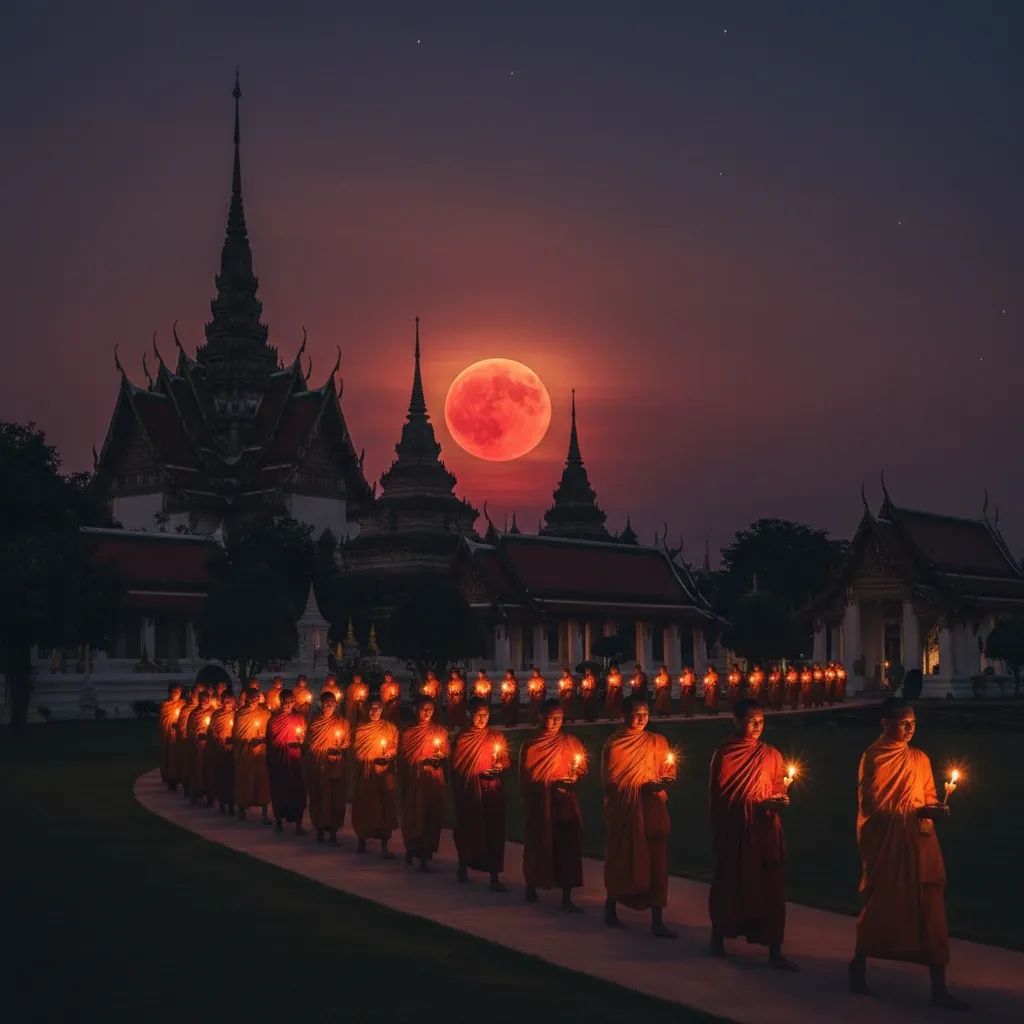
Tuesday evening, March 3, will deliver an extraordinary convergence: Thailand's eastern skies will frame a brilliant crimson Moon at the precise moment the nation honors Makha Bucha, the holiest of Buddhist observances. This total lunar eclipse, arriving around moonrise at 6:23 PM, cuts through the usual routine of ceremonial life with a rare celestial punctuation mark—turning spiritual reflection into an event the entire Kingdom can witness together.
Why This Matters
• The brick-red Moon climbs the horizon already fully eclipsed, offering a 39-minute window of totality visible to everyone regardless of location or equipment.
• NARIT (Thailand's National Astronomical Research Institute) is coordinating viewing events at five major sites and broadcasting live, though the show requires no special access—just clear skies and an eastern view.
• The timing reactivates centuries of Thai folklore about Rahu, the celestial demon said to swallow the Moon, threading ancient belief through modern science.
• Makha Bucha's spiritual practices—temple visits, candlelit processions, merit-making—unfold against the backdrop of this visual rarity, intensifying a night already layered with cultural weight.
How the Eclipse Unfolds in Real Time
The astronomical sequence begins well before visible drama. Starting at 3:44 PM, Earth's outer shadow (the penumbra) first touches the Moon, though this is far too subtle for observers to notice. By 4:50 PM, the true eclipse becomes apparent as the Moon slides into Earth's darker umbra, and the partial phase accelerates. The transition to complete totality occurs at 6:04 PM—precisely when most of Thailand is preparing evening meals and settling into the rhythms of Makha Bucha observance.
Here lies the practical reality for viewers: the Moon won't clear the eastern horizon until 6:23 PM, which means residents will witness the eclipse already in progress. Rather than watching the Moon gradually darken and redden from a distance, Thais will see it rise suddenly crimson, deep red, fully immersed in Earth's shadow. That dramatic moment lasts until 7:02 PM, after which the brick-red hue fades progressively. By 8:17 PM, the Moon exits the umbra entirely, though traces of eclipse persist until 9:23 PM when it clears Earth's penumbra completely.
The 39-minute totality window represents the sweet spot—the period when the blood-moon glow is most striking to the naked eye and when photographs capture the deepest color.
The Science and the Superstition
Sunlight refracted through Earth's atmosphere creates the red color, a phenomenon physicists understand as differential scattering: blue wavelengths scatter and disappear, while longer red wavelengths bend through our air and paint the lunar surface. The exact shade—ranging from brick-red to deep orange to copper—depends on atmospheric dust, volcanic aerosols, and cloud cover along the boundary between day and night on Earth. Scientists at NARIT will monitor atmospheric clarity in the days leading up to March 3 to predict the eclipse's intensity.
Yet for many Thailand residents, the mechanism matters less than the mythology. Rahu, the severed head of a celestial demon from Sanskrit cosmology, traditionally receives blame for consuming the Moon during eclipses. This belief persists not as superstition dismissed but as cultural continuity—a framework through which to understand the event.
King Rama IV (King Mongkut), who ruled 1851–1868, was himself a rigorous astronomer who predicted a total solar eclipse with impressive accuracy. His scientific achievements demonstrate Thailand's long history of celestial observation blending seamlessly with spiritual practice. A 19th-century manuscript from his reign documents two types of "red moons" and notes cultural associations with subsequent events; whether these represent genuine causation or coincidence, the records endure as cultural memory.
The Makha Bucha Convergence
The Buddhist calendar delivers the Makha Bucha commemoration on the full moon of the third lunar month, which this year aligns precisely with the eclipse. The holiday recalls a spontaneous gathering of 1,250 enlightened monks—all ordained directly by the Buddha—nine months after his enlightenment. During this assembly, the Buddha distilled Buddhism into three principles: cease from all evil, do good deeds, and cleanse the mind (a teaching known as the Ovada Patimokkha sermon).
Modern Buddhists honor this by visiting temples, offering meals to monks, observing the Five Precepts (or stricter Eight Precepts for the particularly devoted), and performing the Wian Tien procession at twilight. This ritual involves circumambulating the temple's ordination hall three times clockwise while carrying flowers, incense, and lit candles—an act of homage to the Buddha, his teachings (Dharma), and the monastic community (Sangha).
The eclipse transforms this already spiritually resonant evening into something extraordinary. Thousands of candles held aloft in temple courtyards, illuminating processions in near-darkness, will coincide with a russet Moon hanging overhead—a visual merger of human reverence and celestial drama. Whether intentional or coincidental, the convergence deepens the night's emotional weight for observers of faith.
Where to View Across Thailand: Recommended Temple and Observatory Sites
The eclipse is visible nationwide—a democratic event that reaches Chiang Rai in the north, Songkhla in the south, and everywhere between. The critical variable is clarity on the eastern horizon. Urban areas like central Bangkok face light pollution, yet lunar eclipses are bright enough to penetrate city glow; the effect resembles watching a dim streetlamp rather than gazing into darkness. Contrast and fine detail improve dramatically in darker settings.
NARIT Viewing Centers and Transportation
NARIT operates five dedicated viewing centers where trained astronomers will provide commentary, telescopes, and binoculars:
• Princess Sirindhorn Astropark – Mae Rim district, Chiang Mai (Northern Thailand). Public transit: Songthaew services run from Chiang Mai city center to Mae Rim; allow 45 minutes. Parking available for private vehicles.
• Nakhon Ratchasima Observatory – Accessible via central bus station or rental car (1.5-hour drive from city center)
• Khon Kaen Observatory – City-center location; local bus services available
• Chachoengsao Observatory – 90 minutes east of Bangkok; accessible by train (State Railway of Thailand) or rental car
• Songkhla Observatory – Southern Thailand; local transportation from Hat Yai or Songkhla city
Facebook and YouTube live streams from NARIT will offer remote access for those unable to travel.
Temple Recommendations in Major Expat Areas
Temples hosting extended evening Makha Bucha ceremonies with English-friendly environments:
Bangkok Area:
• Wat Phra Kaew (Temple of the Emerald Buddha) – Grand Palace grounds, central Bangkok. Massive candlelit processions; arrives early for seating.
• Wat Saket (Golden Mount Temple) – Sanam Luang area. Known for welcoming international visitors; clear eastern views from elevated temple grounds.
• Wat Suthat – Historic temple near Democracy Monument; English signage, accessible public areas.
Chiang Mai:
• Wat Chedi Luang – Old City center. Major Makha Bucha gathering; excellent vantage point for eclipse viewing from temple grounds.
• Wat Phra Singh – Older temple with devoted community; quieter alternative to Wat Chedi Luang.
Pattaya:
• Wat Phra Yai (Big Buddha Temple) – Hilltop location offers superior eastern horizon viewing and minimal light pollution.
• Sanctuary of Truth – Large open grounds; excellent for photography and unobstructed moonrise observation.
Phuket:
• Wat Chalong (Chalong Temple) – Southern Thailand's largest and most welcoming to international visitors; extensive temple grounds.
• Big Buddha Phuket – Elevated site with panoramic views; arrive early due to anticipated crowds.
Independent Viewing Sites
National parks, hilltops, and east-facing beaches serve as excellent alternatives. Bring a blanket or portable chair—comfort matters during a 39-minute vigil. Insect repellent is wise for parks and coastal areas. Photographers should arrive with fully charged batteries and manual camera settings configured in advance; smartphones capture video but often struggle with color accuracy in low light. Pairing the eclipse with foreground elements—temple silhouettes, candlelit worshippers, familiar landmarks—transforms a record into an artistic composition.
Weather and Forecast Resources
Weather remains the critical variable. Early March typically offers dry conditions in most of Thailand, though coastal and northeastern regions occasionally encounter cloud cover.
Reliable Thai meteorological resources for daily forecasts:
• Thai Meteorological Department (tmd.go.th) – Official forecasts updated daily; province-specific predictions available
• Windy.com – Real-time cloud cover mapping; excellent for identifying clear zones within Thailand on March 2-3
• Weather Channel Thailand app – Hour-by-hour forecasts with cloud cover percentages
Forecasts become reliable only a few days before the event; residents should monitor local predictions starting March 1 and have a backup plan or secondary location if their primary site shows threatening skies. If your primary location shows unfavorable conditions, identify a secondary site within driving distance or adjust timing slightly to chase clearer skies within the Kingdom.
What This Means for Residents
For Thailand residents, foreign workers, and visitors, the March 3 eclipse presents a low-barrier, high-reward experience. Unlike solar eclipses, which require protective eyewear and precise positioning, lunar events are safe to view directly and visible from nearly anywhere. Makha Bucha's public holiday status means temples operate extended evening hours, encouraging participation.
Expats and tourists considering temple attendance should dress modestly (covered shoulders and knees) and observe silence during chanting. Alcohol sales face restrictions on Makha Bucha—some establishments close entirely, others limit service. This is cultural accommodation, not inconvenience; it reflects the nation's respect for one of its most sacred dates.
Residents planning photography should test equipment in advance, understand their camera's manual exposure controls, and consider composition beyond the Moon itself. The context—temple grounds, silhouetted crowds, the play of candlelight and moonlight—often elevates a photograph from record to narrative. Urban photographers should seek vantage points that minimize light pollution; rooftop access in older neighborhoods often provides superior viewing compared to high-rise developments surrounded by neon.
Work schedules may shift slightly on Makha Bucha—some offices close or reduce hours—so planning in advance prevents disruption. The eclipse itself requires no special preparations beyond checking weather and confirming viewing location.
Preparation Checklist and Final Logistics
With the eclipse arriving March 3, Thailand residents should finalize viewing logistics now:
Essential Steps:
• Identify the moonrise time for your specific province (varies slightly across Thailand's geography)
• Confirm transportation if traveling to a dedicated viewing site; book tickets or arrange rides in advance
• Pack comfort items: portable chair, blanket, insect repellent, water, snacks
• For photographers: test camera settings using the Moon as a subject on March 2 or earlier, ensuring exposure and focus mechanisms perform as expected
• Check local weather forecasts daily from March 1 onward; identify a secondary viewing location as backup
For Temple Attendance:
• Research specific temple locations and expected crowd sizes
• Arrive 30–45 minutes early to claim a reasonable spot for Wian Tien processions
• Prepare modest clothing meeting temple dress codes
• Plan parking or public transit in advance
The March 3 eclipse represents a confluence that won't repeat exactly for years—a total lunar eclipse overlapping Makha Bucha, visible from every inhabited corner of Thailand, arriving at moonrise for maximum drama. Whether approached as scientific phenomenon, spiritual milestone, or simply a rare visual experience, the event offers something for nearly every resident: a shared moment in the night sky that connects personal observation to national calendar and universal physics simultaneously.


