
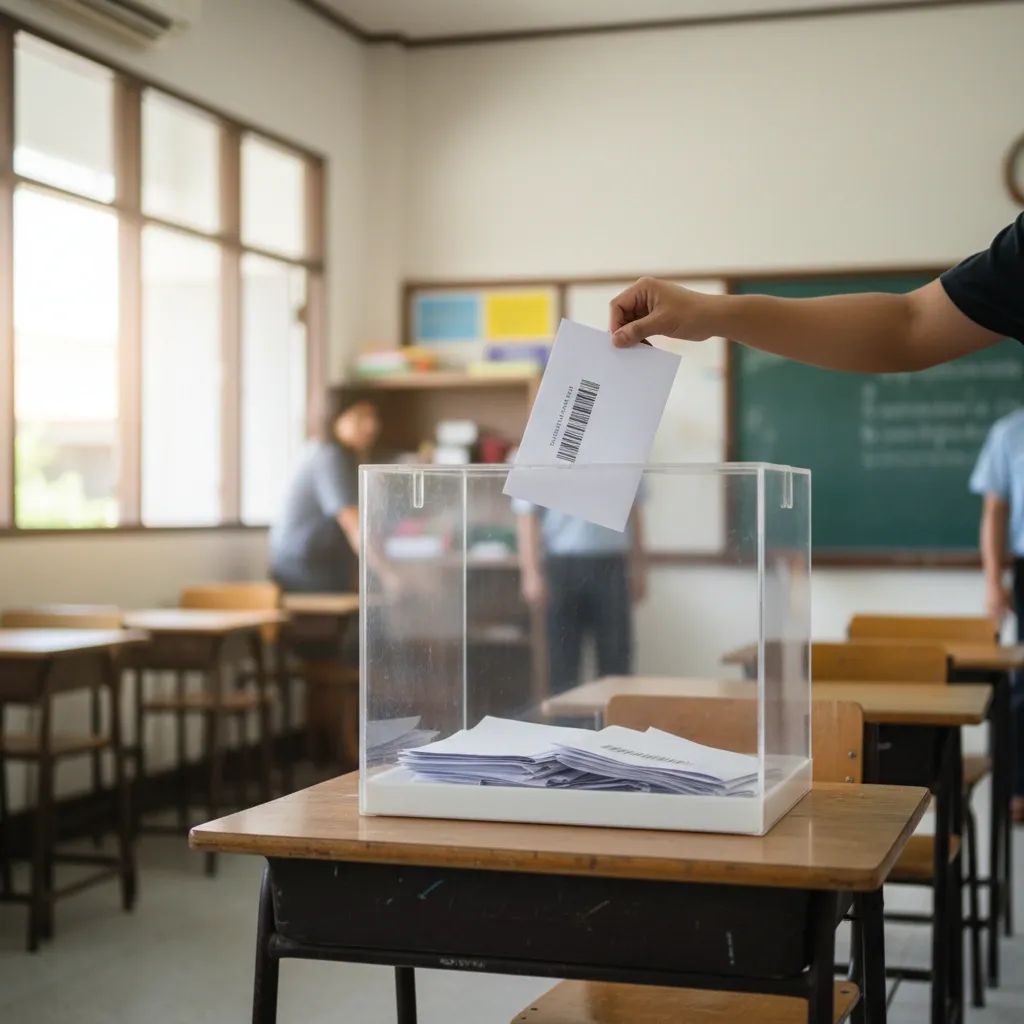
The Thailand Election Commission (EC) has come under fresh legal fire for printing unique barcodes on this year’s ballot papers, a move that could eventually force new polls in contested districts and unsettle the wider political calendar.
Why This Matters
• Constitutional risk: Article 85 demands absolutely secret ballots. If the court rules barcodes breach that clause, parts of the 2026 vote could be voided.
• Possible repeat elections: Three polling stations already face new printing orders; more than 20 units await recount petitions.
• Privacy concerns for households: Activists warn that, in theory, a barcode matched to the voter’s stub could reveal who voted for whom—raising fears of intimidation.
• Economic jitters: Any large-scale rerun would delay coalition building, which Fitch says could shave 0.2 % off Q2 GDP by freezing public-spending bills.
How the Barcode Ended Up on Your Ballot
Thailand’s 2026 ballot redesign introduced a QR code on the green constituency sheet and a linear barcode on the pink party-list sheet. The EC says the codes trace printing batches, deter counterfeits and help tally unused papers. But opposition parties—including Pheu Thai and the smaller Pracha Kao movement—argue the numbering sequence amounts to a “fingerprint” that can be lined up with the signed ballot stub each voter leaves behind.
Election officials insist the numbering data live in a separate vault, inaccessible without a court order. Critics counter that the very possibility of linking ballots to voters chills free choice—echoing the Constitutional Court’s landmark 2006 ruling that annulled an election because camera angles inside booths could have exposed marked ballots.
The Legal Battlefield
Ombudsman’s clock is ticking: Civic groups filed complaints last week; the Ombudsman has 7 days to decide whether to pass them to the Constitutional Court.
Multiple venues: Parallel suits are already in the Administrative Court (procedural illegality) and the Criminal Division for Corruption (abuse of office).
What can happen next?
• The Court may order a targeted re-vote in affected districts.
• It might compel a nationwide redesign but keep current results.
• In the worst case, it could declare the entire poll null and void—a step taken only twice in modern Thai history.
What This Means for Residents
• Your current vote still counts. Unless a specific polling unit is voided, MPs will take their seats as scheduled.
• Watch for local notices. If your district is one of the three flagged for fresh ballots, the sub-district office (amphoe) must post dates 14 days in advance.
• No selfies in booths. Photographing marked ballots remains an offense carrying up to ฿10,000 in fines—barcode controversy changes nothing here.
• Expect possible delays in new policies. Major stimulus bills or visa-rule tweaks promised on the campaign trail could slip to mid-year if court actions drag on.
Investor & Expat Angle
Currency desks at Kasikornbank report a mild uptick in hedging costs; the baht slid 0.4 % against the U.S. dollar after petitions were filed. Property developers eyeing foreign-buyer quotas say any prolonged vacuum in parliament could stall land-tax relief motions. Expats renewing work permits should not face immediate hurdles, but a caretaker cabinet cannot issue new tax incentives.
Expert Voices
• Assc. Prof. Manit Chumpa, Chulalongkorn University, argues that even an unproven ability to trace ballots "undermines the psychological safety of voters."
• Cyber-security lecturer Dr. Napadon Kannika counters that breaking the EC’s three-layer separation—voter list, stub, counted ballot—would require "inside access plus illegal database joins," which he calls "extremely low-probability but not impossible."
Where Things Stand Now
The EC is debating whether newly printed ballots for the three re-polling stations should drop the barcode entirely or replace it with a 5-digit non-sequential lot number. A Senate oversight panel has summoned commissioners for a hearing next week, while an NIDA poll finds 62 % of respondents satisfied with EC logistics but only 37 % trust its fraud-busting power.
Looking Ahead
Lawmakers from across the aisle are floating a mid-year amendment to the Organic Act on Elections (Section 96) that would spell out what kinds of security marks are permissible. Some civil-society groups push for a blockchain-style public ledger where voters can verify ballot authenticity without revealing identity. For now, the spotlight remains on the Constitutional Court; its decision—expected within 60 days if the Ombudsman forwards the case—will determine whether Thailand’s next political chapter opens with a rerun or a ruling that the barcode battle was a false alarm.


