
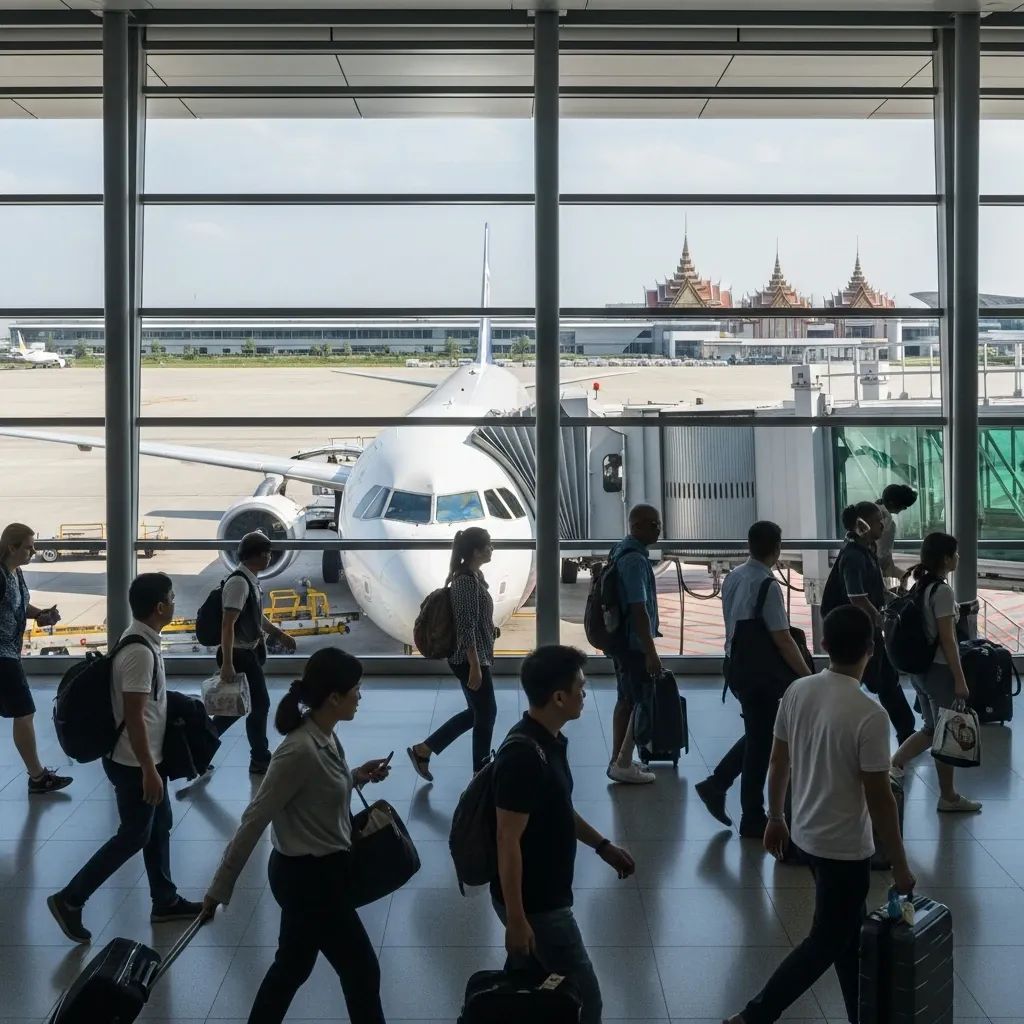
The flight boards at Suvarnabhumi have rarely looked this busy. After a subdued half-decade, the Bangkok–Hong Kong corridor has broken into the world’s 10 most heavily travelled international routes, underscoring both Asia’s aviation rebound and Thailand’s place at the center of it.
Fast Facts at a Glance
• 4.17 M seats scheduled on the Bangkok–Hong Kong route in 2025
• Ranked No. 8 globally for international capacity, according to OAG
• 7 of the top 10 busiest cross-border routes now lie in Asia
• Average one-way fare on the corridor hovers around US$115 and trending lower
• 10 airlines compete head-to-head, from full-service giants to ultra-low-cost newcomers
Asia’s Skies Dominate the 2025 League Table
While North American and European corridors are still rebuilding, Asian routes account for 7 of the 10 busiest international pairings this year. Hong Kong–Taipei remains the globe’s densest air bridge with 6.83 M seats, followed by Cairo–Jeddah and the perennially crowded Kuala Lumpur–Singapore shuttle. Analysts attribute this surge to pent-up intra-regional tourism, the return of Chinese outbound travel, and an aggressive expansion by low-cost carriers that are willing to keep margins thin to capture market share.
Bangkok–Hong Kong: From Regional Link to Global Heavyweight
Just two years ago the BKK–HKG pairing hovered outside the top ten; today it offers 4,169,125 seats, nudging past its 2019 record and clinching eighth place worldwide. The seat map is split among Thai Airways, Cathay Pacific, HK Express, Thai AirAsia, Thai Lion Air, Hong Kong Airlines, Greater Bay Airlines, Emirates, Ethiopian, and United. With such a crowded roster, capacity grew 23 % year-on-year, yet average fares slipped roughly 6 %, giving leisure travellers an unexpected windfall.
Engines of Growth: Tourism, Trade and an Itch to Meet Face-to-Face
Thailand expects up to 41 M foreign arrivals in 2025—slightly above the pre-pandemic peak—while Hong Kong Tourism Board targets 49 M visitors of its own. Business traffic is also rebounding: financial-services firms headquartered in Central are sending teams southward again, and Thai exporters are rotating staff through Hong Kong to court investors. The city’s GDP is projected to expand 3 %, versus Thailand’s more modest 1.5–2.3 %, but both governments are betting on services-sector spending to offset manufacturing jitters. This cocktail of holidaymakers, traders and deal-makers keeps aircraft cabins consistently above 80 % load factor even in shoulder months.
Airline Playbooks: More Seats, More Frequencies, New Tricks
Competition is poised to intensify. United Airlines will inaugurate daily non-stops in late October, while HK Express and Thai AirAsia add frequencies timed for weekend city-breakers. Greater Bay Airlines is dangling sub-US$90 promos to fill its 2-class 737-800s, and legacy carriers are counter-punching with mileage bonuses and free-stopover offers. Behind the scenes, Hong Kong International’s third runway and Suvarnabhumi’s midfield satellite enable each hub to swallow additional slots without breaching curfews.
Why It Matters for Travellers and Thai Businesses
• Cheaper tickets: Fare data show a sustained downward drift despite fuel-cost volatility.• Better connectivity: Hong Kong’s banking heartland is back within a two-hour hop; onward links to North America via Cathay and United shave connection times.• Risk hedge: Diversifying away from over-reliance on mainland Chinese tourists, Thai hotels now court Hong Kong visitors who spend 35 % more per trip on average.• Potential headwinds: Geopolitical flashpoints in the Taiwan Strait or along Thailand’s borders, and Thailand’s slippage to 47th on the WEF tourism-competitiveness index, could dent sentiment if left unaddressed.
Outlook: Room to Grow—With Caveats
Industry forecasters predict the corridor could top 4.5 M seats by 2027, assuming capacity keeps rising at its current 4-year CAGR. Yet carriers warn that demand is price-sensitive and susceptible to security scares. For now, however, the message is clear: Bangkok and Hong Kong have reclaimed their status as Asia’s twin gateways, and residents of Thailand stand to benefit from the fiercest airfare dogfight the route has ever seen.


