
Authorities in Bangkok have dismantled a coordinated late-night motorcycle operation that disrupted traffic on one of the city's major arterials, resulting in 17 arrests and the seizure of 14 bikes. The crackdown demonstrates a hardening enforcement stance that now extends beyond individual riders to target the entire ecosystem supporting illegal racing—modification shops, enablers, and parents alike.
Why This Matters
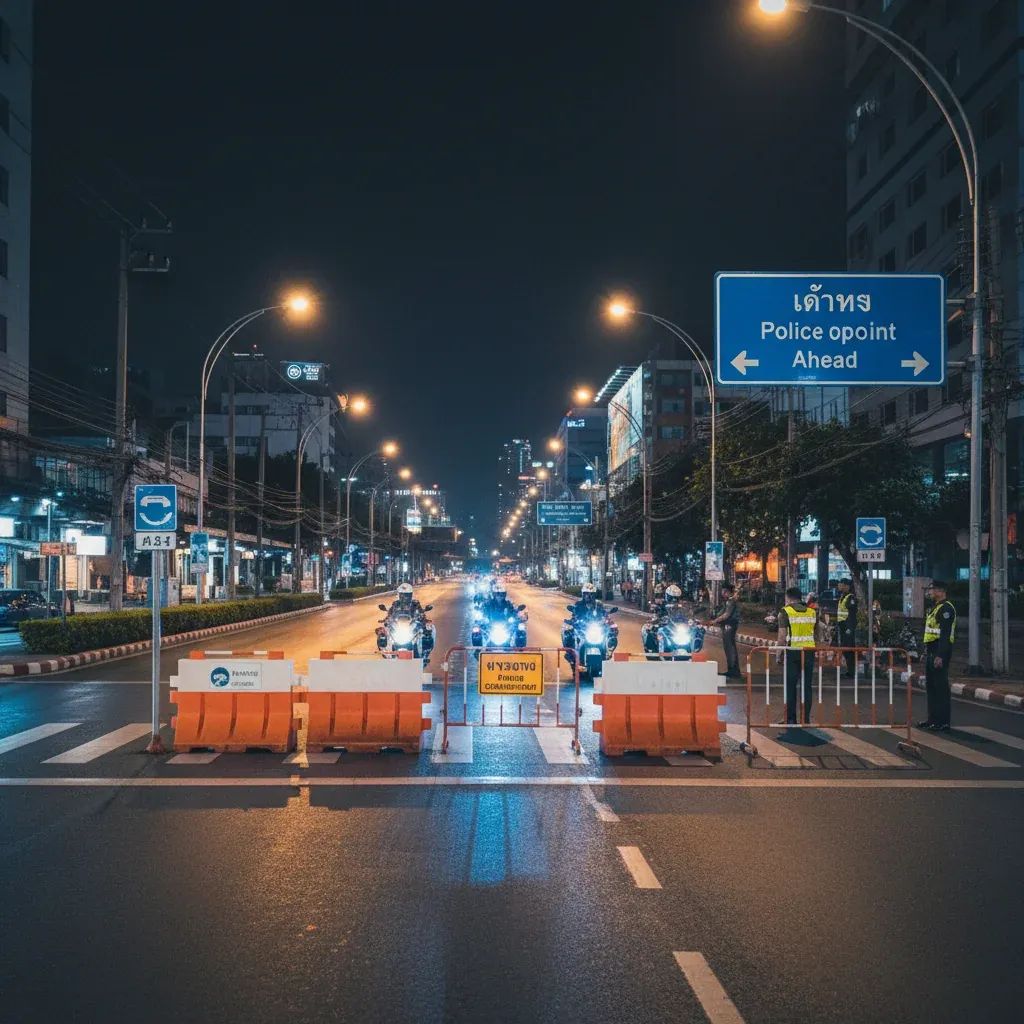
• Your commute and safety: The Royal Thai Police has positioned permanent checkpoints along Vibhavadi Rangsit between Don Mueang and Sutthisan through late February, which will slow evening and night travel for residents relying on this route.
• Vehicle ownership risks: If you own a motorcycle, you're now legally accountable if someone uses it for illegal racing; vehicle confiscation applies to the registered owner regardless of who was actually riding.
• Parental liability surge: Parents of teenagers caught racing face up to ฿30,000 in fines or imprisonment, a penalty many families underestimate when purchasing motorcycles for their children.
Active Checkpoints Affecting Your Route
Location: Vibhavadi Rangsit between Don Mueang and SutthisanDuration: Through late FebruaryPeak Activity: Evening and night hours (11 PM–3 AM)What to Expect: Driver's license verification, vehicle registration checks, and emission system compliance inspections. Riders lacking valid licenses face immediate citations and vehicle impoundment.
How Police Dismantled the Operation
The investigation began with the fundamentals. The Royal Thai Police received dozens of complaints through hotlines 191 and 1197 describing nightly motorcycle gatherings that blocked traffic on Vibhavadi Rangsit. Residents reported organized convoys launching from near Vibhavadi Soi 17 shortly after midnight, accelerating northbound toward Don Mueang Airport before circling back toward Sutthisan—a pattern showing organized coordination.
Pol Lt Col Phuchong Mao-Thung, heading the Traffic Police Sub-Division 2 Control and Traffic Management Center, coordinated a multi-week surveillance initiative combining CCTV review, vehicle registration database matching, and photo identification. The footage confirmed what complainants described: riders occupying every available lane, weaving at prohibited speeds, and deliberately blocking legitimate traffic.
Officers documented the modified bikes themselves, noting stripped exhaust systems (audible from hundreds of meters away), removed mirrors, and tucked license plates—calculated evasion tactics that transformed these motorcycles into unmistakable racing machines. The coordination was sophisticated: WhatsApp and LINE messages preserved timestamped planning communications that investigators cross-referenced against CCTV timestamps and vehicle locations.
All 17 suspects—seven adults and 10 minors—voluntarily presented themselves to police on Thursday and Friday. The Bangkok North Municipal Court imposed one-month suspended sentences and ฿10,000 fines on each adult offender; any subsequent traffic violation automatically triggers imprisonment. The 10 juveniles transferred to the Juvenile Observation and Protection Centre entered Thailand's separate youth justice system.
The court's decision to order permanent confiscation of all 14 motorcycles represented a tactical shift. Rather than temporary impound-and-release procedures, these bikes are now classified as instruments of criminal activity, subject to destruction or auction with proceeds directed to victim compensation funds.
The Business Behind Street Racing
Motorcycle modification garages form the technical foundation enabling Bangkok's racing subculture. These shops perform surgical alterations: aggressive exhaust tuning removes back-pressure regulation, Electronic Control Unit (ECU) reprogramming increases throttle response and horsepower, high-flow air intake systems boost combustion efficiency, lightweight aftermarket rims substitute aluminum for stock steel, and non-essential components—passenger seats, fairings, indicators—vanish to reduce weight by 15-20 kilograms.
Police are now treating these garages as criminal facilitators. Shop owners performing illegal modifications face six months imprisonment and fines between ฿10,000 and ฿20,000. Authorities conduct surprise inspections, examine customer records, cross-reference client lists against arrest databases, and systematically build prosecution cases against proprietors who knowingly service racing operations.
The modifications themselves encode a philosophy. A racer's bike typically reflects racing priorities: maximum acceleration, minimal weight, aggressive noise as psychological intimidation. License plates tucked beneath seats or removed entirely signal intent—eliminating identification mechanisms that would trigger traffic stops. Police now use this absence of visible plate as probable cause for vehicle interdiction.
Social media and encrypted messaging organize these operations with precision. LINE and WhatsApp groups coordinate meeting times, specific meeting points, planned routes, and rotation schedules. Police have embedded technical specialists to monitor these digital communities, cross-referencing usernames with CCTV imagery and registration databases. The Vibhavadi operation demonstrated this capability: digital evidence established timeline links between planning communications and actual convoy activity.
What Changed for Residents and Riders
For anyone traversing Vibhavadi Rangsit during evening and night hours—particularly between 11 PM and 3 AM—expect encounters with enhanced police presence. Checkpoints near Don Mueang and Sutthisan require driver's license verification, vehicle registration, and emission system compliance checks. Riders operating motorcycles lacking valid licenses face immediate citations and vehicle impoundment. Motorcycles exhibiting modification indicators trigger in-depth inspections.
The Royal Thai Police issued a nationwide directive reorienting traffic enforcement toward prosecution and asset forfeiture. This represents a philosophical change: modified motorcycles no longer receive warnings; they face systematic removal from streets. The enforcement shift applies nationally, effectively removing the physical platforms enabling racing culture.
The penalty structure now operating is explicit and ascending. Street racing itself carries up to three months imprisonment or ฿2,000 fines; reckless driving endangering others escalates to one year imprisonment or ฿5,000-฿20,000 fines. Operating without a valid license triggers minimum ฿1,000 penalties. Organizing or promoting unauthorized races reaches six months imprisonment or ฿10,000-฿20,000 fines. Vehicle confiscation applies automatically, not as judicial discretion but as mandatory procedure.
Parents face distinct jeopardy under Thailand's Child Protection Act. A parent whose minor child is arrested for racing faces potential imprisonment up to three months or ฿30,000 fines. For repeat offenders, penalties intensify: second convictions exact ฿30,000 fines, third convictions result in incarceration. This legal framework explicitly criminalizes parental negligence, positioning guardians as accountable parties rather than sympathetic bystanders.
Understanding Why Teenagers Enter Racing Culture
Experts studying Bangkok's racing phenomenon identify a consistent antecedent condition: absence of parental engagement creates psychological space for peer replacement. Adolescents lacking genuine parental attention or structured enrichment activities gravitate toward the adrenaline component and the social belonging that organized racing communities offer. The "brotherhood" dynamic operates powerfully—established racers mentor newcomers, social media amplifies group identity, and the modified motorcycle transforms into a status currency within peer hierarchies.
Secondary factors amplify participation. Neighborhoods lacking youth recreational infrastructure create boredom conditions that racing fills. Motorcycles remain extraordinarily accessible—over 60% of units purchased from retail shops reportedly end up in young riders' hands, suggesting minimal dealer verification of purchaser qualifications. A historical perception of weak enforcement emboldened participation; generations of racers treated late-night operations as consequence-free activity.
Behavioral researchers note clustering patterns: street racers frequently engage in concurrent substance abuse—smoking, drinking, drug experimentation—suggesting these behaviors operate as coordinated risk-taking impulses rather than isolated phenomena. Neuroscientific understanding indicates adolescent brains show heightened responsiveness to reward stimuli and reduced sensitivity to punishment signals, creating developmental vulnerability to thrill-seeking behaviors.
Intervention programs acknowledge this complexity. The Department of Juvenile Observation and Protection (DJOP) operates "shock therapy" rehabilitation requiring mandatory parental attendance, forcing guardians to confront their role in enabling their children's choices. The Ratchapreuk Model at Ban Metta Juvenile Remand Home employs family-based positive reinforcement to reduce recidivism rates. Public prosecutors increasingly offer restorative justice alternatives: first-time juvenile offenders may avoid formal prosecution if they complete rehabilitation and demonstrate sustained behavioral change. However, this leniency threshold diminishes with each subsequent offense.
How to Report—and Why It Matters
The Royal Thai Police maintain open public reporting channels operating continuously via:
• 191 (national emergency hotline)
• 1197 (Bangkok Traffic Police Division)
• 1193 (Highway Police Division for expressway-based activity)
• 1599 (nationwide multi-province coordination line)
Effective reports include specific location details, time of observation, vehicle count, rider descriptions, and photographic or video documentation. Authorities treat all submissions confidentially, analyzing tips against surveillance databases to establish corroborating evidence. The Vibhavadi operation itself originated entirely from citizen complaints—demonstrating that public reporting directly catalyzes police investigations and enforcement.
The Broader Traffic Safety Picture
Street racing-related motorcycle fatalities represent a disproportionate share of Bangkok's late-night crash deaths, particularly among riders aged 15-24—a demographic already demonstrating statistically elevated risk tolerance and impulse control deficits. The Thailand Ministry of Transport estimates that racing-related collisions create secondary hazards affecting non-participant commuters, families in nearby vehicles, and emergency responders.
However, enforcement action alone has never eliminated underground racing in any urban context globally. Law enforcement data suggests that parallel investments in youth programming, family counseling accessibility, and sanctioned racing infrastructure prove necessary to dismantle racing subculture fundamentally. Several provinces have proposed constructing controlled racing facilities within stadium environments—climate-controlled spaces equipped with safety barriers, medical personnel, and insurance protocols where adrenaline-seeking impulses can be channeled without endangering public road users.
Until such alternatives materialize, the Royal Thai Police have committed to sustained patrols, zero-tolerance vehicle confiscation, prosecution of enabling ecosystems—modification shops, organizers, parents—and permanent criminal records affecting employment and educational prospects. For potential participants, the calculus has fundamentally shifted: the cost now includes vehicle forfeiture, potential imprisonment, parental prosecution, and permanent criminal marking rather than mere traffic citations.
The Vibhavadi operation succeeded through methodical police work—complaint aggregation, surveillance analysis, digital forensics—combined with judicial willingness to treat racing motorcycles as criminal instruments subject to permanent confiscation. Whether this enforcement model successfully scales across Bangkok's remaining known racing hotspots remains uncertain, but the message directed at racing communities is unambiguous: tolerance has terminated.


