
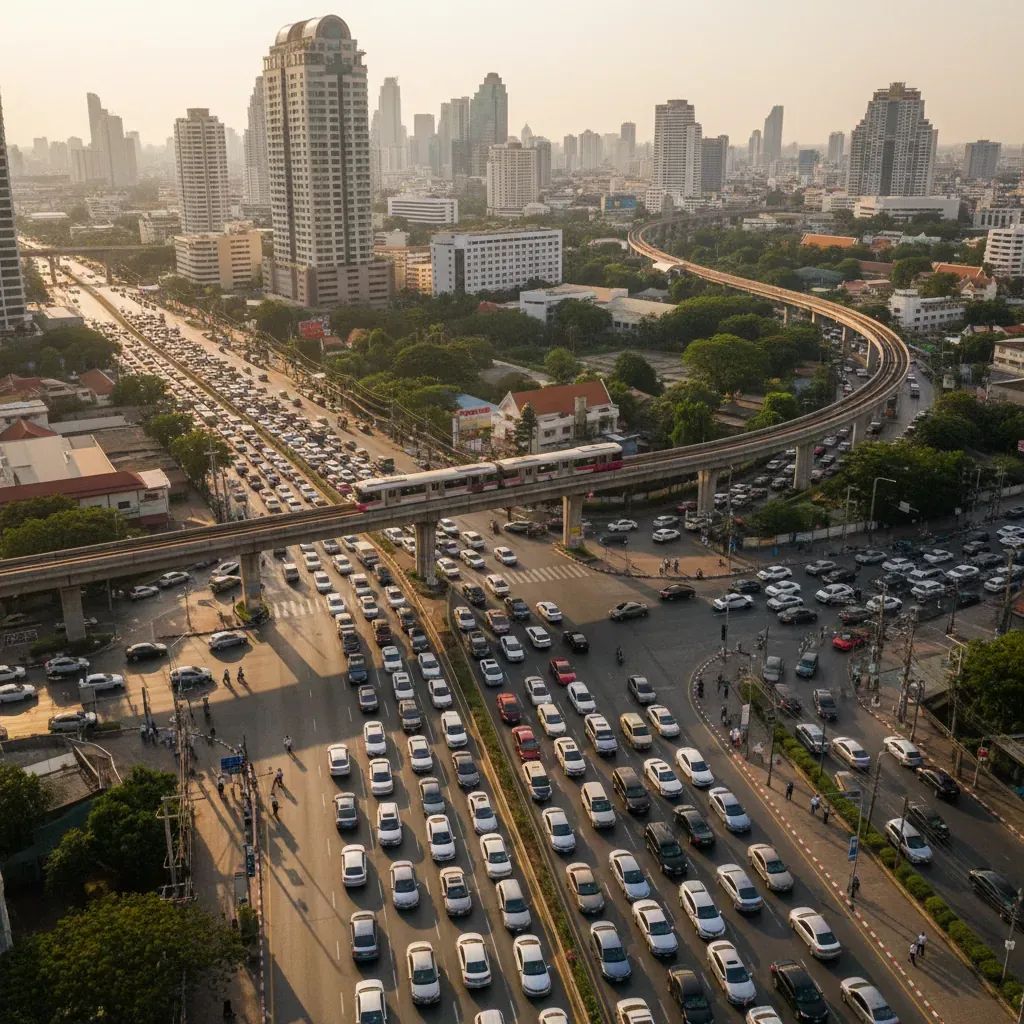
Why This Matters
• Traffic lockdown from noon to 6 PM: The Asoke-Sukhumvit intersection will experience severe congestion due to a six-hour rally at Ocean Tower 2; expect 1–2 extra hours on any vehicle journey through the zone.
• Public transit is your lifeline: The BTS Skytrain (Asoke station) and MRT (Sukhumvit station) will operate at normal frequency; both offer the only predictable escape from gridlock.
• Dual security presence at sensitive locations: Police are maintaining heightened surveillance at the Israeli Embassy and related diplomatic sites due to International Quds Day demonstrations. These are two separate, unrelated events happening on the same day—one local (Ocean Tower 2 rally), one related to international tensions linked to conflict in the Middle East.
Bangkok's transport arteries face a six-hour squeeze today as a large demonstration unfolds outside Ocean Tower 2 on Sukhumvit 21 Soi 3, while Thailand's Metropolitan Police Bureau simultaneously heightens surveillance at sensitive diplomatic locations amid international tensions. The practical reality for residents: if you drive through Asoke between noon and evening, you will sit in traffic. If you take transit, you arrive reliably.
The convergence of these two separate events—one local, one related to international developments—creates what authorities call a "heightened operations day," but for commuters, the mathematics are simpler: reroute or wait.
Understanding the Traffic Squeeze
The Lumpini Police Division confirmed earlier this week that a substantial gathering will occupy the street-level perimeter of Ocean Tower 2, a 42-story office tower completed in the mid-2000s that houses corporate offices, service providers, and multinational tenants. The demonstration runs precisely from 12:00 PM to 6:00 PM—a timing that slots directly into Bangkok's peak afternoon congestion window, when office workers are either leaving or arriving, school pickup traffic is spiking, and ride-hailing services are saturated.
The organizers and specific grievances driving the rally remain undisclosed by authorities. Thai police typically manage this way: announcing the disruption for public safety purposes while releasing minimal information about the demonstration's cause, sponsoring organizations, or political context. Residents learn that a rally occurs but often remain uncertain why until after it concludes, if official clarification ever arrives.
What police did specify: Sukhumvit 21 Soi 3 becomes inaccessible to through-traffic. The designated workaround is Sukhumvit 21 Soi 1, a narrower service road that will itself become overloaded as cars divert. Authorities estimate an additional 60–120 minutes for any journey through the vicinity. A typical 15-minute crossing could expand to 45 minutes or longer depending on point of origin and destination.
The Asoke intersection, already one of Bangkok's chronic congestion points where Sukhumvit Road intersects with Petchburi and Ploenchit Roads, will degrade further. Even peripheral streets typically used to bypass Asoke will see unusual volume. Traffic apps like Google Maps and Waze will likely show this zone in solid red by early afternoon.
The International Security Context
Overlapping this local event is heightened police monitoring at sensitive diplomatic locations. Thailand's Metropolitan Police Bureau is maintaining surveillance protocols at venues including the Embassy of Israel and related sites in response to International Quds Day, an annual pro-Palestinian solidarity demonstration that typically draws approximately 300 participants to designated areas.
Thailand's cosmopolitan character, with significant populations of Israeli, American, and Iranian expatriates, means that international tensions linked to conflict in the Middle East can manifest locally. Police response reflects this reality: enhanced monitoring focuses on diplomatic compounds and community institutions like the Chabad-Lubavitch House, a synagogue and social center in the Sukhumvit area frequented by Israeli residents and tourists. Uniformed officers are positioned at sensitive venues, and parking restrictions have been imposed near embassies to prevent vehicle-borne incidents.
The group PSC Thailand (Palestine Solidarity Coalition Thailand) is confirmed as an organizing force behind this year's demonstration. Past gatherings have remained peaceful. Police are specifically tasked with maintaining security and preventing escalation between demonstrators and enforcement personnel.
This security posture does not affect the Ocean Tower 2 rally directly—the two events are organizationally and spatially distinct—but both consume police resources simultaneously.
Impact on Daily Movement
Vehicle drivers: Avoid the Asoke-Sukhumvit corridor until 7 PM if your schedule permits. If you must transit the area during the 12-6 PM window, use Sukhumvit 21 Soi 1 as your bypass and mentally prepare for 30–45 minutes on what might normally take 15 minutes. Traffic prediction apps provide real-time updates, but during severe congestion, apps lag and route suggestions become unreliable. Monitor the Lumpini Police Facebook page or Metropolitan Police Bureau official channels for authoritative updates.
Public transit commuters: This is the day to embrace the BTS Skytrain or MRT. Both systems operate on standard Friday capacity. The Asoke Station (BTS) and Sukhumvit Station (MRT) sit within walking distance of Ocean Tower 2, offering complete avoidance of street-level congestion. Expect slightly elevated ridership during evening rush hours as diverted drivers convert to transit, but the systems are designed for this volume. Add 10–15 minutes to your journey time for station access and minor delays—modest compared to potential vehicle-based delays.
Delivery and logistics operators: Expect widespread delays. Restaurants in the Asoke zone will experience late food deliveries or fulfillment failures. Same-day package delivery to Sukhumvit addresses may be rerouted entirely or held until evening. Businesses relying on just-in-time supply chains or immediate delivery should preposition goods or prepare backup plans. Third-party logistics providers (Grab, Flash Express, Lalamove) will face the same gridlock as private vehicles; no service can escape infrastructure constraint.
Office tenants and workers at Ocean Tower 2: Building management will likely coordinate with police to implement temporary access restrictions. The demonstration occurs outside the structure, but security cordons and crowd management perimeters may impede normal foot and vehicle ingress during peak hours. Staff should verify entry/exit procedures with their company's office manager or with building security before arriving. Staggered departures or delayed starts may be recommended. Employees stationed at nearby buildings should prepare for heightened police presence and possible street-level congestion affecting their commute.
Residents in the immediate vicinity: If your residence is on Sukhumvit 21 or adjacent sois, plan an alternative departure route if you need to leave during the 12-6 PM window. Emergency responders (ambulances, fire services) will still have access, but non-emergency traffic will face delays. Noise levels may increase depending on demonstration amplification or chanting intensity.
The Precedent and Context
Bangkok's political environment has featured recurring demonstrations since the February 2026 elections. Ongoing tensions between government authority, civil liberties advocacy, and pro-democracy movements have created a landscape where diverse groups organize rallies addressing domestic grievances, international solidarity causes, or both. The current administration, described as conservative-led, has faced criticism from rights advocates regarding freedom of expression and assembly restrictions.
The city's multicultural character and historical tolerance for peaceful demonstrations (when politically permissible) have positioned Bangkok as a venue where international causes manifest locally. PSC Thailand and similar organizations leverage this space to express solidarity with Palestinian causes or protest US-Israeli foreign policy. Simultaneously, domestic groups use public spaces to mobilize around labor rights, housing, wages, or governance.
Police manage this through spatial containment and communication monitoring rather than outright suppression. The strategy is ring-fencing—controlling the demonstration area, monitoring communications for genuine threats, and deploying sufficient presence to prevent vandalism or violence. The outcome is typically managed disruption rather than confrontation.
Practical Navigation
Timing: Plan your route outside the 12-6 PM window if flexibility exists. If you must traverse during this period, depart early (before 11:30 AM) or wait until after 8 PM, when secondary congestion from diverted traffic has dispersed and traffic flow normalizes.
Route selection: If public transit is impossible, take side streets rather than main arterials. Apps like Google Maps can suggest less-congested alternatives, though these will add distance and time. Sukhumvit 21 Soi 1 is the official alternate, but expect it to be nearly as congested.
Information gathering: Real-time updates from Waze, Google Maps, or Thai traffic radio (frequency varies; check your local station) provide live conditions. Official police channels often post alerts on social media. Refresh these sources 30–60 minutes before departure, not just before leaving.
Backup communication: If you're coordinating with colleagues or family about arrival times, build in buffer time. "I'll be there in 30 minutes" becomes guesswork; "I'll be there between 45 and 90 minutes" is more honest.
The Evening Reprieve
The demonstration concludes nominally at 6 PM, but police clearance and crowd dispersal will extend until 7–8 PM. Traffic will remain volatile as diverted vehicles simultaneously attempt to resume normal routes, creating secondary congestion waves across the district. The BTS and MRT, meanwhile, will absorb increased evening-rush ridership but operate predictably—a crucial advantage on a day when surface traffic is unpredictable.
By 9 PM, normal Friday evening patterns should resume, and the Asoke-Sukhumvit area will be passable again. If you have flexibility, this timing window offers a clean window for outbound movement.
Bangkok's status as a Southeast Asian crossroads means occasional friction—some homegrown, some tied to international developments. Today's convergence of a domestic rally and heightened surveillance at diplomatic sites exemplifies this reality. Neither event alone would be unusual; the simultaneous occurrence strains a specific geographic zone. For residents and workers navigating the area, the takeaway is straightforward: adjust expectations, choose transit wisely, and treat this as a manageable 8-hour disruption rather than a citywide crisis.


