
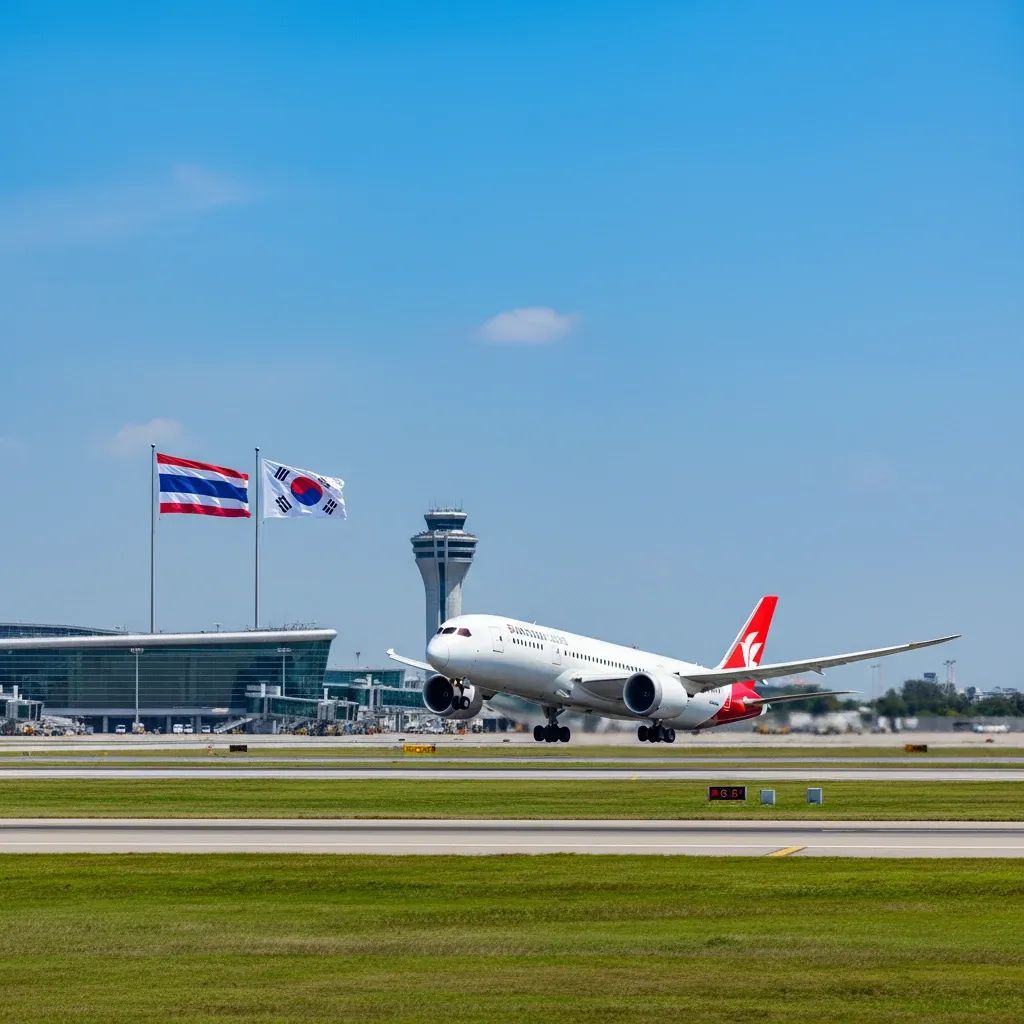
AirAsia Group, a Malaysia-based low-cost carrier with major operations in Thailand, has committed to a $19 billion purchase of 150 Airbus A220-300 jets—the largest single firm order in the Canadian-built aircraft's history. The transaction positions the region's dominant low-cost carrier to reshape Southeast Asian air travel by unlocking dozens of previously unprofitable routes while pressuring rivals such as Scoot, Jetstar Asia, and Cebu Pacific. For Thailand residents and travelers, this order promises new direct flights from Bangkok to underserved destinations and lower fares on existing routes by late 2028.
What This Means for Thailand Travelers
For travelers and residents in Thailand, the practical impact of this aircraft order will manifest in three key ways by late 2028 and beyond:
New regional routes from Bangkok: Expect new direct flights from Bangkok and regional Thai airports to underserved destinations in Laos, Cambodia, and Myanmar, as well as secondary cities across Indonesia and the Philippines. These routes were previously unprofitable for airlines using larger aircraft.
Lower fares on existing Thai routes: Increased frequency on existing routes—such as Bangkok–Phuket or Bangkok–Chiang Mai—should drive down average fares as AirAsia leverages significantly lower operating costs from the fuel-efficient A220 jets.
Better cabin experience at budget prices: The A220 offers passengers larger windows, quieter engines, and improved air quality—a noticeable upgrade over older aircraft operated by competitors, even within the low-cost segment.
Why This Aircraft Order Matters
Fleet composition and route strategy: Deliveries of the new aircraft begin in Q1 2028, enabling AirAsia to serve routes between smaller cities—what aviation professionals call "thin city pairs"—that larger A320s cannot operate profitably. These are routes where daily passenger demand falls between 100 and 140 travelers, making them unsuitable for larger aircraft but viable for the mid-sized A220.
160-seat configuration: AirAsia becomes the first airline to fly a high-density 160-seat A220-300, achieved through an extra emergency exit. This configuration maximizes revenue per flight while maintaining the aircraft's reputation for passenger comfort, allowing the airline to offer superior cabin experience at lower unit costs.
Fuel efficiency advantage: The Pratt & Whitney GTF engines (modern turbofan engines designed for fuel efficiency) powering these jets consume 20–25% less fuel per passenger than previous-generation narrowbody aircraft. Since fuel represents roughly 30–40% of operating costs for low-cost carriers in Southeast Asia, this efficiency directly translates to lower fares for consumers.
Long-term expansion plans: AirAsia has purchase rights for an optional 150 additional jets if a larger A220-500 variant is developed, positioning the carrier to grow its combined fleet to approximately 600 aircraft by 2035.
Strategic Fleet Redeployment
The A220 order triggers significant fleet optimization across AirAsia Group's network. By assigning A220s to shorter routes between smaller cities, the airline frees larger A320s and A321 jets for mid-haul markets such as Kuala Lumpur–Taipei or Bangkok–Tokyo. Even larger A330 widebody aircraft can shift to longer-haul international routes into Europe, Australia, and North America.
This redeployment addresses a critical gap in Southeast Asian aviation: while major hubs like Bangkok Suvarnabhumi, Singapore Changi, and Kuala Lumpur International enjoy strong connectivity, secondary Thai cities remain underserved. The A220's ability to operate from smaller regional airports with limited runway infrastructure enables AirAsia to establish new direct city-to-city services that bypass traditional hub-based connections, potentially saving Thai travelers time and money.
Competitive Context
Southeast Asia's low-cost carrier market is highly competitive, with AirAsia, Lion Air, VietJet Air, Scoot, Jetstar Asia, and Cebu Pacific competing aggressively on pricing. The introduction of right-sized, fuel-efficient aircraft gives AirAsia a first-mover advantage on routes where competitors lack suitable equipment.
Scoot operates primarily larger A320s and Boeing 787s, making it difficult to justify service to smaller markets without losing profitability. Jetstar Asia faces similar constraints. Cebu Pacific, AirAsia's closest Philippine rival, operates A320 variants but lacks an intermediate solution for lower-demand routes. Industry analysts expect AirAsia's A220 deployment to pressure rivals into either ordering similar aircraft or accepting market share erosion on emerging routes.
AirAsia's CEO Tony Fernandes has noted that the competitive evaluation came down to Airbus versus Embraer, with the A220's superior range, cabin width, and fuel efficiency making the difference.
Aircraft Specifications and Economics
Size and capacity: The A220 bridges the gap between 100-seat regional jets and 180-seat A320 aircraft. With its 160-seat high-density configuration, the jet enables airlines to operate routes with 100–140 daily passengers—impossible for larger aircraft to serve profitably.
Break-even economics: The A220 requires a lower percentage of seats to be filled to cover operating costs (what aviation professionals call "break-even load factor") compared to larger aircraft. This means AirAsia can profitably operate flights with fewer passengers, enabling service to routes between smaller Thai cities that other carriers cannot sustainably serve.
Range capability: The aircraft's 7-hour range allows AirAsia to serve intra-ASEAN markets without stopover requirements, important for Thailand travelers seeking direct connections to neighboring countries.
Maintenance support: AirAsia has secured a 12-year engine maintenance agreement with Pratt & Whitney, protecting the airline from unpredictable repair expenses—critical given the historically documented durability challenges with GTF engines that affected some airlines in 2025-2026.
Production and Delivery Timeline
Airbus currently targets 12–13 new A220 aircraft per month by 2028, when AirAsia's deliveries commence. The manufacturer delivered 75 A220s in 2024 and 93 in 2025, with substantially more production ramp-up required to meet backlog commitments.
AirAsia's order of 150 jets pushes the global A220 program past 1,000 firm orders, a symbolic milestone strengthening Airbus's supplier negotiations and investment justification. However, engine supplier Pratt & Whitney's component durability issues from 2025-2026 represent a potential wildcard that could affect delivery schedules.
Thailand's Strategic Aviation Position
This deal underscores Thailand's strategic importance as a regional aviation hub. While these aircraft are manufactured in Canada, AirAsia's operational headquarters in Bangkok and Kuala Lumpur ensure that network planning, crew training, and maintenance operations will generate substantial economic activity across Thailand and the broader region. The carrier's expansion targets position it as a major employer and infrastructure investor throughout ASEAN for the next decade.
Industry Implications
For Airbus, the AirAsia order validates a decade-long investment in the A220 program, which the manufacturer acquired from Canadian company Bombardier in 2018. The jet's economics—lower fuel consumption, longer range, and superior passenger comfort—have attracted orders from full-service carriers like Delta, Air France, and Swiss, but adoption among low-cost carriers remained limited until this order.
AirAsia's willingness to densify the cabin and commit to large-scale deployment demonstrates the A220 can meet the operational standards of ultra-low-cost carriers, potentially unlocking a new customer segment for Airbus. The airline's interest in a proposed A220-500 variant adds urgency to Airbus's internal discussions about fuselage stretching.
Should Airbus proceed with the larger variant, AirAsia's option for 150 additional jets would effectively double its order to 300 aircraft, cementing the A220 program's financial viability and signaling that AirAsia intends to remain Southeast Asia's most operationally aggressive carrier well into the 2030s—with clear benefits for Thailand-based travelers seeking affordable, frequent connectivity to regional destinations.


