
A hush fell over Rajamangala just hours after the fireworks had faded. Cambodia’s athletes—who only the night before marched in smiling—are heading home, leaving the 33rd SEA Games to confront its first major crisis. Organisers insist the show will go on, but the sudden exit underscores how fragile international sport can be when it meets real-world conflict.
Quick Snapshot: What Thais Should Keep In Mind
• 137 Cambodian athletes and staff pulled out less than 24 h after the opening ceremony.
• Key reason: escalating Thai–Cambodian border clashes and intense pressure from families.
• Thailand has moved to triple security levels around venues and athletes’ villages.
• Ten nations remain; schedules for karate, sepak takraw, fencing may require last-minute tweaks.
• Officials in Bangkok promise spectators: “Tickets remain valid, competitions continue.”
Sudden Departure After Opening Night
Even before dawn on 10 December, Cambodian officials had drafted a letter to the Southeast Asian Games Federation (SEAGF) confirming withdrawal. By 11 a.m., the document—signed by National Olympic Committee of Cambodia secretary-general Vath Chamroeun—was on the desk of Thai organisers. Less than 48 h later, charter buses will roll from the Bangkok Athletes’ Village to Suvarnabhumi Airport, ferrying the 137-strong delegation back to Phnom Penh.
Cambodia had already scaled back its presence—21 sports trimmed to 12—amid simmering tensions along the frontier. Still, few expected a complete exit after a jubilant parade that saw the Kingdom’s flag cheered by Thai crowds. “We feel genuinely welcomed,” one Khmer volleyball player told Thai reporters moments before the decision. The warm memories now travel home unfinished.
Safety Fears Eclipse Sporting Spirit
Behind the scenes, phones rang nonstop. Parents from Battambang, Siem Reap, Banteay Meanchey pleaded for immediate repatriation as fresh skirmishes were reported near Preah Vihear. Thai officials said the border incidents were localized, yet social-media clips of artillery flashes ricocheted through Cambodian chat groups, stoking dread.
For Cambodian coaches, the calculation was stark: risk an escalation that could strand teenagers abroad or accept the diplomatic embarrassment of quitting. “When family security outweighs medals, there is only one choice,” a Khmer athletics official explained. Thailand’s Sports Authority attempted to reassure with an expanded police perimeter and joint patrols, but by then the momentum to leave was unstoppable.
Bangkok Scrambles to Reassure Remaining Delegations
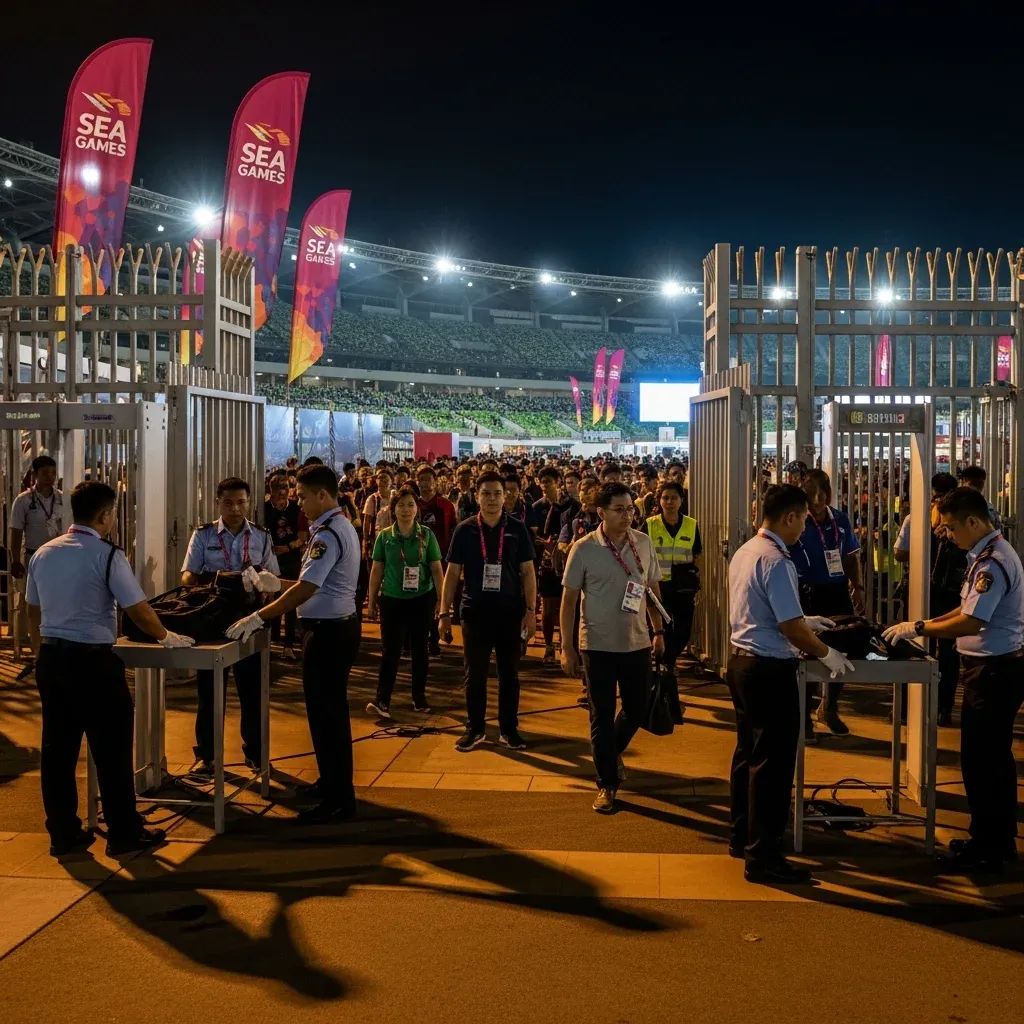
Thai Games chief Dr. Kongsak Yodmanee ordered an immediate Level-3 security protocol—metal-detector corridors, bag checks at every gate, and visible military patrols around the stadium cluster in Hua Mak. A hotline now links every national contingent with the Ministry of Foreign Affairs should evacuation routes become necessary.
SEAGF CEO Datuk Seri Chaiyapak Siriwat expressed surprise but not anger. “It is Cambodia’s sovereign right,” he said, adding that no other nation has signalled withdrawal. Thai organisers meanwhile circulated fresh risk-assessment maps, emphasising that venues sit hundreds of kilometres from the artillery exchanges.
Ripple Effect on Competition Schedule
Cambodia’s absence leaves certain brackets awkwardly under-populated. In karate kumite –60 kg and women’s team kata, entries drop below the minimum four-nation threshold, forcing the Technical Committee to consider combining weight classes or awarding single-bout golds. Sepak takraw still retains sufficient teams, though round-robin fixtures will be reshuffled.
For Thai athletes, the change is double-edged: an easier path to medals in some events, but fewer opportunities to test against familiar regional rivals. Fans with tickets to Cambodian fixtures will be offered seat upgrades for other high-demand sports such as badminton and Muay Thai.
Border Tensions: What’s Happening and Why Now?
Military analysts point to a chain of skirmishes that flared in late November around the contested ridge line near Ta Krabey. Thai Air Force F-16 patrols reportedly responded to rocket fire, according to security scholar Zachary Abuza. Bangkok insists rules of engagement remain defensive; Phnom Penh claims inadvertent shelling of civilian farms.
The region has seen periodic flare-ups since the 1962 World Court ruling on Preah Vihear, but this month’s escalation is the sharpest in a decade. Analysts warn external powers could exploit the vacuum if dialogue stalls. For the SEA Games, geography matters: stadiums are 400 km from the shooting, yet perceptions of risk travel faster than official statements.
Voices From The Field – Athletes, Officials, Parents
• A Cambodian taekwondo mother, reached in Kandal: “My son is 19. I watched videos of explosions on Facebook. I could not sleep until he promised to leave.”
• Thai karateka Natharin Rattanawong: “I’m disappointed. We trained months for a rematch with Cambodia’s champion. Now the bracket feels empty.”
• Volunteer bus marshal Suchada Prakobkit: “Security briefing length doubled overnight. But athletes from Vietnam, Malaysia, Laos still boarded smiling. They trust Thailand can keep them safe.”
Expert View: Could Politics Crash the Party?
Security commentator Assoc. Prof. Panitan Wattanayagorn warns that sports events in Southeast Asia often mirror regional tensions. “When nationalism peaks, soft-power showcases can become collateral,” he said. Still, he credits Thailand for swift crisis management and transparent updates, which he says could prevent domino withdrawals.
Meanwhile, sports-diplomacy specialist Narupon Duangpraphai notes that Cambodia’s exit may actually harden Thai resolve to stage a flawless Games. “If Bangkok can demonstrate resilience, it strengthens its bid for future mega-events like the 2034 Asian Games.”
What Happens Next?
The Cambodian contingent is expected to cross immigration at Phnom Penh International Airport by late Thursday, where the NOCC will brief domestic media. In Bangkok, competition marches on with swimming heats at 9 a.m. Friday and the men’s football group matches under tightened surveillance.
For spectators and athletes alike, the lesson is clear: regional friendship can be as fragile—or as durable—as the political winds allow. Thailand now has two weeks to prove that the SEA Games can outshine the shadows on its northern border.


