
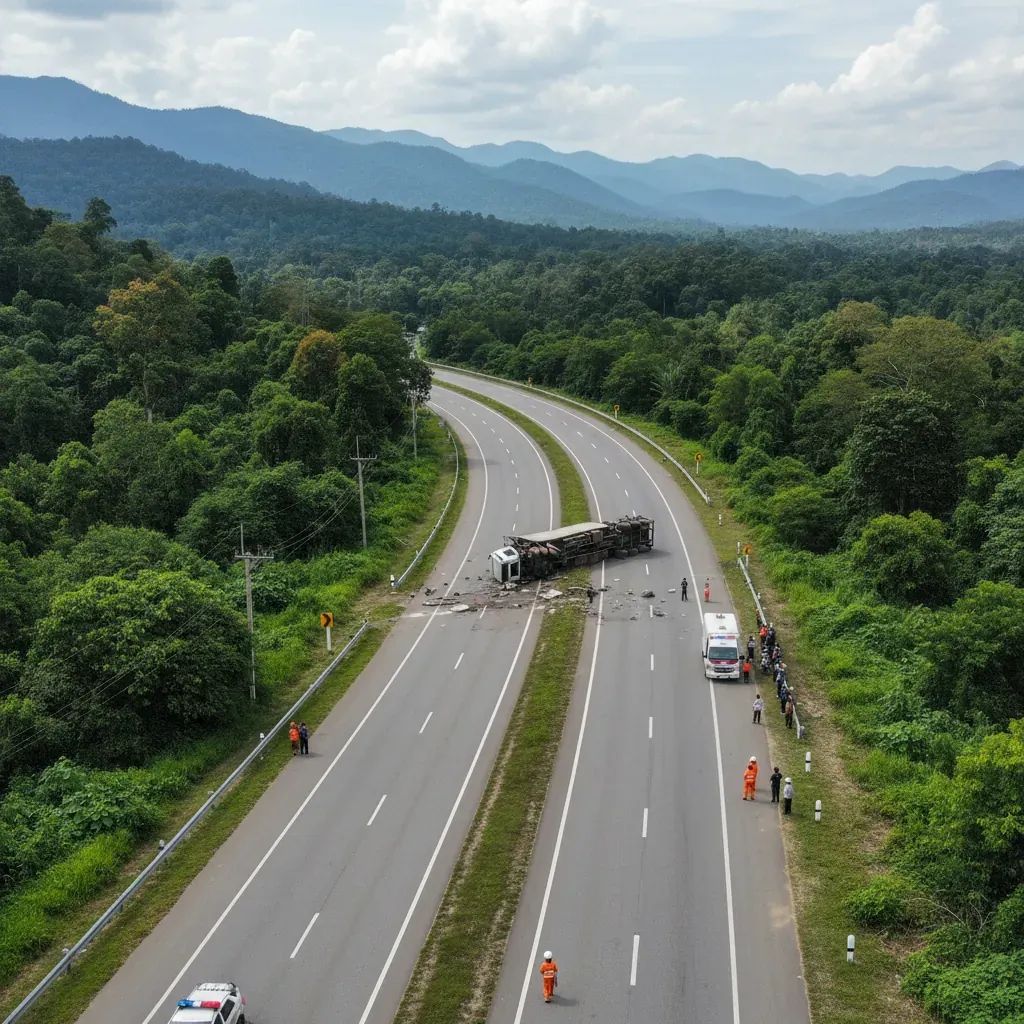
A crackdown on a smuggling network in Thailand's western borderlands has exposed the vulnerability of migrants caught between economic desperation and transnational criminal enterprise. On February 26, 2026, a high-speed pursuit along Highway 323 in Kanchanaburi province ended in a rollover that injured 21 people out of 44 total migrants and exposed a trafficking operation designed to funnel undocumented workers toward Malaysian employment.
The Pursuit and Aftermath
Officers working under the Thailand Central Investigation Bureau and the Highway Police Division first identified a white Mitsubishi Triton with fraudulent registration plates moving through Sai Yok district in Kanchanaburi. Once the driver accelerated and began swerving into oncoming traffic lanes to evade pursuit, a chase unfolded across more than 50 kilometers of Highway 323. The vehicle lost traction near kilometer marker 81–82 in Wang Dong sub-district, flipping violently. Emergency responders discovered 44 Myanmar nationals packed inside, none carrying valid identity documents. Twenty-one sustained injuries requiring hospitalization. The driver vanished into the chaos.
Lat Ya Police Station processed the survivors, who are now in custody pending prosecution under the Immigration Act and potential anti-trafficking charges. The vehicle was impounded as evidence. Charges against the still-fugitive driver include reckless endangerment, human trafficking, and document fraud—offenses that carry sentences of 10 to 20 years and fines reaching ฿2 million under trafficking statutes.
Why This Matters for You
• Border security friction: The natural crossing at Sangkhla Buri continues enabling unauthorized entry despite enhanced patrol efforts by Thailand's border forces, suggesting vulnerabilities that may persist along the entire Myanmar frontier.
• Labor market distortion: Undocumented workers compete directly with legal residents in low-wage sectors; understanding trafficking routes helps explain downward wage pressure in agriculture, construction, and domestic services.
• Legal liability exposure: Residents who unknowingly transport or house undocumented migrants face asset seizure and imprisonment under Thailand's trafficking statutes—a risk that extends beyond intentional complicity.
The Economics of Coercion
Each of the 44 migrants had paid smugglers ฿130,000—equivalent to roughly six to eight months of Thailand's minimum wage—for passage and employment connection in Malaysia. This sum represents the full savings of entire families, often assembled through collective effort and informal lending. During questioning, the migrants revealed they'd crossed through a natural border pass in Sangkhla Buri district, a mountainous corridor where terrain and ethnic Karen settlements complicate enforcement.
The debt mechanism operates as a trap. Even working at Malaysia's advertised wage rates, repaying ฿130,000 while covering food and shelter would require months of labor without taking a single day off, making debt repayment extremely difficult. Evidence suggests smugglers add secondary charges for housing, meals, and document processing once workers arrive, deepening the obligation cyclically.
Myanmar's Economic Crisis Drives Outbound Migration
Myanmar's economic collapse since the 2021 military coup has intensified outbound migration pressure. The country's inflation surge, military conscription, and reduced employment opportunities have left families choosing between extreme poverty at home or attempting to find work abroad illegally. Malaysia attracts these migrants as a relatively high-wage destination, and Thailand's geography makes it the inevitable land bridge.
Thailand Border Patrol Forces intercepted approximately 5,420 undocumented crossings along the Myanmar frontier during the six-month period ending March 2026. This figure has remained consistent year-on-year despite increased drone surveillance and reinforced checkpoints, suggesting that smuggling networks are adapting faster than enforcement capacity can adjust or that genuine economic drivers overwhelm deterrent effects.
Intelligence reports indicate a sophisticated routing: migrants cross into southern Thailand through informal checkpoints without stamps, travel northward by road, then re-enter Myanmar through mountain passes into regions controlled by ethnic armed organizations. From there, many are relocated to cyber scam compounds in border towns where trafficked individuals are coerced into running online fraud operations targeting victims across Asia.
What This Means for Residents
For employers: Hiring undocumented workers carries criminal liability. Thailand's Prevention and Suppression of Human Trafficking Act permits authorities to seize personal and business assets linked to trafficking facilitation—a consequence that extends to landlords, transport operators, and business owners. The Thailand Ministry of Labor has intensified workplace audits in agricultural and construction zones.
For motorists: Highway 323, particularly the stretch between Sai Yok and Wang Dong, serves as a known smuggling corridor. High-speed chases between traffickers and police pose risks to ordinary traffic. Exercise caution when observing erratic driving or unusual vehicle configurations on rural highways.
For communities: Reporting suspicious activity—people being loaded into concealed truck beds, vehicles with obscured plates, or safe houses with unusual occupancy patterns—remains the most effective intervention. The Thailand Highway Police operates a dedicated hotline for trafficking tips, and previous reports have yielded significant seizures.
For labor market participants: Undocumented workers suppress formal wage levels. While Myanmar nationals contribute significantly to Thailand's economy, much of this value flows through informal channels that evade taxation and labor protections. A formalized migrant labor pathway would help level competitive conditions for legal workers.
Broader Trafficking Landscape and Policy Challenges
Thailand remains simultaneously a transit country, a destination, and a sourcing point for regional trafficking. The U.S. State Department classified Thailand as Tier 2 in its 2023 Trafficking in Persons Report, indicating measurable government effort but shortfalls against international minimum standards. During 2023, Thailand's authorities investigated 312 trafficking cases—a 23% increase from 2022—with courts convicting 211 traffickers and asset forfeiture reaching approximately ฿31.84 million.
The Thailand Ministry of Labor has pledged to expand bilateral labor agreements with Myanmar, Laos, and Cambodia, offering legal pathways for workers. In practice, these agreements remain inaccessible to most prospective migrants. Processing fees, document costs, and bureaucratic delays often exceed smuggler fees, while timelines stretch into months. Smugglers guarantee rapid transit and immediate employment connection—both unreliable promises, but compelling ones when families face immediate financial crisis.
The February 26 incident in Kanchanaburi represents a predictable outcome of structural misalignment: supply of desperate labor far exceeds legal pathways; criminal networks fill the gap efficiently; and enforcement resources remain insufficient. Until policy makers expand legal channels and reduce processing costs, the cycle of debt-bonded migration and dangerous overland chases will persist.


